

5.5 Reaction Network in the Oxidative Coupling of Methane
111
Table 5.1 Initial formation
rates of the products in the
oxidative coupling of methane
Compounds
Initial formation rate/mol s −1
Li/CaO a
Li/MgO b
C 2 H 6
1.67 × 10 −5
1.54 × 10 −5
C 2 H 4
0
0
CO
1.04 × 10 −4
0
CO 2
1.94 × 10 −5
5.00 × 10 −6
(Reported in refs. [69] and [70])
Reaction temperature: 983 K, O 2 : 7 kPa, CH 4 : 67 kPa, He: 26 kPa
a Reported in ref. [69]
b Reported in ref. [70]
5 in Scheme 5.1. However, it was not clear whether CH 4 was directly converted to
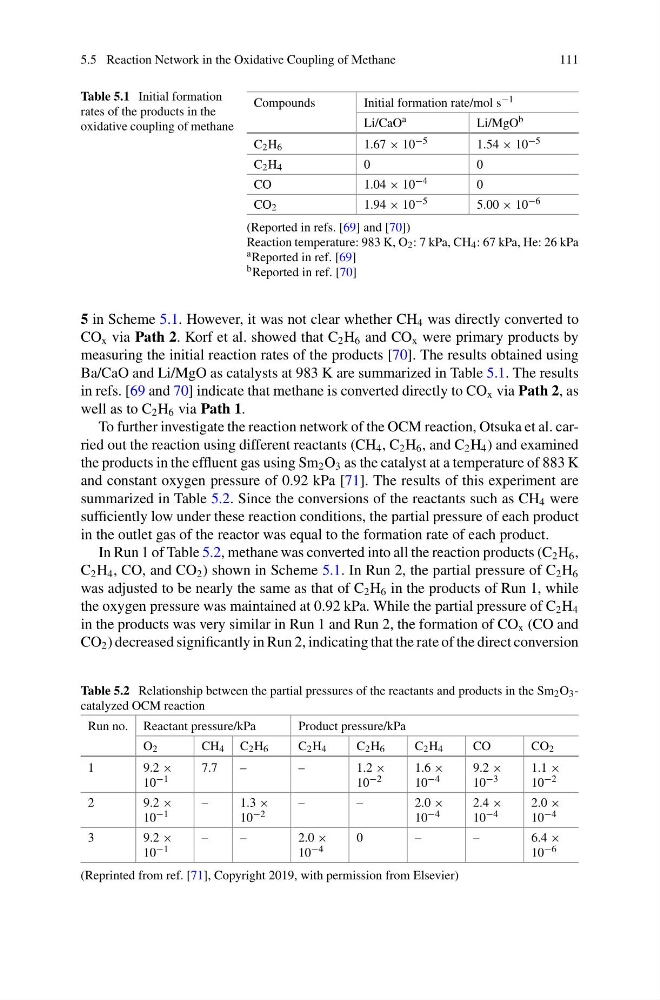
CO x via Path 2. Korf et al. showed that C 2 H 6 and CO x were primary products by
measuring the initial reaction rates of the products [70]. The results obtained using
Ba/CaO and Li/MgO as catalysts at 983 K are summarized in Table 5.1. The results
in refs. [69 and 70] indicate that methane is converted directly to CO x via Path 2, as
well as to C 2 H 6 via Path 1.
To further investigate the reaction network of the OCM reaction, Otsuka et al. carried out the reaction using different reactants (CH 4 , C 2 H 6 , and C 2 H 4 ) and examined
the products in the effluent gas using Sm 2 O 3 as the catalyst at a temperature of 883 K
and constant oxygen pressure of 0.92 kPa [71]. The results of this experiment are
summarized in Table 5.2. Since the conversions of the reactants such as CH 4 were
sufficiently low under these reaction conditions, the partial pressure of each product
in the outlet gas of the reactor was equal to the formation rate of each product.
In Run 1 of Table 5.2, methane was converted into all the reaction products (C 2 H 6 ,
C 2 H 4 , CO, and CO 2 ) shown in Scheme 5.1. In Run 2, the partial pressure of C 2 H 6
was adjusted to be nearly the same as that of C 2 H 6 in the products of Run 1, while
the oxygen pressure was maintained at 0.92 kPa. While the partial pressure of C 2 H 4
in the products was very similar in Run 1 and Run 2, the formation of CO x (CO and
CO 2 ) decreased significantly in Run 2, indicating that the rate of the direct conversion
Table 5.2 Relationship between the partial pressures of the reactants and products in the Sm 2 O 3 -
catalyzed OCM reaction
Run no. Reactant pressure/kPa
Product pressure/kPa
O 2
CH 4 C 2 H 6
C 2 H 4
C 2 H 6
C 2 H 4
CO
CO 2
1
9.2 ×
10 −1
7.7
–
–
1.2 ×
10 −2
1.6 ×
10 −4
9.2 ×
10 −3
1.1 ×
10 −2
2
9.2 ×
10 −1
–
1.3 ×
10 −2
–
–
2.0 ×
10 −4
2.4 ×
10 −4
2.0 ×
10 −4
3
9.2 ×
10 −1
–
–
2.0 ×
10 −4
0
–
–
6.4 ×
10 −6
(Reprinted from ref. [71], Copyright 2019, with permission from Elsevier)
111
Table 5.1 Initial formation
rates of the products in the
oxidative coupling of methane
Compounds
Initial formation rate/mol s −1
Li/CaO a
Li/MgO b
C 2 H 6
1.67 × 10 −5
1.54 × 10 −5
C 2 H 4
0
0
CO
1.04 × 10 −4
0
CO 2
1.94 × 10 −5
5.00 × 10 −6
(Reported in refs. [69] and [70])
Reaction temperature: 983 K, O 2 : 7 kPa, CH 4 : 67 kPa, He: 26 kPa
a Reported in ref. [69]
b Reported in ref. [70]
5 in Scheme 5.1. However, it was not clear whether CH 4 was directly converted to
CO x via Path 2. Korf et al. showed that C 2 H 6 and CO x were primary products by
measuring the initial reaction rates of the products [70]. The results obtained using
Ba/CaO and Li/MgO as catalysts at 983 K are summarized in Table 5.1. The results
in refs. [69 and 70] indicate that methane is converted directly to CO x via Path 2, as
well as to C 2 H 6 via Path 1.
To further investigate the reaction network of the OCM reaction, Otsuka et al. carried out the reaction using different reactants (CH 4 , C 2 H 6 , and C 2 H 4 ) and examined
the products in the effluent gas using Sm 2 O 3 as the catalyst at a temperature of 883 K
and constant oxygen pressure of 0.92 kPa [71]. The results of this experiment are
summarized in Table 5.2. Since the conversions of the reactants such as CH 4 were
sufficiently low under these reaction conditions, the partial pressure of each product
in the outlet gas of the reactor was equal to the formation rate of each product.
In Run 1 of Table 5.2, methane was converted into all the reaction products (C 2 H 6 ,
C 2 H 4 , CO, and CO 2 ) shown in Scheme 5.1. In Run 2, the partial pressure of C 2 H 6
was adjusted to be nearly the same as that of C 2 H 6 in the products of Run 1, while
the oxygen pressure was maintained at 0.92 kPa. While the partial pressure of C 2 H 4
in the products was very similar in Run 1 and Run 2, the formation of CO x (CO and
CO 2 ) decreased significantly in Run 2, indicating that the rate of the direct conversion
Table 5.2 Relationship between the partial pressures of the reactants and products in the Sm 2 O 3 -
catalyzed OCM reaction
Run no. Reactant pressure/kPa
Product pressure/kPa
O 2
CH 4 C 2 H 6
C 2 H 4
C 2 H 6
C 2 H 4
CO
CO 2
1
9.2 ×
10 −1
7.7
–
–
1.2 ×
10 −2
1.6 ×
10 −4
9.2 ×
10 −3
1.1 ×
10 −2
2
9.2 ×
10 −1
–
1.3 ×
10 −2
–
–
2.0 ×
10 −4
2.4 ×
10 −4
2.0 ×
10 −4
3
9.2 ×
10 −1
–
–
2.0 ×
10 −4
0
–
–
6.4 ×
10 −6
(Reprinted from ref. [71], Copyright 2019, with permission from Elsevier)