

110
5 C–C Bond Formation via the Condensation …
conditions [61–68]. These results demonstrated that the oxygen species Mn–O–Si,
W–O–Si, W=O, Na–O–Mn, and Na–O–W may abstract a hydrogen atom from CH 4
to generate a •CH 3 radical during the initial stage of the OCM reaction. However,
thus far, it has not been possible to identify the site of the active oxygen species on
Mn–Na 2 WO 4 /SiO 2 catalysts.
5.5 Reaction Network in the Oxidative Coupling
of Methane
As discussed in Sects. 5.2 and 5.3, the OCM reaction comprises heterogeneous
catalytic and homogeneous non-catalytic processes and converts methane mainly into
ethane and ethylene. These processes depend on the reaction conditions, especially
the reaction temperature. In addition to the formation of these hydrocarbons, nonselective oxidation to CO and CO 2 also occurs. CO and CO 2 are collectively referred
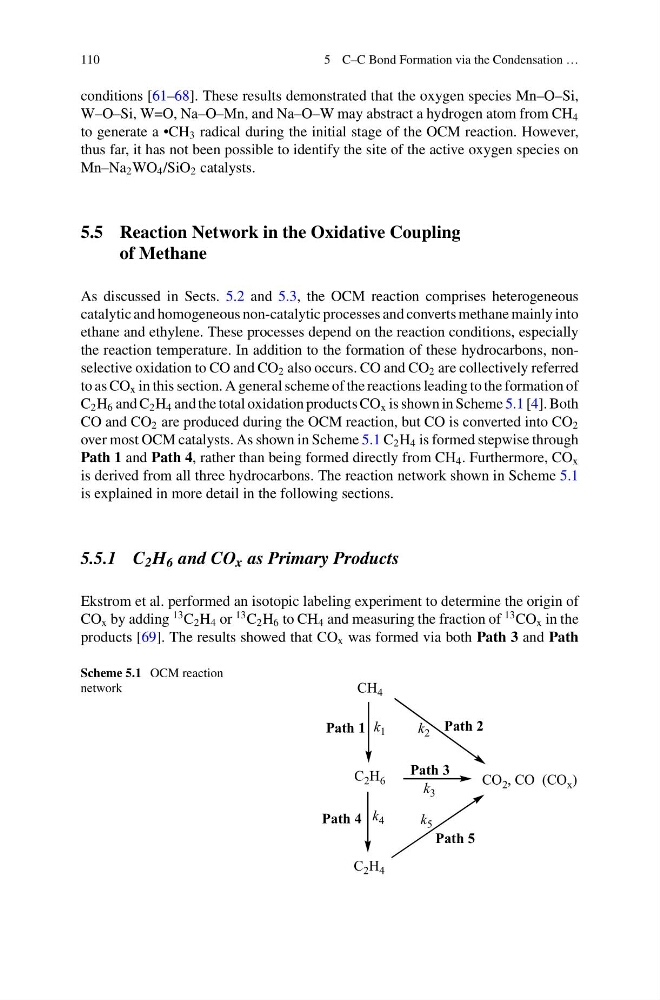
to as CO x in this section. A general scheme of the reactions leading to the formation of
C 2 H 6 and C 2 H 4 and the total oxidation products CO x is shown in Scheme 5.1 [4]. Both
CO and CO 2 are produced during the OCM reaction, but CO is converted into CO 2
over most OCM catalysts. As shown in Scheme 5.1 C 2 H 4 is formed stepwise through
Path 1 and Path 4, rather than being formed directly from CH 4 . Furthermore, CO x
is derived from all three hydrocarbons. The reaction network shown in Scheme 5.1
is explained in more detail in the following sections.
5.5.1 C 2 H 6 and CO x as Primary Products
Ekstrom et al. performed an isotopic labeling experiment to determine the origin of
CO x by adding
13 C 2 H 4 or
13 C 2 H 6 to CH 4 and measuring the fraction of
13 CO x in the
products [69]. The results showed that CO x was formed via both Path 3 and Path
Scheme 5.1 OCM reaction
network
CH 4
C 2 H 6
C 2 H 4
CO 2 , CO (CO x )
Path 1
Path 2
Path 3
Path 4
Path 5
k 1
k 2
k 3
k 4
k 5
5 C–C Bond Formation via the Condensation …
conditions [61–68]. These results demonstrated that the oxygen species Mn–O–Si,
W–O–Si, W=O, Na–O–Mn, and Na–O–W may abstract a hydrogen atom from CH 4
to generate a •CH 3 radical during the initial stage of the OCM reaction. However,
thus far, it has not been possible to identify the site of the active oxygen species on
Mn–Na 2 WO 4 /SiO 2 catalysts.
5.5 Reaction Network in the Oxidative Coupling
of Methane
As discussed in Sects. 5.2 and 5.3, the OCM reaction comprises heterogeneous
catalytic and homogeneous non-catalytic processes and converts methane mainly into
ethane and ethylene. These processes depend on the reaction conditions, especially
the reaction temperature. In addition to the formation of these hydrocarbons, nonselective oxidation to CO and CO 2 also occurs. CO and CO 2 are collectively referred
to as CO x in this section. A general scheme of the reactions leading to the formation of
C 2 H 6 and C 2 H 4 and the total oxidation products CO x is shown in Scheme 5.1 [4]. Both
CO and CO 2 are produced during the OCM reaction, but CO is converted into CO 2
over most OCM catalysts. As shown in Scheme 5.1 C 2 H 4 is formed stepwise through
Path 1 and Path 4, rather than being formed directly from CH 4 . Furthermore, CO x
is derived from all three hydrocarbons. The reaction network shown in Scheme 5.1
is explained in more detail in the following sections.
5.5.1 C 2 H 6 and CO x as Primary Products
Ekstrom et al. performed an isotopic labeling experiment to determine the origin of
CO x by adding
13 C 2 H 4 or
13 C 2 H 6 to CH 4 and measuring the fraction of
13 CO x in the
products [69]. The results showed that CO x was formed via both Path 3 and Path
Scheme 5.1 OCM reaction
network
CH 4
C 2 H 6
C 2 H 4
CO 2 , CO (CO x )
Path 1
Path 2
Path 3
Path 4
Path 5
k 1
k 2
k 3
k 4
k 5