

5.4 Role of Oxygen Species …
109
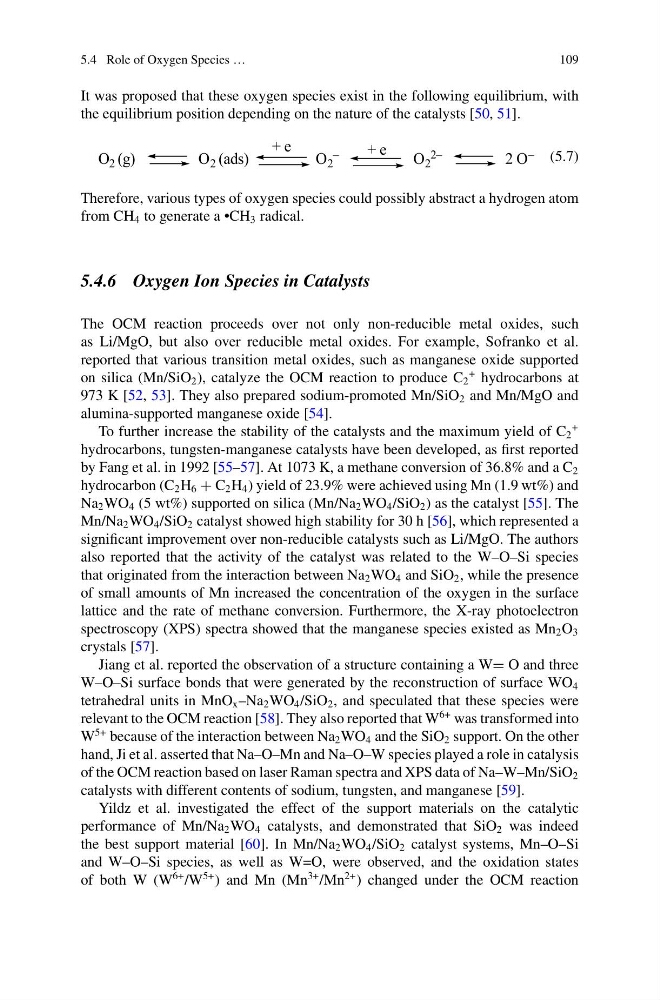
It was proposed that these oxygen species exist in the following equilibrium, with
the equilibrium position depending on the nature of the catalysts [50, 51].
(5.7)
Therefore, various types of oxygen species could possibly abstract a hydrogen atom
from CH 4 to generate a •CH 3 radical.
5.4.6 Oxygen Ion Species in Catalysts
The OCM reaction proceeds over not only non-reducible metal oxides, such
as Li/MgO, but also over reducible metal oxides. For example, Sofranko et al.
reported that various transition metal oxides, such as manganese oxide supported
on silica (Mn/SiO 2 ), catalyze the OCM reaction to produce C 2
+ hydrocarbons at
973 K [52, 53]. They also prepared sodium-promoted Mn/SiO 2 and Mn/MgO and
alumina-supported manganese oxide [54].
To further increase the stability of the catalysts and the maximum yield of C 2
+
hydrocarbons, tungsten-manganese catalysts have been developed, as first reported
by Fang et al. in 1992 [55–57]. At 1073 K, a methane conversion of 36.8% and a C 2
hydrocarbon (C 2 H 6 + C 2 H 4 ) yield of 23.9% were achieved using Mn (1.9 wt%) and
Na 2 WO 4 (5 wt%) supported on silica (Mn/Na 2 WO 4 /SiO 2 ) as the catalyst [55]. The
Mn/Na 2 WO 4 /SiO 2 catalyst showed high stability for 30 h [56], which represented a
significant improvement over non-reducible catalysts such as Li/MgO. The authors
also reported that the activity of the catalyst was related to the W–O–Si species
that originated from the interaction between Na 2 WO 4 and SiO 2 , while the presence
of small amounts of Mn increased the concentration of the oxygen in the surface
lattice and the rate of methane conversion. Furthermore, the X-ray photoelectron
spectroscopy (XPS) spectra showed that the manganese species existed as Mn 2 O 3
crystals [57].
Jiang et al. reported the observation of a structure containing a W= O and three
W–O–Si surface bonds that were generated by the reconstruction of surface WO 4
tetrahedral units in MnO x –Na 2 WO 4 /SiO 2 , and speculated that these species were
relevant to the OCM reaction [58]. They also reported that W
6+ was transformed into
W
5+ because of the interaction between Na 2 WO 4 and the SiO 2 support. On the other
hand, Ji et al. asserted that Na–O–Mn and Na–O–W species played a role in catalysis
of the OCM reaction based on laser Raman spectra and XPS data of Na–W–Mn/SiO 2
catalysts with different contents of sodium, tungsten, and manganese [59].
Yildz et al. investigated the effect of the support materials on the catalytic
performance of Mn/Na 2 WO 4 catalysts, and demonstrated that SiO 2 was indeed
the best support material [60]. In Mn/Na 2 WO 4 /SiO 2 catalyst systems, Mn–O–Si
and W–O–Si species, as well as W=O, were observed, and the oxidation states
of both W (W
6+ /W
5+ ) and Mn (Mn
3+ /Mn
2+ ) changed under the OCM reaction
109
It was proposed that these oxygen species exist in the following equilibrium, with
the equilibrium position depending on the nature of the catalysts [50, 51].
(5.7)
Therefore, various types of oxygen species could possibly abstract a hydrogen atom
from CH 4 to generate a •CH 3 radical.
5.4.6 Oxygen Ion Species in Catalysts
The OCM reaction proceeds over not only non-reducible metal oxides, such
as Li/MgO, but also over reducible metal oxides. For example, Sofranko et al.
reported that various transition metal oxides, such as manganese oxide supported
on silica (Mn/SiO 2 ), catalyze the OCM reaction to produce C 2
+ hydrocarbons at
973 K [52, 53]. They also prepared sodium-promoted Mn/SiO 2 and Mn/MgO and
alumina-supported manganese oxide [54].
To further increase the stability of the catalysts and the maximum yield of C 2
+
hydrocarbons, tungsten-manganese catalysts have been developed, as first reported
by Fang et al. in 1992 [55–57]. At 1073 K, a methane conversion of 36.8% and a C 2
hydrocarbon (C 2 H 6 + C 2 H 4 ) yield of 23.9% were achieved using Mn (1.9 wt%) and
Na 2 WO 4 (5 wt%) supported on silica (Mn/Na 2 WO 4 /SiO 2 ) as the catalyst [55]. The
Mn/Na 2 WO 4 /SiO 2 catalyst showed high stability for 30 h [56], which represented a
significant improvement over non-reducible catalysts such as Li/MgO. The authors
also reported that the activity of the catalyst was related to the W–O–Si species
that originated from the interaction between Na 2 WO 4 and SiO 2 , while the presence
of small amounts of Mn increased the concentration of the oxygen in the surface
lattice and the rate of methane conversion. Furthermore, the X-ray photoelectron
spectroscopy (XPS) spectra showed that the manganese species existed as Mn 2 O 3
crystals [57].
Jiang et al. reported the observation of a structure containing a W= O and three
W–O–Si surface bonds that were generated by the reconstruction of surface WO 4
tetrahedral units in MnO x –Na 2 WO 4 /SiO 2 , and speculated that these species were
relevant to the OCM reaction [58]. They also reported that W
6+ was transformed into
W
5+ because of the interaction between Na 2 WO 4 and the SiO 2 support. On the other
hand, Ji et al. asserted that Na–O–Mn and Na–O–W species played a role in catalysis
of the OCM reaction based on laser Raman spectra and XPS data of Na–W–Mn/SiO 2
catalysts with different contents of sodium, tungsten, and manganese [59].
Yildz et al. investigated the effect of the support materials on the catalytic
performance of Mn/Na 2 WO 4 catalysts, and demonstrated that SiO 2 was indeed
the best support material [60]. In Mn/Na 2 WO 4 /SiO 2 catalyst systems, Mn–O–Si
and W–O–Si species, as well as W=O, were observed, and the oxidation states
of both W (W
6+ /W
5+ ) and Mn (Mn
3+ /Mn
2+ ) changed under the OCM reaction