

108
5 C–C Bond Formation via the Condensation …
5.4.4 Superoxide Ion (O 2
− ) Species
Superoxide (O 2
− ) ions have been observed on the surface of La 2 O 3 via ESR spectroscopy [42–44]. However, O 2
− species were demonstrated to be unstable on La 2 O 3
under OCM reaction conditions, and suggested that their instability resulted from
the low partial pressures of oxygen commonly used in the OCM reaction [43, 44].
Iwamoto et al. showed that O 2
− ions were not active toward simple alkanes such
as CH 4 on MgO at temperatures up to 448 K; this temperature is lower than those
typically used in the OCM reaction (~1000 K) [45]. Otsuka et al. also demonstrated
that the O 2
− oxygen species contained in simple metal peroxides, such as Na 2 O 2 ,
were not active in the OCM reaction [33].
5.4.5 Various Oxygen Species for the Formation of Methyl
Radicals on the Catalyst Surface
Sections 5.4.2, 5.4.3, and 5.4.4 discuss the abstraction of a hydrogen atom from CH 4
to produce a •CH 3 radical by O
− (oxygen anion radical), O 2
2− (peroxide), and/or O 2
−
(superoxide) oxygen species on the catalyst surface. These oxygen species may be
generated on various metal-doped oxides, including multi-component oxides such as
Li/MgO or single-component metal oxides such as MgO. Furthermore, the oxidation
states of the metal ions do not change. However, oxygen vacancies exist in these
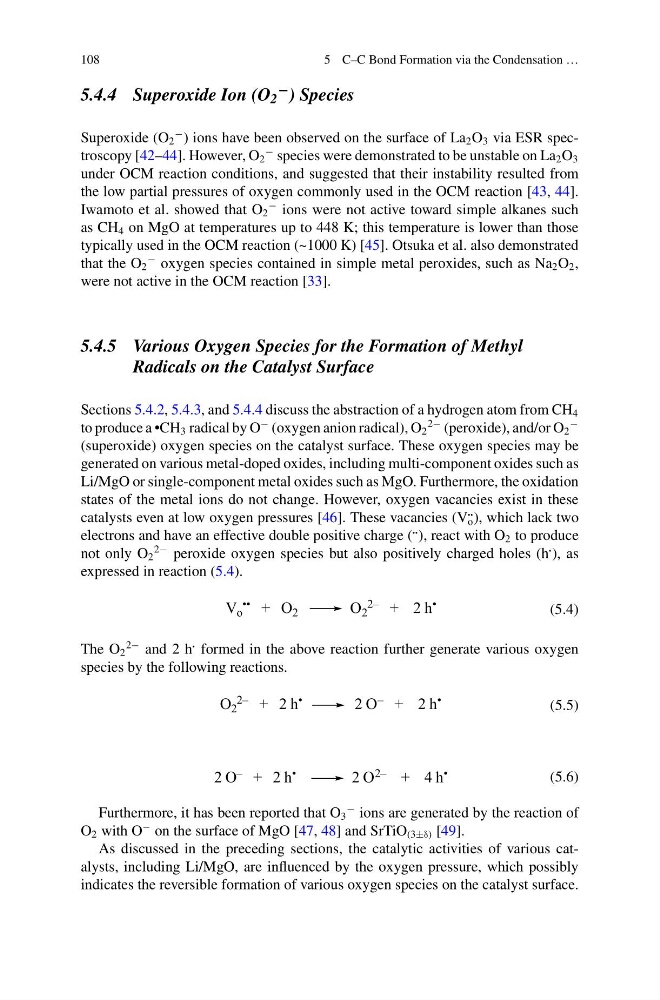
catalysts even at low oxygen pressures [46]. These vacancies (V ·· o ), which lack two
electrons and have an effective double positive charge ( ·· ), react with O 2 to produce
not only O 2
2− peroxide oxygen species but also positively charged holes (h · ), as
expressed in reaction (5.4).
(5.4)
The O 2
2− and 2 h · formed in the above reaction further generate various oxygen
species by the following reactions.
(5.5)
(5.6)
Furthermore, it has been reported that O 3
− ions are generated by the reaction of
O 2 with O
− on the surface of MgO [47, 48] and SrTiO (3±δ) [49].
As discussed in the preceding sections, the catalytic activities of various catalysts, including Li/MgO, are influenced by the oxygen pressure, which possibly
indicates the reversible formation of various oxygen species on the catalyst surface.
5 C–C Bond Formation via the Condensation …
5.4.4 Superoxide Ion (O 2
− ) Species
Superoxide (O 2
− ) ions have been observed on the surface of La 2 O 3 via ESR spectroscopy [42–44]. However, O 2
− species were demonstrated to be unstable on La 2 O 3
under OCM reaction conditions, and suggested that their instability resulted from
the low partial pressures of oxygen commonly used in the OCM reaction [43, 44].
Iwamoto et al. showed that O 2
− ions were not active toward simple alkanes such
as CH 4 on MgO at temperatures up to 448 K; this temperature is lower than those
typically used in the OCM reaction (~1000 K) [45]. Otsuka et al. also demonstrated
that the O 2
− oxygen species contained in simple metal peroxides, such as Na 2 O 2 ,
were not active in the OCM reaction [33].
5.4.5 Various Oxygen Species for the Formation of Methyl
Radicals on the Catalyst Surface
Sections 5.4.2, 5.4.3, and 5.4.4 discuss the abstraction of a hydrogen atom from CH 4
to produce a •CH 3 radical by O
− (oxygen anion radical), O 2
2− (peroxide), and/or O 2
−
(superoxide) oxygen species on the catalyst surface. These oxygen species may be
generated on various metal-doped oxides, including multi-component oxides such as
Li/MgO or single-component metal oxides such as MgO. Furthermore, the oxidation
states of the metal ions do not change. However, oxygen vacancies exist in these
catalysts even at low oxygen pressures [46]. These vacancies (V ·· o ), which lack two
electrons and have an effective double positive charge ( ·· ), react with O 2 to produce
not only O 2
2− peroxide oxygen species but also positively charged holes (h · ), as
expressed in reaction (5.4).
(5.4)
The O 2
2− and 2 h · formed in the above reaction further generate various oxygen
species by the following reactions.
(5.5)
(5.6)
Furthermore, it has been reported that O 3
− ions are generated by the reaction of
O 2 with O
− on the surface of MgO [47, 48] and SrTiO (3±δ) [49].
As discussed in the preceding sections, the catalytic activities of various catalysts, including Li/MgO, are influenced by the oxygen pressure, which possibly
indicates the reversible formation of various oxygen species on the catalyst surface.