

5.4 Role of Oxygen Species …
107
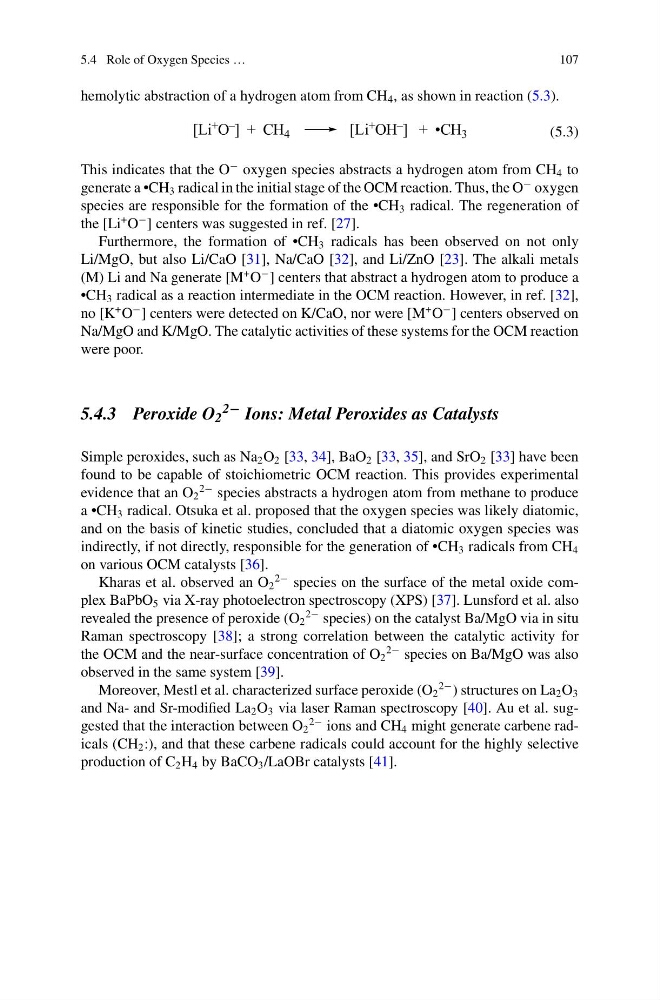
hemolytic abstraction of a hydrogen atom from CH 4 , as shown in reaction (5.3).
(5.3)
This indicates that the O
− oxygen species abstracts a hydrogen atom from CH 4 to
generate a •CH 3 radical in the initial stage of the OCM reaction. Thus, the O
− oxygen
species are responsible for the formation of the •CH 3 radical. The regeneration of
the [Li
+ O
− ] centers was suggested in ref. [27].
Furthermore, the formation of •CH 3 radicals has been observed on not only
Li/MgO, but also Li/CaO [31], Na/CaO [32], and Li/ZnO [23]. The alkali metals
(M) Li and Na generate [M
+ O
− ] centers that abstract a hydrogen atom to produce a
•CH 3 radical as a reaction intermediate in the OCM reaction. However, in ref. [32],
no [K
+ O
− ] centers were detected on K/CaO, nor were [M
+ O
− ] centers observed on
Na/MgO and K/MgO. The catalytic activities of these systems for the OCM reaction
were poor.
5.4.3 Peroxide O 2
2− Ions: Metal Peroxides as Catalysts
Simple peroxides, such as Na 2 O 2 [33, 34], BaO 2 [33, 35], and SrO 2 [33] have been
found to be capable of stoichiometric OCM reaction. This provides experimental
evidence that an O 2
2− species abstracts a hydrogen atom from methane to produce
a •CH 3 radical. Otsuka et al. proposed that the oxygen species was likely diatomic,
and on the basis of kinetic studies, concluded that a diatomic oxygen species was
indirectly, if not directly, responsible for the generation of •CH 3 radicals from CH 4
on various OCM catalysts [36].
Kharas et al. observed an O 2
2− species on the surface of the metal oxide complex BaPbO 5 via X-ray photoelectron spectroscopy (XPS) [37]. Lunsford et al. also
revealed the presence of peroxide (O 2
2− species) on the catalyst Ba/MgO via in situ
Raman spectroscopy [38]; a strong correlation between the catalytic activity for
the OCM and the near-surface concentration of O 2
2− species on Ba/MgO was also
observed in the same system [39].
Moreover, Mestl et al. characterized surface peroxide (O 2
2− ) structures on La 2 O 3
and Na- and Sr-modified La 2 O 3 via laser Raman spectroscopy [40]. Au et al. suggested that the interaction between O 2
2− ions and CH 4 might generate carbene radicals (CH 2 :), and that these carbene radicals could account for the highly selective
production of C 2 H 4 by BaCO 3 /LaOBr catalysts [41].
107
hemolytic abstraction of a hydrogen atom from CH 4 , as shown in reaction (5.3).
(5.3)
This indicates that the O
− oxygen species abstracts a hydrogen atom from CH 4 to
generate a •CH 3 radical in the initial stage of the OCM reaction. Thus, the O
− oxygen
species are responsible for the formation of the •CH 3 radical. The regeneration of
the [Li
+ O
− ] centers was suggested in ref. [27].
Furthermore, the formation of •CH 3 radicals has been observed on not only
Li/MgO, but also Li/CaO [31], Na/CaO [32], and Li/ZnO [23]. The alkali metals
(M) Li and Na generate [M
+ O
− ] centers that abstract a hydrogen atom to produce a
•CH 3 radical as a reaction intermediate in the OCM reaction. However, in ref. [32],
no [K
+ O
− ] centers were detected on K/CaO, nor were [M
+ O
− ] centers observed on
Na/MgO and K/MgO. The catalytic activities of these systems for the OCM reaction
were poor.
5.4.3 Peroxide O 2
2− Ions: Metal Peroxides as Catalysts
Simple peroxides, such as Na 2 O 2 [33, 34], BaO 2 [33, 35], and SrO 2 [33] have been
found to be capable of stoichiometric OCM reaction. This provides experimental
evidence that an O 2
2− species abstracts a hydrogen atom from methane to produce
a •CH 3 radical. Otsuka et al. proposed that the oxygen species was likely diatomic,
and on the basis of kinetic studies, concluded that a diatomic oxygen species was
indirectly, if not directly, responsible for the generation of •CH 3 radicals from CH 4
on various OCM catalysts [36].
Kharas et al. observed an O 2
2− species on the surface of the metal oxide complex BaPbO 5 via X-ray photoelectron spectroscopy (XPS) [37]. Lunsford et al. also
revealed the presence of peroxide (O 2
2− species) on the catalyst Ba/MgO via in situ
Raman spectroscopy [38]; a strong correlation between the catalytic activity for
the OCM and the near-surface concentration of O 2
2− species on Ba/MgO was also
observed in the same system [39].
Moreover, Mestl et al. characterized surface peroxide (O 2
2− ) structures on La 2 O 3
and Na- and Sr-modified La 2 O 3 via laser Raman spectroscopy [40]. Au et al. suggested that the interaction between O 2
2− ions and CH 4 might generate carbene radicals (CH 2 :), and that these carbene radicals could account for the highly selective
production of C 2 H 4 by BaCO 3 /LaOBr catalysts [41].