

92
4 Application of Biocatalysts for the Production of Methanol …
0
1 0
2 0
3 0
5 0
40
10 -6
10 -5
10 -4
10 -3
10 -2
10 -1
1
10
Productivity of methanol (mmol L -1
h -1
)
Methane in gas phase (%)
60
10 -6
10 -5
10 -4
10 -3
10 -2
10 -1
1
10 -7
Productivity of methanol (g g-dry weight cellsl -1
h -1
)
10 -8
Methane in gas phase (%)
0
1 0
2 0
3 0
5 0
40
60
(a)
(b)
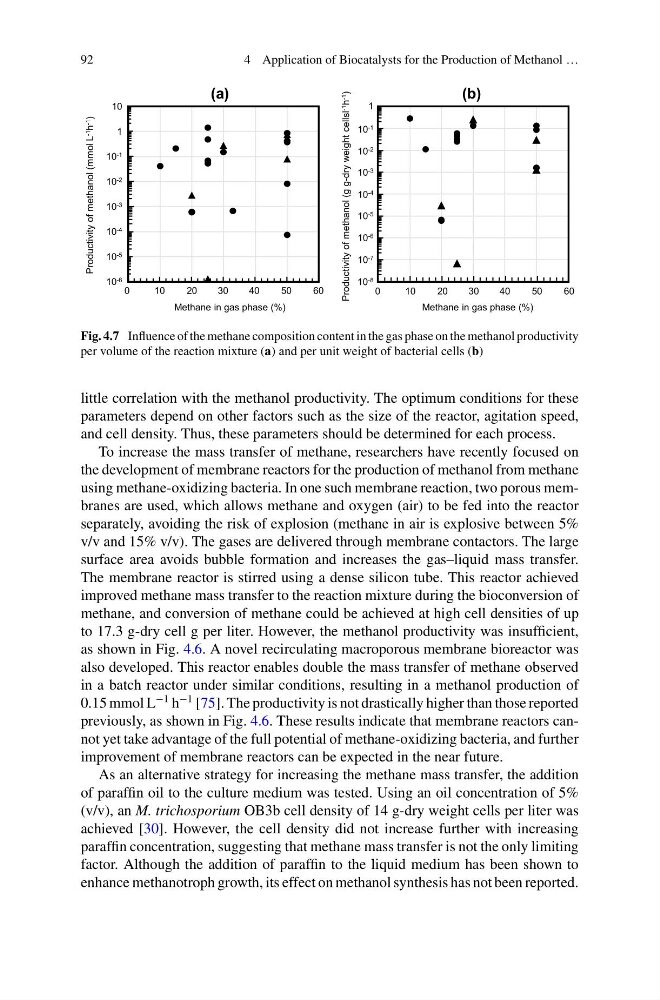
Fig. 4.7 Influence of the methane composition content in the gas phase on the methanol productivity
per volume of the reaction mixture (a) and per unit weight of bacterial cells (b)
little correlation with the methanol productivity. The optimum conditions for these
parameters depend on other factors such as the size of the reactor, agitation speed,
and cell density. Thus, these parameters should be determined for each process.
To increase the mass transfer of methane, researchers have recently focused on
the development of membrane reactors for the production of methanol from methane
using methane-oxidizing bacteria. In one such membrane reaction, two porous membranes are used, which allows methane and oxygen (air) to be fed into the reactor
separately, avoiding the risk of explosion (methane in air is explosive between 5%
v/v and 15% v/v). The gases are delivered through membrane contactors. The large
surface area avoids bubble formation and increases the gas–liquid mass transfer.
The membrane reactor is stirred using a dense silicon tube. This reactor achieved
improved methane mass transfer to the reaction mixture during the bioconversion of
methane, and conversion of methane could be achieved at high cell densities of up
to 17.3 g-dry cell g per liter. However, the methanol productivity was insufficient,
as shown in Fig. 4.6. A novel recirculating macroporous membrane bioreactor was
also developed. This reactor enables double the mass transfer of methane observed
in a batch reactor under similar conditions, resulting in a methanol production of
0.15 mmol L
−1 h
−1 [75]. The productivity is not drastically higher than those reported
previously, as shown in Fig. 4.6. These results indicate that membrane reactors cannot yet take advantage of the full potential of methane-oxidizing bacteria, and further
improvement of membrane reactors can be expected in the near future.
As an alternative strategy for increasing the methane mass transfer, the addition
of paraffin oil to the culture medium was tested. Using an oil concentration of 5%
(v/v), an M. trichosporium OB3b cell density of 14 g-dry weight cells per liter was
achieved [30]. However, the cell density did not increase further with increasing
paraffin concentration, suggesting that methane mass transfer is not the only limiting
factor. Although the addition of paraffin to the liquid medium has been shown to
enhance methanotroph growth, its effect on methanol synthesis has not been reported.
4 Application of Biocatalysts for the Production of Methanol …
0
1 0
2 0
3 0
5 0
40
10 -6
10 -5
10 -4
10 -3
10 -2
10 -1
1
10
Productivity of methanol (mmol L -1
h -1
)
Methane in gas phase (%)
60
10 -6
10 -5
10 -4
10 -3
10 -2
10 -1
1
10 -7
Productivity of methanol (g g-dry weight cellsl -1
h -1
)
10 -8
Methane in gas phase (%)
0
1 0
2 0
3 0
5 0
40
60
(a)
(b)
Fig. 4.7 Influence of the methane composition content in the gas phase on the methanol productivity
per volume of the reaction mixture (a) and per unit weight of bacterial cells (b)
little correlation with the methanol productivity. The optimum conditions for these
parameters depend on other factors such as the size of the reactor, agitation speed,
and cell density. Thus, these parameters should be determined for each process.
To increase the mass transfer of methane, researchers have recently focused on
the development of membrane reactors for the production of methanol from methane
using methane-oxidizing bacteria. In one such membrane reaction, two porous membranes are used, which allows methane and oxygen (air) to be fed into the reactor
separately, avoiding the risk of explosion (methane in air is explosive between 5%
v/v and 15% v/v). The gases are delivered through membrane contactors. The large
surface area avoids bubble formation and increases the gas–liquid mass transfer.
The membrane reactor is stirred using a dense silicon tube. This reactor achieved
improved methane mass transfer to the reaction mixture during the bioconversion of
methane, and conversion of methane could be achieved at high cell densities of up
to 17.3 g-dry cell g per liter. However, the methanol productivity was insufficient,
as shown in Fig. 4.6. A novel recirculating macroporous membrane bioreactor was
also developed. This reactor enables double the mass transfer of methane observed
in a batch reactor under similar conditions, resulting in a methanol production of
0.15 mmol L
−1 h
−1 [75]. The productivity is not drastically higher than those reported
previously, as shown in Fig. 4.6. These results indicate that membrane reactors cannot yet take advantage of the full potential of methane-oxidizing bacteria, and further
improvement of membrane reactors can be expected in the near future.
As an alternative strategy for increasing the methane mass transfer, the addition
of paraffin oil to the culture medium was tested. Using an oil concentration of 5%
(v/v), an M. trichosporium OB3b cell density of 14 g-dry weight cells per liter was
achieved [30]. However, the cell density did not increase further with increasing
paraffin concentration, suggesting that methane mass transfer is not the only limiting
factor. Although the addition of paraffin to the liquid medium has been shown to
enhance methanotroph growth, its effect on methanol synthesis has not been reported.