

4.2 Methane Metabolism in Methane-Oxidizing Bacteria
91
(a)
(b)
Cell density (g-dry weight cells L -1 )
10 -3
10 -2
10 -1
1
1 0 2
10
10 -6
10 -5
10 -4
10 -3
10 -2
10 -1
1
10
Productivity of methanol (mmol L -1
h -1
)
10 -6
10 -5
10 -4
10 -3
10 -2
10 -1
1
10 -7
Productivity of methanol (g g-dry weight cellsl -1
h -1
)
Cell density (g-dry weight cells L -1 )
10 -3
10 -2
10 -1
1
1 0 2
10
10 -8
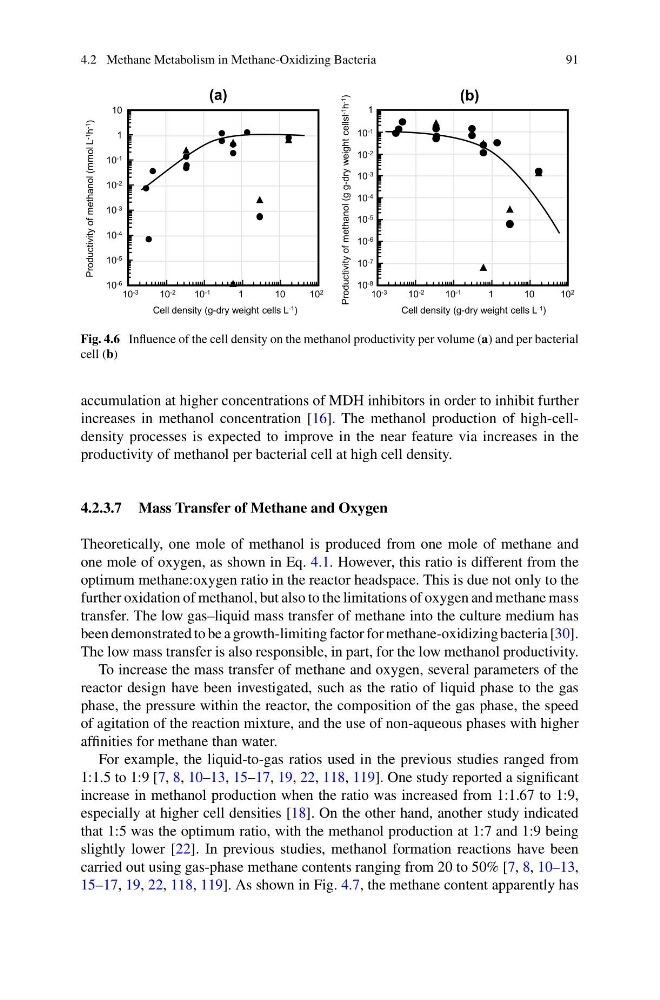
Fig. 4.6 Influence of the cell density on the methanol productivity per volume (a) and per bacterial
cell (b)
accumulation at higher concentrations of MDH inhibitors in order to inhibit further
increases in methanol concentration [16]. The methanol production of high-celldensity processes is expected to improve in the near feature via increases in the
productivity of methanol per bacterial cell at high cell density.
4.2.3.7 Mass Transfer of Methane and Oxygen
Theoretically, one mole of methanol is produced from one mole of methane and
one mole of oxygen, as shown in Eq. 4.1. However, this ratio is different from the
optimum methane:oxygen ratio in the reactor headspace. This is due not only to the
further oxidation of methanol, but also to the limitations of oxygen and methane mass
transfer. The low gas–liquid mass transfer of methane into the culture medium has
been demonstrated to be a growth-limiting factor for methane-oxidizing bacteria [30].
The low mass transfer is also responsible, in part, for the low methanol productivity.
To increase the mass transfer of methane and oxygen, several parameters of the
reactor design have been investigated, such as the ratio of liquid phase to the gas
phase, the pressure within the reactor, the composition of the gas phase, the speed
of agitation of the reaction mixture, and the use of non-aqueous phases with higher
affinities for methane than water.
For example, the liquid-to-gas ratios used in the previous studies ranged from
1:1.5 to 1:9 [7, 8, 10–13, 15–17, 19, 22, 118, 119]. One study reported a significant
increase in methanol production when the ratio was increased from 1:1.67 to 1:9,
especially at higher cell densities [18]. On the other hand, another study indicated
that 1:5 was the optimum ratio, with the methanol production at 1:7 and 1:9 being
slightly lower [22]. In previous studies, methanol formation reactions have been
carried out using gas-phase methane contents ranging from 20 to 50% [7, 8, 10–13,
15–17, 19, 22, 118, 119]. As shown in Fig. 4.7, the methane content apparently has
91
(a)
(b)
Cell density (g-dry weight cells L -1 )
10 -3
10 -2
10 -1
1
1 0 2
10
10 -6
10 -5
10 -4
10 -3
10 -2
10 -1
1
10
Productivity of methanol (mmol L -1
h -1
)
10 -6
10 -5
10 -4
10 -3
10 -2
10 -1
1
10 -7
Productivity of methanol (g g-dry weight cellsl -1
h -1
)
Cell density (g-dry weight cells L -1 )
10 -3
10 -2
10 -1
1
1 0 2
10
10 -8
Fig. 4.6 Influence of the cell density on the methanol productivity per volume (a) and per bacterial
cell (b)
accumulation at higher concentrations of MDH inhibitors in order to inhibit further
increases in methanol concentration [16]. The methanol production of high-celldensity processes is expected to improve in the near feature via increases in the
productivity of methanol per bacterial cell at high cell density.
4.2.3.7 Mass Transfer of Methane and Oxygen
Theoretically, one mole of methanol is produced from one mole of methane and
one mole of oxygen, as shown in Eq. 4.1. However, this ratio is different from the
optimum methane:oxygen ratio in the reactor headspace. This is due not only to the
further oxidation of methanol, but also to the limitations of oxygen and methane mass
transfer. The low gas–liquid mass transfer of methane into the culture medium has
been demonstrated to be a growth-limiting factor for methane-oxidizing bacteria [30].
The low mass transfer is also responsible, in part, for the low methanol productivity.
To increase the mass transfer of methane and oxygen, several parameters of the
reactor design have been investigated, such as the ratio of liquid phase to the gas
phase, the pressure within the reactor, the composition of the gas phase, the speed
of agitation of the reaction mixture, and the use of non-aqueous phases with higher
affinities for methane than water.
For example, the liquid-to-gas ratios used in the previous studies ranged from
1:1.5 to 1:9 [7, 8, 10–13, 15–17, 19, 22, 118, 119]. One study reported a significant
increase in methanol production when the ratio was increased from 1:1.67 to 1:9,
especially at higher cell densities [18]. On the other hand, another study indicated
that 1:5 was the optimum ratio, with the methanol production at 1:7 and 1:9 being
slightly lower [22]. In previous studies, methanol formation reactions have been
carried out using gas-phase methane contents ranging from 20 to 50% [7, 8, 10–13,
15–17, 19, 22, 118, 119]. As shown in Fig. 4.7, the methane content apparently has