

4.3 Comparison of the Methanol Productivity …
93
4.3 Comparison of the Methanol Productivity
of Biocatalysts and Heterogeneous Catalysts
In order to apply the biocatalytic synthesis of methanol in a practical context, biocatalytic processes that can meet industrial performance demands must be developed.
One important performance parameter in industry is productivity. In catalytic reactions, productivity is defined as the amount of product produced per unit reaction
time and unit of the catalyst. For example, the productivity of methanol production
is given as g-methanol per g-catalyst per hour.
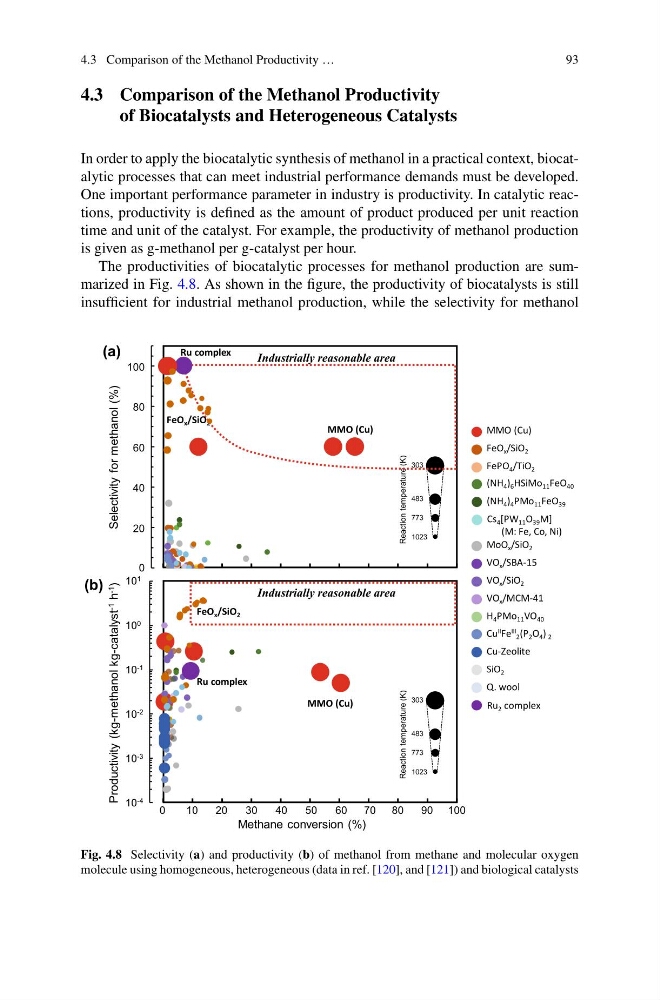
The productivities of biocatalytic processes for methanol production are summarized in Fig. 4.8. As shown in the figure, the productivity of biocatalysts is still
insufficient for industrial methanol production, while the selectivity for methanol
0
20
40
60
80
100
Selectivity for methanol (%)
10 -4
10 -3
10 -2
10 -1
10 0
10 1
Productivity (kg-methanol kg-catalyst -1
h -1
)
(a)
(b)
Methane conversion (%)
0
10
20
30
40
50
60
70
80
90 100
MMO (Cu)
FeO x /SiO 2
VO x /MCM-41
H 4 PMo 11 VO 40
(NH 4 ) 4 PMo 11 FeO 39
(NH 4 ) 6 HSiMo 11 FeO 40
VO x /SiO 2
FePO 4 /TiO 2
MoO x /SiO 2
VO x /SBA-15
Cu II Fe III
2 (P 2 O 4 ) 2
Cs 4 [PW 11 O 39 M]
(M: Fe, Co, Ni)
Cu-Zeolite
SiO 2
Q. wool
Ru 2 complex
Fig. 4.8 Selectivity (a) and productivity (b) of methanol from methane and molecular oxygen
molecule using homogeneous, heterogeneous (data in ref. [120], and [121]) and biological catalysts
93
4.3 Comparison of the Methanol Productivity
of Biocatalysts and Heterogeneous Catalysts
In order to apply the biocatalytic synthesis of methanol in a practical context, biocatalytic processes that can meet industrial performance demands must be developed.
One important performance parameter in industry is productivity. In catalytic reactions, productivity is defined as the amount of product produced per unit reaction
time and unit of the catalyst. For example, the productivity of methanol production
is given as g-methanol per g-catalyst per hour.
The productivities of biocatalytic processes for methanol production are summarized in Fig. 4.8. As shown in the figure, the productivity of biocatalysts is still
insufficient for industrial methanol production, while the selectivity for methanol
0
20
40
60
80
100
Selectivity for methanol (%)
10 -4
10 -3
10 -2
10 -1
10 0
10 1
Productivity (kg-methanol kg-catalyst -1
h -1
)
(a)
(b)
Methane conversion (%)
0
10
20
30
40
50
60
70
80
90 100
MMO (Cu)
FeO x /SiO 2
VO x /MCM-41
H 4 PMo 11 VO 40
(NH 4 ) 4 PMo 11 FeO 39
(NH 4 ) 6 HSiMo 11 FeO 40
VO x /SiO 2
FePO 4 /TiO 2
MoO x /SiO 2
VO x /SBA-15
Cu II Fe III
2 (P 2 O 4 ) 2
Cs 4 [PW 11 O 39 M]
(M: Fe, Co, Ni)
Cu-Zeolite
SiO 2
Q. wool
Ru 2 complex
Fig. 4.8 Selectivity (a) and productivity (b) of methanol from methane and molecular oxygen
molecule using homogeneous, heterogeneous (data in ref. [120], and [121]) and biological catalysts