

1.7 Flight Tests
19
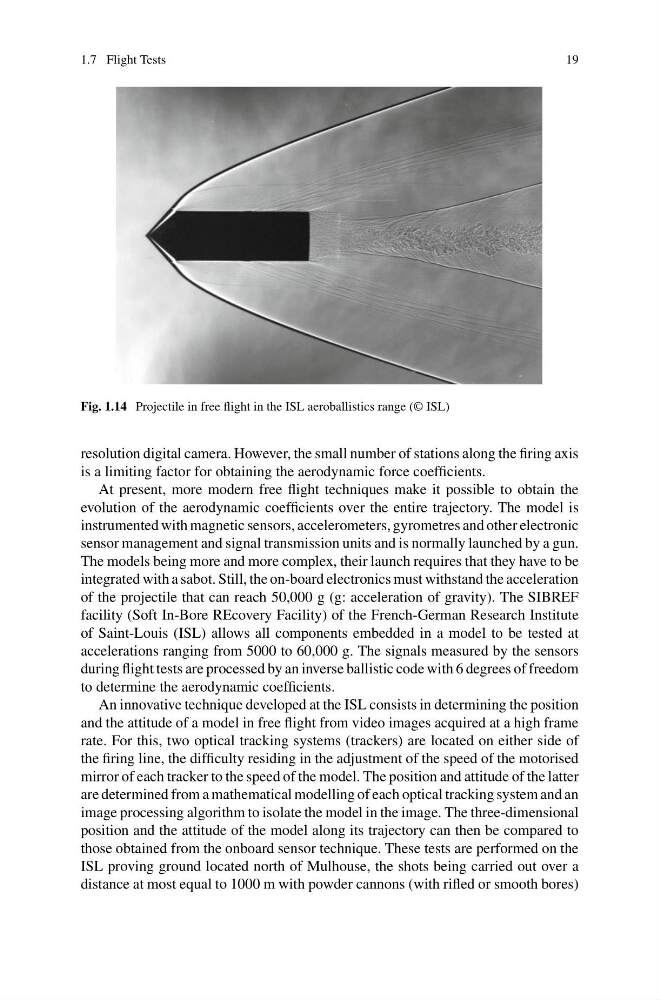
Fig. 1.14 Projectile in free flight in the ISL aeroballistics range (© ISL)
resolution digital camera. However, the small number of stations along the firing axis
is a limiting factor for obtaining the aerodynamic force coefficients.
At present, more modern free flight techniques make it possible to obtain the
evolution of the aerodynamic coefficients over the entire trajectory. The model is
instrumented with magnetic sensors, accelerometers, gyrometres and other electronic
sensor management and signal transmission units and is normally launched by a gun.
The models being more and more complex, their launch requires that they have to be
integrated with a sabot. Still, the on-board electronics must withstand the acceleration
of the projectile that can reach 50,000 g (g: acceleration of gravity). The SIBREF
facility (Soft In-Bore REcovery Facility) of the French-German Research Institute
of Saint-Louis (ISL) allows all components embedded in a model to be tested at
accelerations ranging from 5000 to 60,000 g. The signals measured by the sensors
during flight tests are processed by an inverse ballistic code with 6 degrees of freedom
to determine the aerodynamic coefficients.
An innovative technique developed at the ISL consists in determining the position
and the attitude of a model in free flight from video images acquired at a high frame
rate. For this, two optical tracking systems (trackers) are located on either side of
the firing line, the difficulty residing in the adjustment of the speed of the motorised
mirror of each tracker to the speed of the model. The position and attitude of the latter
are determined from a mathematical modelling of each optical tracking system and an
image processing algorithm to isolate the model in the image. The three-dimensional
position and the attitude of the model along its trajectory can then be compared to
those obtained from the onboard sensor technique. These tests are performed on the
ISL proving ground located north of Mulhouse, the shots being carried out over a
distance at most equal to 1000 m with powder cannons (with rifled or smooth bores)
19
Fig. 1.14 Projectile in free flight in the ISL aeroballistics range (© ISL)
resolution digital camera. However, the small number of stations along the firing axis
is a limiting factor for obtaining the aerodynamic force coefficients.
At present, more modern free flight techniques make it possible to obtain the
evolution of the aerodynamic coefficients over the entire trajectory. The model is
instrumented with magnetic sensors, accelerometers, gyrometres and other electronic
sensor management and signal transmission units and is normally launched by a gun.
The models being more and more complex, their launch requires that they have to be
integrated with a sabot. Still, the on-board electronics must withstand the acceleration
of the projectile that can reach 50,000 g (g: acceleration of gravity). The SIBREF
facility (Soft In-Bore REcovery Facility) of the French-German Research Institute
of Saint-Louis (ISL) allows all components embedded in a model to be tested at
accelerations ranging from 5000 to 60,000 g. The signals measured by the sensors
during flight tests are processed by an inverse ballistic code with 6 degrees of freedom
to determine the aerodynamic coefficients.
An innovative technique developed at the ISL consists in determining the position
and the attitude of a model in free flight from video images acquired at a high frame
rate. For this, two optical tracking systems (trackers) are located on either side of
the firing line, the difficulty residing in the adjustment of the speed of the motorised
mirror of each tracker to the speed of the model. The position and attitude of the latter
are determined from a mathematical modelling of each optical tracking system and an
image processing algorithm to isolate the model in the image. The three-dimensional
position and the attitude of the model along its trajectory can then be compared to
those obtained from the onboard sensor technique. These tests are performed on the
ISL proving ground located north of Mulhouse, the shots being carried out over a
distance at most equal to 1000 m with powder cannons (with rifled or smooth bores)