

1.7 Flight Tests
17
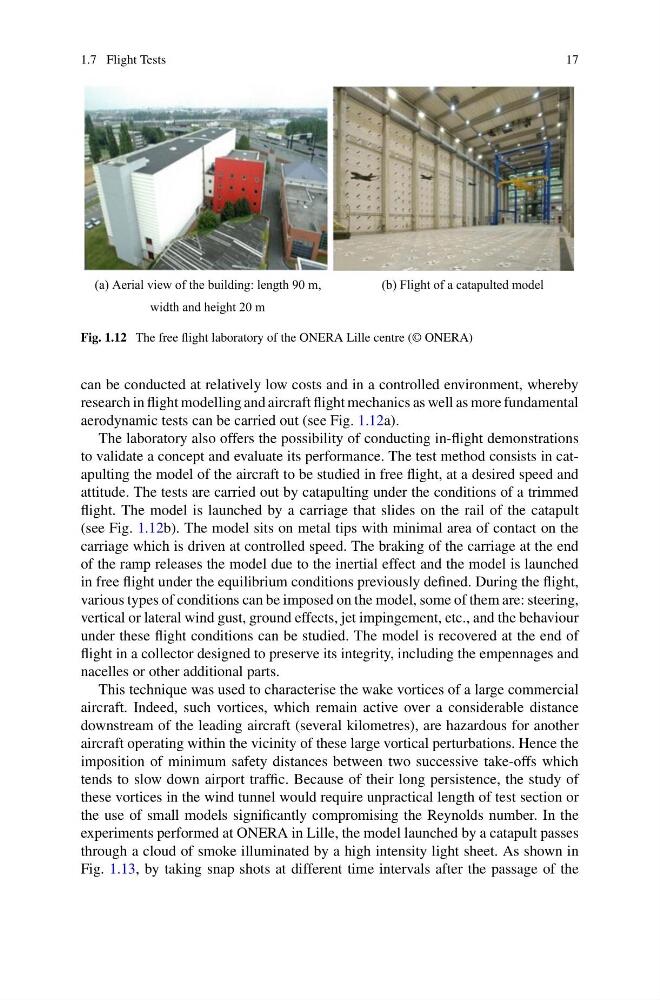
(a) Aerial view of the building: length 90 m,
width and height 20 m
(b) Flight of a catapulted model
Fig. 1.12 The free flight laboratory of the ONERA Lille centre (© ONERA)
can be conducted at relatively low costs and in a controlled environment, whereby
research in flight modelling and aircraft flight mechanics as well as more fundamental
aerodynamic tests can be carried out (see Fig. 1.12a).
The laboratory also offers the possibility of conducting in-flight demonstrations
to validate a concept and evaluate its performance. The test method consists in catapulting the model of the aircraft to be studied in free flight, at a desired speed and
attitude. The tests are carried out by catapulting under the conditions of a trimmed
flight. The model is launched by a carriage that slides on the rail of the catapult
(see Fig. 1.12b). The model sits on metal tips with minimal area of contact on the
carriage which is driven at controlled speed. The braking of the carriage at the end
of the ramp releases the model due to the inertial effect and the model is launched
in free flight under the equilibrium conditions previously defined. During the flight,
various types of conditions can be imposed on the model, some of them are: steering,
vertical or lateral wind gust, ground effects, jet impingement, etc., and the behaviour
under these flight conditions can be studied. The model is recovered at the end of
flight in a collector designed to preserve its integrity, including the empennages and
nacelles or other additional parts.
This technique was used to characterise the wake vortices of a large commercial
aircraft. Indeed, such vortices, which remain active over a considerable distance
downstream of the leading aircraft (several kilometres), are hazardous for another
aircraft operating within the vicinity of these large vortical perturbations. Hence the
imposition of minimum safety distances between two successive take-offs which
tends to slow down airport traffic. Because of their long persistence, the study of
these vortices in the wind tunnel would require unpractical length of test section or
the use of small models significantly compromising the Reynolds number. In the
experiments performed at ONERA in Lille, the model launched by a catapult passes
through a cloud of smoke illuminated by a high intensity light sheet. As shown in
Fig. 1.13, by taking snap shots at different time intervals after the passage of the
17
(a) Aerial view of the building: length 90 m,
width and height 20 m
(b) Flight of a catapulted model
Fig. 1.12 The free flight laboratory of the ONERA Lille centre (© ONERA)
can be conducted at relatively low costs and in a controlled environment, whereby
research in flight modelling and aircraft flight mechanics as well as more fundamental
aerodynamic tests can be carried out (see Fig. 1.12a).
The laboratory also offers the possibility of conducting in-flight demonstrations
to validate a concept and evaluate its performance. The test method consists in catapulting the model of the aircraft to be studied in free flight, at a desired speed and
attitude. The tests are carried out by catapulting under the conditions of a trimmed
flight. The model is launched by a carriage that slides on the rail of the catapult
(see Fig. 1.12b). The model sits on metal tips with minimal area of contact on the
carriage which is driven at controlled speed. The braking of the carriage at the end
of the ramp releases the model due to the inertial effect and the model is launched
in free flight under the equilibrium conditions previously defined. During the flight,
various types of conditions can be imposed on the model, some of them are: steering,
vertical or lateral wind gust, ground effects, jet impingement, etc., and the behaviour
under these flight conditions can be studied. The model is recovered at the end of
flight in a collector designed to preserve its integrity, including the empennages and
nacelles or other additional parts.
This technique was used to characterise the wake vortices of a large commercial
aircraft. Indeed, such vortices, which remain active over a considerable distance
downstream of the leading aircraft (several kilometres), are hazardous for another
aircraft operating within the vicinity of these large vortical perturbations. Hence the
imposition of minimum safety distances between two successive take-offs which
tends to slow down airport traffic. Because of their long persistence, the study of
these vortices in the wind tunnel would require unpractical length of test section or
the use of small models significantly compromising the Reynolds number. In the
experiments performed at ONERA in Lille, the model launched by a catapult passes
through a cloud of smoke illuminated by a high intensity light sheet. As shown in
Fig. 1.13, by taking snap shots at different time intervals after the passage of the