

14.2 Flow Control
289
(a) Solid VGs in a transonic flow
(b) Fluidic VGs on an aircraft wing (CFD)
Fig. 14.3 Control of separation by vortex generators (VGs) (© ONERA)
the field produced by fluidic VGs placed close to the leading edge of a wing in order
to control buffet (CFD results).
Last but not the least, the wing tip vortices of large transport aircraft are also the
subject of major research because of the hazard they represent for an aircraft closely
following or landing or taking off in the wake of these vortices. Thus, devices such
as winglets or sharklets and wingtip fences placed at the extremity of the wing can
control these vortices to a certain extent, but mainly helps in reducing the lift induced
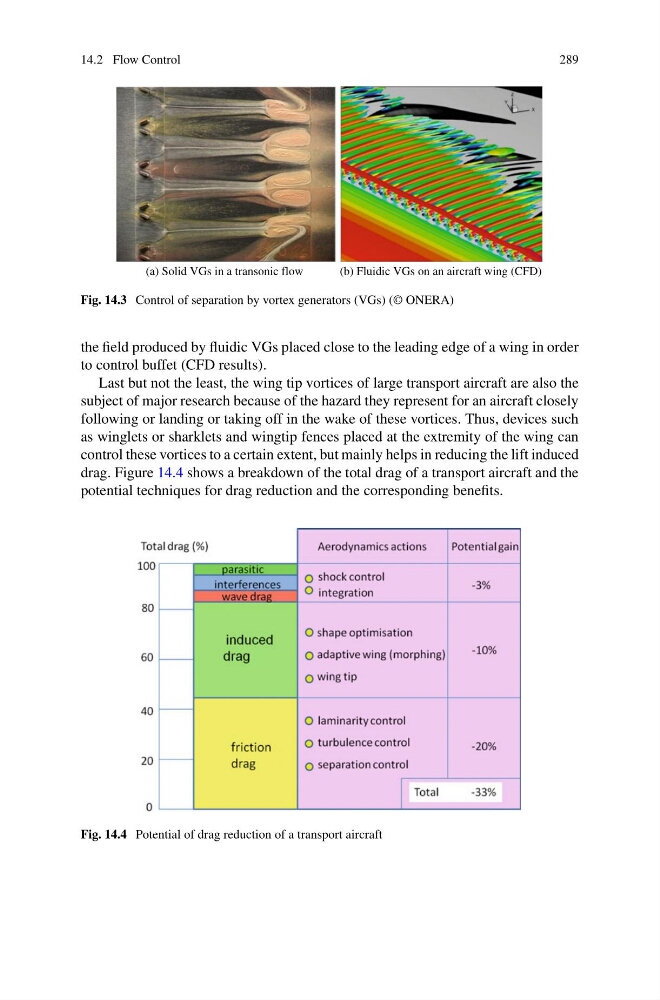
drag. Figure 14.4 shows a breakdown of the total drag of a transport aircraft and the
potential techniques for drag reduction and the corresponding benefits.
Fig. 14.4 Potential of drag reduction of a transport aircraft
289
(a) Solid VGs in a transonic flow
(b) Fluidic VGs on an aircraft wing (CFD)
Fig. 14.3 Control of separation by vortex generators (VGs) (© ONERA)
the field produced by fluidic VGs placed close to the leading edge of a wing in order
to control buffet (CFD results).
Last but not the least, the wing tip vortices of large transport aircraft are also the
subject of major research because of the hazard they represent for an aircraft closely
following or landing or taking off in the wake of these vortices. Thus, devices such
as winglets or sharklets and wingtip fences placed at the extremity of the wing can
control these vortices to a certain extent, but mainly helps in reducing the lift induced
drag. Figure 14.4 shows a breakdown of the total drag of a transport aircraft and the
potential techniques for drag reduction and the corresponding benefits.
Fig. 14.4 Potential of drag reduction of a transport aircraft