

288
14 Prospects and Challenges for Aerodynamics
of an aircraft in operation can be compromised by the existence of defects on the
surface, in particular at the interface of leading-edge slats or the anti-icing devices.
A major issue is that the potential benefits of transition control technique cannot be
easily assessed in classical wind tunnels due to higher levels of turbulence intensity
and background noise (see Sects. 1.7.1 and 5.4).
The second aim of flow control is delaying or suppressing the separation of the
boundary layer experiencing strong adverse pressure gradients, a rapid surface discontinuity (flows around corners and ramps) or in a shock wave. The presence of a
separation almost always has detrimental consequences resulting in an increase in
pressure drag, with the occurrence of large-scale fluctuations (buffeting on a wing),
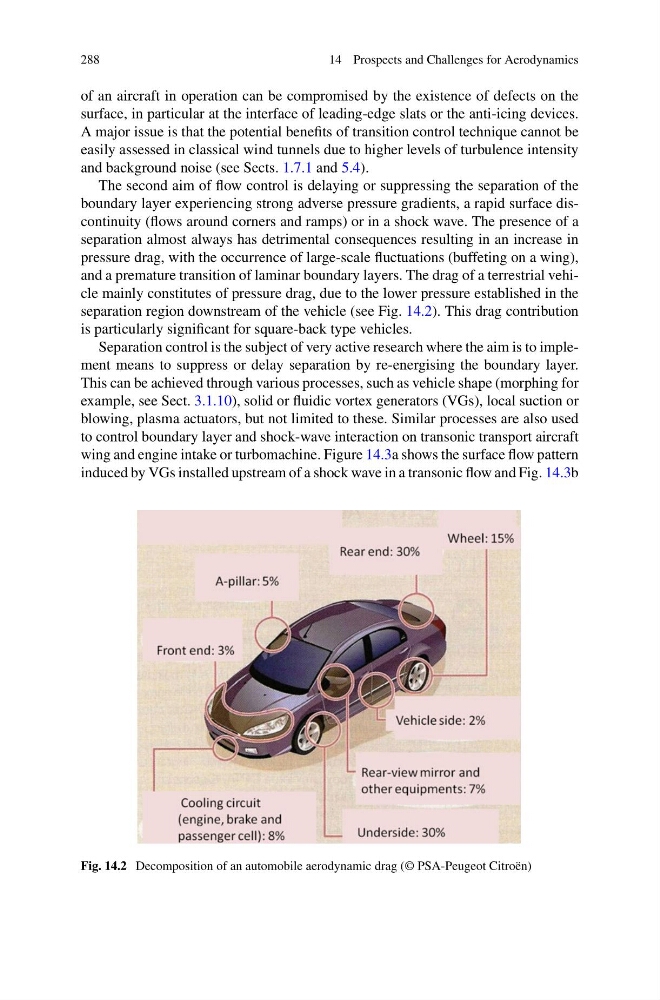
and a premature transition of laminar boundary layers. The drag of a terrestrial vehicle mainly constitutes of pressure drag, due to the lower pressure established in the
separation region downstream of the vehicle (see Fig. 14.2). This drag contribution
is particularly significant for square-back type vehicles.
Separation control is the subject of very active research where the aim is to implement means to suppress or delay separation by re-energising the boundary layer.
This can be achieved through various processes, such as vehicle shape (morphing for
example, see Sect. 3.1.10), solid or fluidic vortex generators (VGs), local suction or
blowing, plasma actuators, but not limited to these. Similar processes are also used
to control boundary layer and shock-wave interaction on transonic transport aircraft
wing and engine intake or turbomachine. Figure 14.3a shows the surface flow pattern
induced by VGs installed upstream of a shock wave in a transonic flow and Fig. 14.3b
Fig. 14.2 Decomposition of an automobile aerodynamic drag (© PSA-Peugeot Citroën)
14 Prospects and Challenges for Aerodynamics
of an aircraft in operation can be compromised by the existence of defects on the
surface, in particular at the interface of leading-edge slats or the anti-icing devices.
A major issue is that the potential benefits of transition control technique cannot be
easily assessed in classical wind tunnels due to higher levels of turbulence intensity
and background noise (see Sects. 1.7.1 and 5.4).
The second aim of flow control is delaying or suppressing the separation of the
boundary layer experiencing strong adverse pressure gradients, a rapid surface discontinuity (flows around corners and ramps) or in a shock wave. The presence of a
separation almost always has detrimental consequences resulting in an increase in
pressure drag, with the occurrence of large-scale fluctuations (buffeting on a wing),
and a premature transition of laminar boundary layers. The drag of a terrestrial vehicle mainly constitutes of pressure drag, due to the lower pressure established in the
separation region downstream of the vehicle (see Fig. 14.2). This drag contribution
is particularly significant for square-back type vehicles.
Separation control is the subject of very active research where the aim is to implement means to suppress or delay separation by re-energising the boundary layer.
This can be achieved through various processes, such as vehicle shape (morphing for
example, see Sect. 3.1.10), solid or fluidic vortex generators (VGs), local suction or
blowing, plasma actuators, but not limited to these. Similar processes are also used
to control boundary layer and shock-wave interaction on transonic transport aircraft
wing and engine intake or turbomachine. Figure 14.3a shows the surface flow pattern
induced by VGs installed upstream of a shock wave in a transonic flow and Fig. 14.3b
Fig. 14.2 Decomposition of an automobile aerodynamic drag (© PSA-Peugeot Citroën)