

13.4 Towards the Hybrid Wind Tunnel
279
– accelerate the processing of the large amount of data generated by methods such
as PIV, PSP, TSP and measurements of model deformation,
– optimise the number of parameters for numerical simulations, such as the
turbulence model and the computational mesh,
– consolidate the database constituting numerical simulations and test results
obtained under identical conditions in order to improve the accuracy of CFD
prediction.
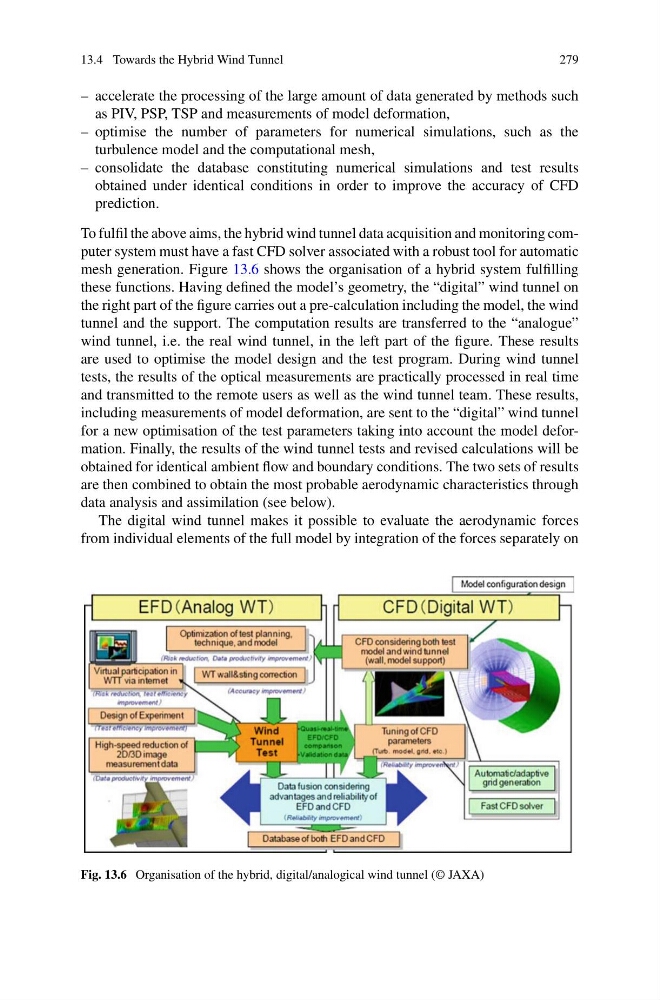
To fulfil the above aims, the hybrid wind tunnel data acquisition and monitoring computer system must have a fast CFD solver associated with a robust tool for automatic
mesh generation. Figure 13.6 shows the organisation of a hybrid system fulfilling
these functions. Having defined the model’s geometry, the “digital” wind tunnel on
the right part of the figure carries out a pre-calculation including the model, the wind
tunnel and the support. The computation results are transferred to the “analogue”
wind tunnel, i.e. the real wind tunnel, in the left part of the figure. These results
are used to optimise the model design and the test program. During wind tunnel
tests, the results of the optical measurements are practically processed in real time
and transmitted to the remote users as well as the wind tunnel team. These results,
including measurements of model deformation, are sent to the “digital” wind tunnel
for a new optimisation of the test parameters taking into account the model deformation. Finally, the results of the wind tunnel tests and revised calculations will be
obtained for identical ambient flow and boundary conditions. The two sets of results
are then combined to obtain the most probable aerodynamic characteristics through
data analysis and assimilation (see below).
The digital wind tunnel makes it possible to evaluate the aerodynamic forces
from individual elements of the full model by integration of the forces separately on
Fig. 13.6 Organisation of the hybrid, digital/analogical wind tunnel (© JAXA)
279
– accelerate the processing of the large amount of data generated by methods such
as PIV, PSP, TSP and measurements of model deformation,
– optimise the number of parameters for numerical simulations, such as the
turbulence model and the computational mesh,
– consolidate the database constituting numerical simulations and test results
obtained under identical conditions in order to improve the accuracy of CFD
prediction.
To fulfil the above aims, the hybrid wind tunnel data acquisition and monitoring computer system must have a fast CFD solver associated with a robust tool for automatic
mesh generation. Figure 13.6 shows the organisation of a hybrid system fulfilling
these functions. Having defined the model’s geometry, the “digital” wind tunnel on
the right part of the figure carries out a pre-calculation including the model, the wind
tunnel and the support. The computation results are transferred to the “analogue”
wind tunnel, i.e. the real wind tunnel, in the left part of the figure. These results
are used to optimise the model design and the test program. During wind tunnel
tests, the results of the optical measurements are practically processed in real time
and transmitted to the remote users as well as the wind tunnel team. These results,
including measurements of model deformation, are sent to the “digital” wind tunnel
for a new optimisation of the test parameters taking into account the model deformation. Finally, the results of the wind tunnel tests and revised calculations will be
obtained for identical ambient flow and boundary conditions. The two sets of results
are then combined to obtain the most probable aerodynamic characteristics through
data analysis and assimilation (see below).
The digital wind tunnel makes it possible to evaluate the aerodynamic forces
from individual elements of the full model by integration of the forces separately on
Fig. 13.6 Organisation of the hybrid, digital/analogical wind tunnel (© JAXA)