

276
13 Computer-Aided Wind Tunnel Test and Analysis
with or without detail features of the wind tunnel, such as the model supports and
other intrusive instruments, and can be focused on the complete model, as well as
on a particular component of the aircraft in concern.
Moreover, a preliminary access to the behaviour of the flow around the model
provides the test engineer the possibility of identifying the interesting or critical
zones. This is particularly true when unconventional or new configurations are tested.
CFD thus provides an initial assessment of the flow characteristics, making it possible
to direct the choice and positioning of instrumentation on the model. For instance, the
pressure tappings can thus be placed adequately ensuring a precise measurement of
very local phenomena such as rapid expansions or shock waves. CFD is also used to
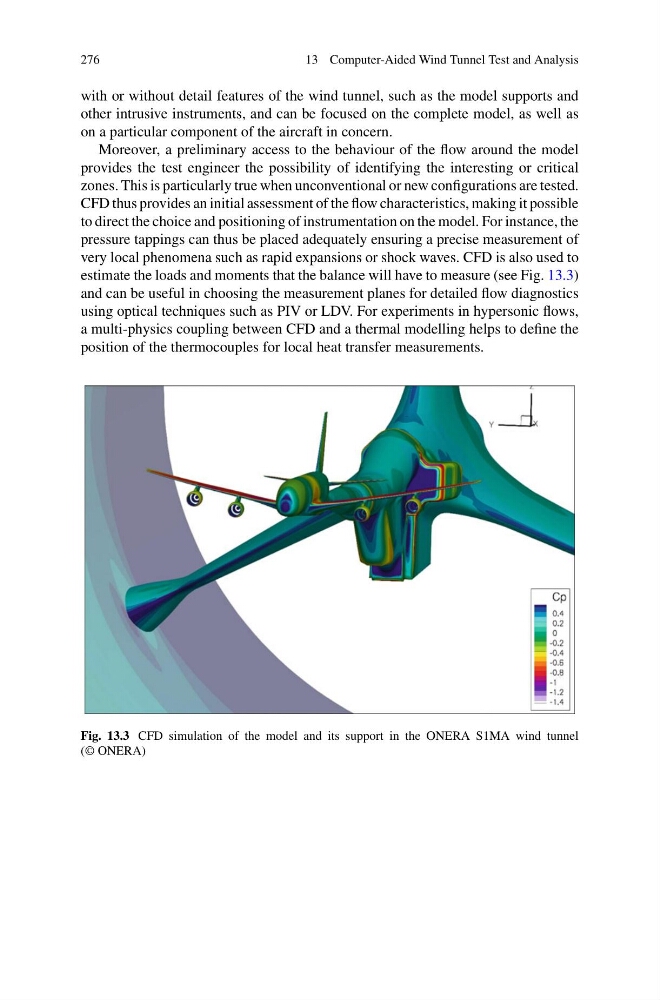
estimate the loads and moments that the balance will have to measure (see Fig. 13.3)
and can be useful in choosing the measurement planes for detailed flow diagnostics
using optical techniques such as PIV or LDV. For experiments in hypersonic flows,
a multi-physics coupling between CFD and a thermal modelling helps to define the
position of the thermocouples for local heat transfer measurements.
Fig. 13.3 CFD simulation of the model and its support in the ONERA S1MA wind tunnel
(© ONERA)
13 Computer-Aided Wind Tunnel Test and Analysis
with or without detail features of the wind tunnel, such as the model supports and
other intrusive instruments, and can be focused on the complete model, as well as
on a particular component of the aircraft in concern.
Moreover, a preliminary access to the behaviour of the flow around the model
provides the test engineer the possibility of identifying the interesting or critical
zones. This is particularly true when unconventional or new configurations are tested.
CFD thus provides an initial assessment of the flow characteristics, making it possible
to direct the choice and positioning of instrumentation on the model. For instance, the
pressure tappings can thus be placed adequately ensuring a precise measurement of
very local phenomena such as rapid expansions or shock waves. CFD is also used to
estimate the loads and moments that the balance will have to measure (see Fig. 13.3)
and can be useful in choosing the measurement planes for detailed flow diagnostics
using optical techniques such as PIV or LDV. For experiments in hypersonic flows,
a multi-physics coupling between CFD and a thermal modelling helps to define the
position of the thermocouples for local heat transfer measurements.
Fig. 13.3 CFD simulation of the model and its support in the ONERA S1MA wind tunnel
(© ONERA)