

12.8 Electron Beam Induced Glow Discharge Measurements
271
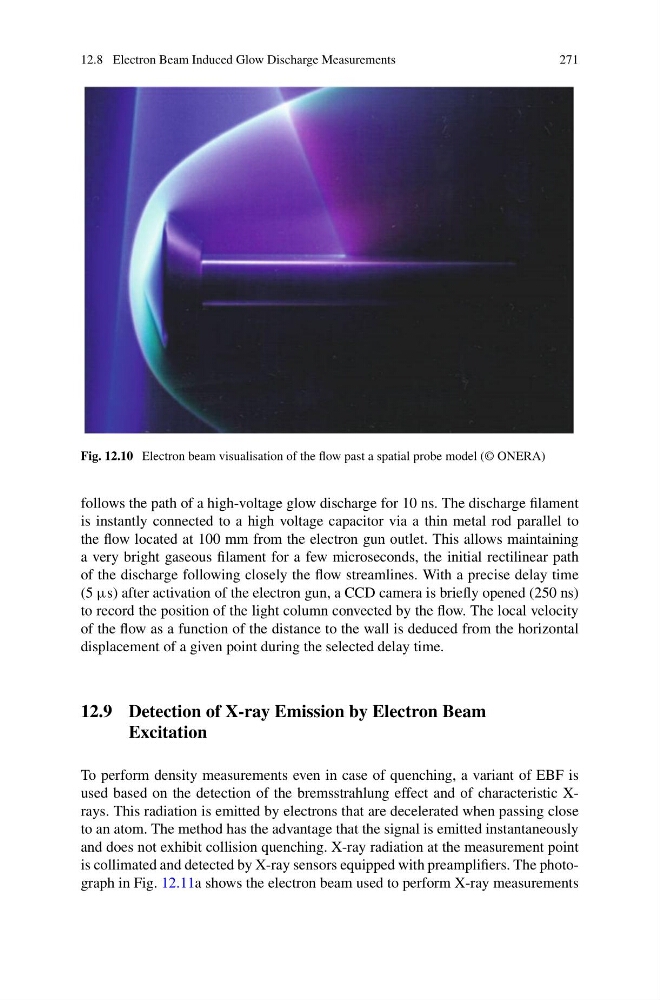
Fig. 12.10 Electron beam visualisation of the flow past a spatial probe model (© ONERA)
follows the path of a high-voltage glow discharge for 10 ns. The discharge filament
is instantly connected to a high voltage capacitor via a thin metal rod parallel to
the flow located at 100 mm from the electron gun outlet. This allows maintaining
a very bright gaseous filament for a few microseconds, the initial rectilinear path
of the discharge following closely the flow streamlines. With a precise delay time
(5 µs) after activation of the electron gun, a CCD camera is briefly opened (250 ns)
to record the position of the light column convected by the flow. The local velocity
of the flow as a function of the distance to the wall is deduced from the horizontal
displacement of a given point during the selected delay time.
12.9 Detection of X-ray Emission by Electron Beam
Excitation
To perform density measurements even in case of quenching, a variant of EBF is
used based on the detection of the bremsstrahlung effect and of characteristic Xrays. This radiation is emitted by electrons that are decelerated when passing close
to an atom. The method has the advantage that the signal is emitted instantaneously
and does not exhibit collision quenching. X-ray radiation at the measurement point
is collimated and detected by X-ray sensors equipped with preamplifiers. The photograph in Fig. 12.11a shows the electron beam used to perform X-ray measurements
271
Fig. 12.10 Electron beam visualisation of the flow past a spatial probe model (© ONERA)
follows the path of a high-voltage glow discharge for 10 ns. The discharge filament
is instantly connected to a high voltage capacitor via a thin metal rod parallel to
the flow located at 100 mm from the electron gun outlet. This allows maintaining
a very bright gaseous filament for a few microseconds, the initial rectilinear path
of the discharge following closely the flow streamlines. With a precise delay time
(5 µs) after activation of the electron gun, a CCD camera is briefly opened (250 ns)
to record the position of the light column convected by the flow. The local velocity
of the flow as a function of the distance to the wall is deduced from the horizontal
displacement of a given point during the selected delay time.
12.9 Detection of X-ray Emission by Electron Beam
Excitation
To perform density measurements even in case of quenching, a variant of EBF is
used based on the detection of the bremsstrahlung effect and of characteristic Xrays. This radiation is emitted by electrons that are decelerated when passing close
to an atom. The method has the advantage that the signal is emitted instantaneously
and does not exhibit collision quenching. X-ray radiation at the measurement point
is collimated and detected by X-ray sensors equipped with preamplifiers. The photograph in Fig. 12.11a shows the electron beam used to perform X-ray measurements