

258
11 Non-intrusive Measurement Techniques
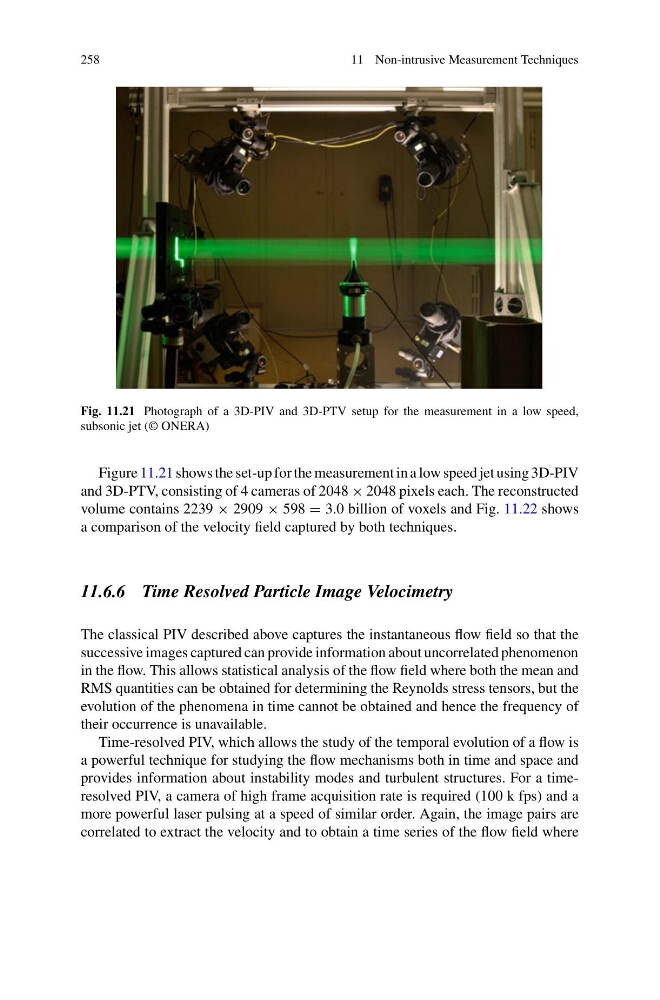
Fig. 11.21 Photograph of a 3D-PIV and 3D-PTV setup for the measurement in a low speed,
subsonic jet (© ONERA)
Figure 11.21 shows the set-up for the measurement in a low speed jet using 3D-PIV
and 3D-PTV, consisting of 4 cameras of 2048 × 2048 pixels each. The reconstructed
volume contains 2239 × 2909 × 598 = 3.0 billion of voxels and Fig. 11.22 shows
a comparison of the velocity field captured by both techniques.
11.6.6 Time Resolved Particle Image Velocimetry
The classical PIV described above captures the instantaneous flow field so that the
successive images captured can provide information about uncorrelated phenomenon
in the flow. This allows statistical analysis of the flow field where both the mean and
RMS quantities can be obtained for determining the Reynolds stress tensors, but the
evolution of the phenomena in time cannot be obtained and hence the frequency of
their occurrence is unavailable.
Time-resolved PIV, which allows the study of the temporal evolution of a flow is
a powerful technique for studying the flow mechanisms both in time and space and
provides information about instability modes and turbulent structures. For a timeresolved PIV, a camera of high frame acquisition rate is required (100 k fps) and a
more powerful laser pulsing at a speed of similar order. Again, the image pairs are
correlated to extract the velocity and to obtain a time series of the flow field where
11 Non-intrusive Measurement Techniques
Fig. 11.21 Photograph of a 3D-PIV and 3D-PTV setup for the measurement in a low speed,
subsonic jet (© ONERA)
Figure 11.21 shows the set-up for the measurement in a low speed jet using 3D-PIV
and 3D-PTV, consisting of 4 cameras of 2048 × 2048 pixels each. The reconstructed
volume contains 2239 × 2909 × 598 = 3.0 billion of voxels and Fig. 11.22 shows
a comparison of the velocity field captured by both techniques.
11.6.6 Time Resolved Particle Image Velocimetry
The classical PIV described above captures the instantaneous flow field so that the
successive images captured can provide information about uncorrelated phenomenon
in the flow. This allows statistical analysis of the flow field where both the mean and
RMS quantities can be obtained for determining the Reynolds stress tensors, but the
evolution of the phenomena in time cannot be obtained and hence the frequency of
their occurrence is unavailable.
Time-resolved PIV, which allows the study of the temporal evolution of a flow is
a powerful technique for studying the flow mechanisms both in time and space and
provides information about instability modes and turbulent structures. For a timeresolved PIV, a camera of high frame acquisition rate is required (100 k fps) and a
more powerful laser pulsing at a speed of similar order. Again, the image pairs are
correlated to extract the velocity and to obtain a time series of the flow field where