

11.6 Particle Image Velocimetry
257
During one of its most common utilisation mode the results processing involves
two main steps; firstly, a tomographic reconstruction which determines the intensity of the particles within a three-dimensional grid of voxels for all time instants.
Secondly, the displacement is determined using an algorithm based on a threedimensional correlation, using as input the volume of intensities as opposed to pixel
intensities in planar PIV. This results in a three-dimensional velocity field of all 3
components.
This method has already been used previously to characterise canonical flows, but
still, it is more delicate to employ as opposed to planar or even stereoscopic PIV. The
set-up is bulkier and requires more space due to the additional numbers of camera,
supports and traverse system for the calibration, for a relatively small measurement
domain of 10 × 10 × 2 cm
3 . Besides, the accuracy of the volumetric measurements
depends significantly on the seeding particle density and a high concentration can
introduce a lot of noise, due to the presence of spurious peaks or ghost particles during
the reconstruction of the volume intensity. A very low seeding density is detrimental
either for correlation or to resolve the smallest length scale accurately in complex
flows.
11.6.5 Particle Tracking Velocimetry
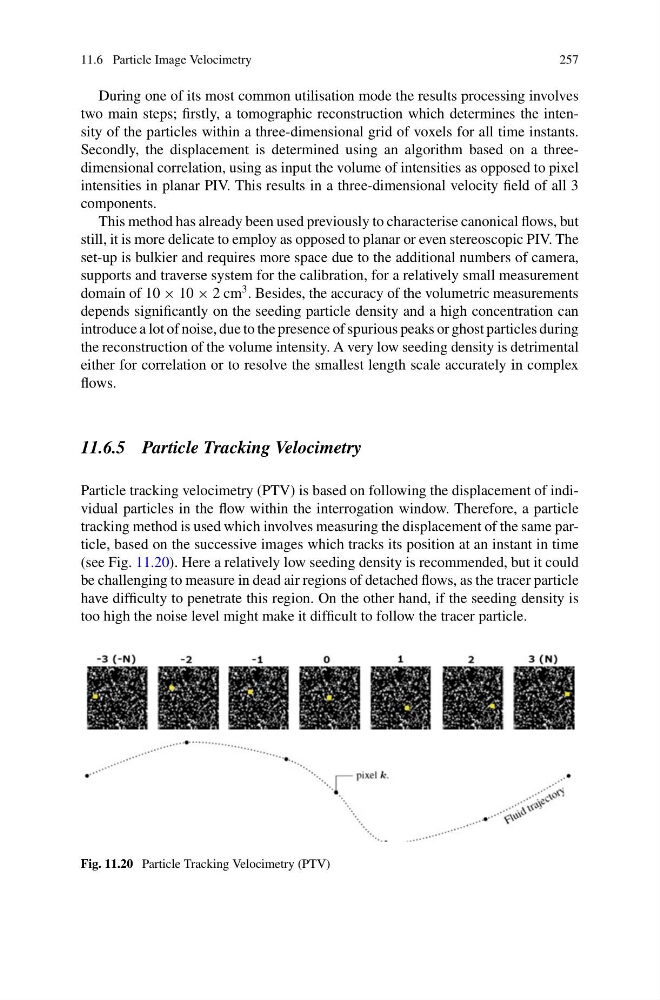
Particle tracking velocimetry (PTV) is based on following the displacement of individual particles in the flow within the interrogation window. Therefore, a particle
tracking method is used which involves measuring the displacement of the same particle, based on the successive images which tracks its position at an instant in time
(see Fig. 11.20). Here a relatively low seeding density is recommended, but it could
be challenging to measure in dead air regions of detached flows, as the tracer particle
have difficulty to penetrate this region. On the other hand, if the seeding density is
too high the noise level might make it difficult to follow the tracer particle.
Fig. 11.20 Particle Tracking Velocimetry (PTV)
257
During one of its most common utilisation mode the results processing involves
two main steps; firstly, a tomographic reconstruction which determines the intensity of the particles within a three-dimensional grid of voxels for all time instants.
Secondly, the displacement is determined using an algorithm based on a threedimensional correlation, using as input the volume of intensities as opposed to pixel
intensities in planar PIV. This results in a three-dimensional velocity field of all 3
components.
This method has already been used previously to characterise canonical flows, but
still, it is more delicate to employ as opposed to planar or even stereoscopic PIV. The
set-up is bulkier and requires more space due to the additional numbers of camera,
supports and traverse system for the calibration, for a relatively small measurement
domain of 10 × 10 × 2 cm
3 . Besides, the accuracy of the volumetric measurements
depends significantly on the seeding particle density and a high concentration can
introduce a lot of noise, due to the presence of spurious peaks or ghost particles during
the reconstruction of the volume intensity. A very low seeding density is detrimental
either for correlation or to resolve the smallest length scale accurately in complex
flows.
11.6.5 Particle Tracking Velocimetry
Particle tracking velocimetry (PTV) is based on following the displacement of individual particles in the flow within the interrogation window. Therefore, a particle
tracking method is used which involves measuring the displacement of the same particle, based on the successive images which tracks its position at an instant in time
(see Fig. 11.20). Here a relatively low seeding density is recommended, but it could
be challenging to measure in dead air regions of detached flows, as the tracer particle
have difficulty to penetrate this region. On the other hand, if the seeding density is
too high the noise level might make it difficult to follow the tracer particle.
Fig. 11.20 Particle Tracking Velocimetry (PTV)