

240
11 Non-intrusive Measurement Techniques
accuracy, for instance in transonic flows where ρ changes by about 10%. In order to
increase the number of fringes, wedge fringe interferometry mode can be employed
as shown in Fig. 11.1b.
Instead of both light waves being parallel as in the infinite fringe mode, one is
tilted by a mirror and this introduces a linear variation in the optical path length while
it passes through the flow. In the absence of a flow the black and white fringes are
parallel to each other. The development of the flow introduces a change in the density
which distorts the fringe pattern. This is captured on another sensing optic which is
compared with the pattern obtained from finite fringe mode and used for calculation
of density and further analysis.
Interferometry is employed for axisymmetric flows without major changes to the
mode of operation, the main modification is to the image treatment as the relation
between the fringe position and optical path length is different. Since the density of
the flow field is not uniform along the span, it is calculated using the classical Abel’s
transform.
11.2.2 Mach-Zehnder Interferometry
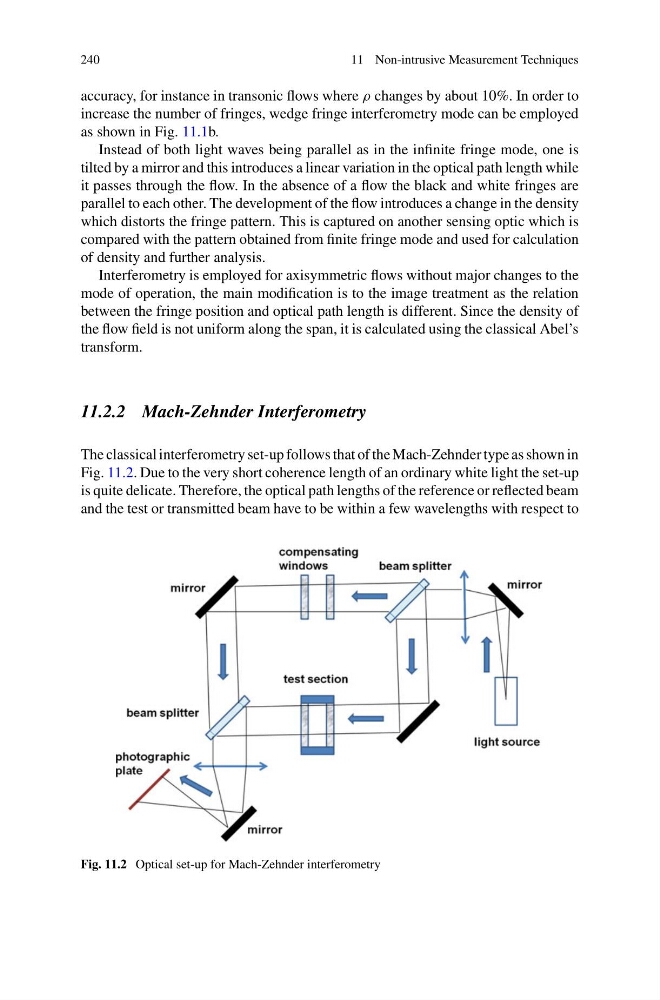
The classical interferometry set-up follows that of the Mach-Zehnder type as shown in
Fig. 11.2. Due to the very short coherence length of an ordinary white light the set-up
is quite delicate. Therefore, the optical path lengths of the reference or reflected beam
and the test or transmitted beam have to be within a few wavelengths with respect to
Fig. 11.2 Optical set-up for Mach-Zehnder interferometry
11 Non-intrusive Measurement Techniques
accuracy, for instance in transonic flows where ρ changes by about 10%. In order to
increase the number of fringes, wedge fringe interferometry mode can be employed
as shown in Fig. 11.1b.
Instead of both light waves being parallel as in the infinite fringe mode, one is
tilted by a mirror and this introduces a linear variation in the optical path length while
it passes through the flow. In the absence of a flow the black and white fringes are
parallel to each other. The development of the flow introduces a change in the density
which distorts the fringe pattern. This is captured on another sensing optic which is
compared with the pattern obtained from finite fringe mode and used for calculation
of density and further analysis.
Interferometry is employed for axisymmetric flows without major changes to the
mode of operation, the main modification is to the image treatment as the relation
between the fringe position and optical path length is different. Since the density of
the flow field is not uniform along the span, it is calculated using the classical Abel’s
transform.
11.2.2 Mach-Zehnder Interferometry
The classical interferometry set-up follows that of the Mach-Zehnder type as shown in
Fig. 11.2. Due to the very short coherence length of an ordinary white light the set-up
is quite delicate. Therefore, the optical path lengths of the reference or reflected beam
and the test or transmitted beam have to be within a few wavelengths with respect to
Fig. 11.2 Optical set-up for Mach-Zehnder interferometry