

11.2 Interferometry
241
each other. Thus very high optical quality glass is required for the windows of the
working section and usually an additional pair is required for the reference beam to
account for losses due aberration from the windows.
11.2.3 Holographic Interferometry
Due to the larger distance of coherence of the light wave generated from laser sources,
interferometry technique has been greatly simplified and this has attracted holographic techniques for creating interference patterns which can be treated using the
same analysis process during classical interferometry. In the holographic technique
the reference and the transmitted beam is created using either a helium-neon or argon
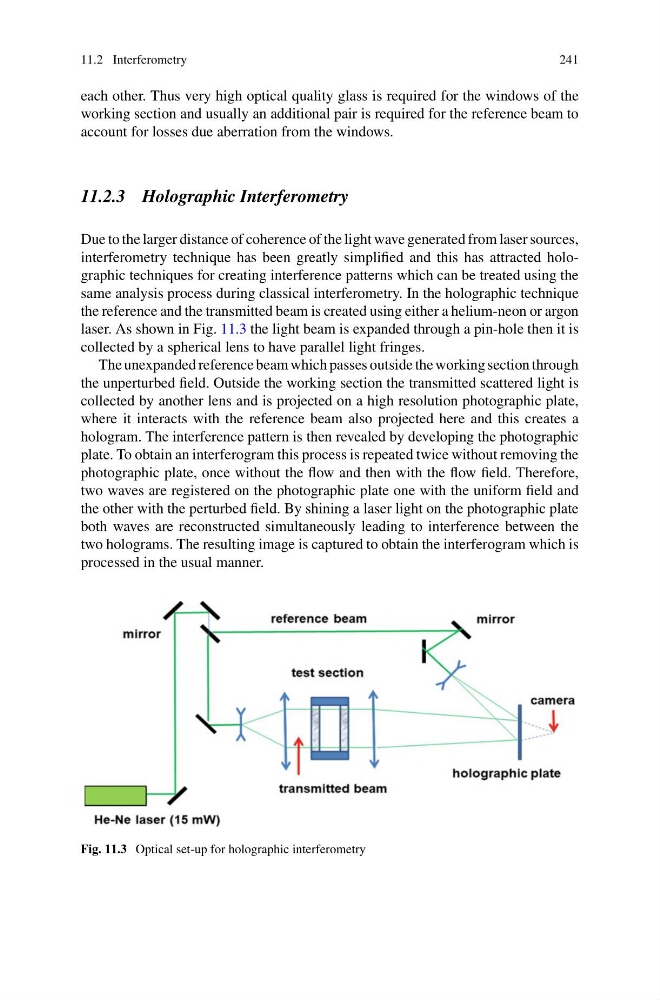
laser. As shown in Fig. 11.3 the light beam is expanded through a pin-hole then it is
collected by a spherical lens to have parallel light fringes.
The unexpanded reference beam which passes outside the working section through
the unperturbed field. Outside the working section the transmitted scattered light is
collected by another lens and is projected on a high resolution photographic plate,
where it interacts with the reference beam also projected here and this creates a
hologram. The interference pattern is then revealed by developing the photographic
plate. To obtain an interferogram this process is repeated twice without removing the
photographic plate, once without the flow and then with the flow field. Therefore,
two waves are registered on the photographic plate one with the uniform field and
the other with the perturbed field. By shining a laser light on the photographic plate
both waves are reconstructed simultaneously leading to interference between the
two holograms. The resulting image is captured to obtain the interferogram which is
processed in the usual manner.
Fig. 11.3 Optical set-up for holographic interferometry
241
each other. Thus very high optical quality glass is required for the windows of the
working section and usually an additional pair is required for the reference beam to
account for losses due aberration from the windows.
11.2.3 Holographic Interferometry
Due to the larger distance of coherence of the light wave generated from laser sources,
interferometry technique has been greatly simplified and this has attracted holographic techniques for creating interference patterns which can be treated using the
same analysis process during classical interferometry. In the holographic technique
the reference and the transmitted beam is created using either a helium-neon or argon
laser. As shown in Fig. 11.3 the light beam is expanded through a pin-hole then it is
collected by a spherical lens to have parallel light fringes.
The unexpanded reference beam which passes outside the working section through
the unperturbed field. Outside the working section the transmitted scattered light is
collected by another lens and is projected on a high resolution photographic plate,
where it interacts with the reference beam also projected here and this creates a
hologram. The interference pattern is then revealed by developing the photographic
plate. To obtain an interferogram this process is repeated twice without removing the
photographic plate, once without the flow and then with the flow field. Therefore,
two waves are registered on the photographic plate one with the uniform field and
the other with the perturbed field. By shining a laser light on the photographic plate
both waves are reconstructed simultaneously leading to interference between the
two holograms. The resulting image is captured to obtain the interferogram which is
processed in the usual manner.
Fig. 11.3 Optical set-up for holographic interferometry