

10.4 Measurement Using Hot Wire and Hot Film Anemometry
235
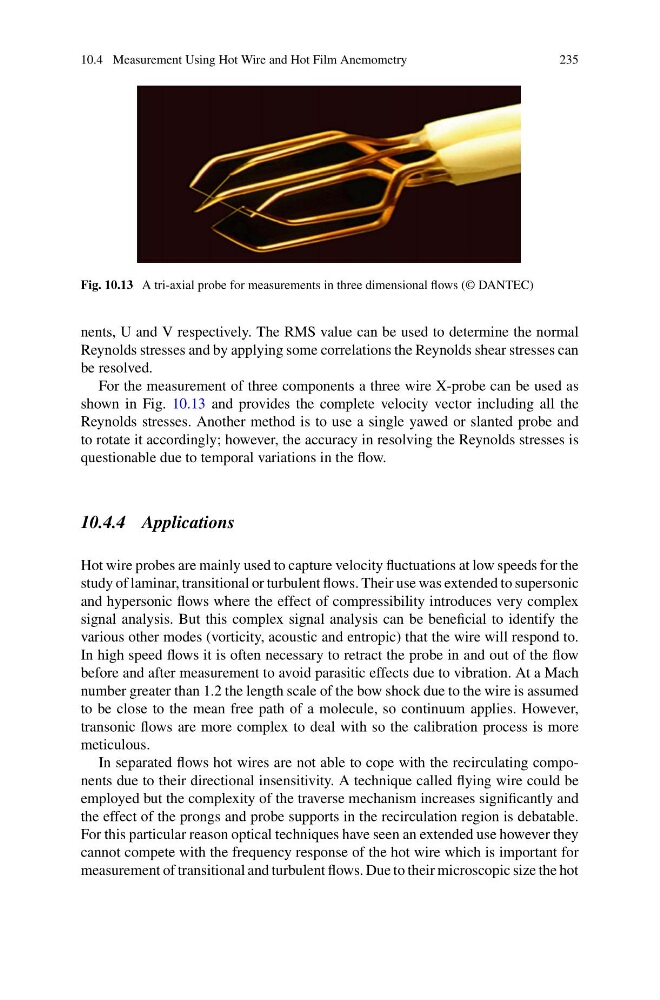
Fig. 10.13 A tri-axial probe for measurements in three dimensional flows (© DANTEC)
nents, U and V respectively. The RMS value can be used to determine the normal
Reynolds stresses and by applying some correlations the Reynolds shear stresses can
be resolved.
For the measurement of three components a three wire X-probe can be used as
shown in Fig. 10.13 and provides the complete velocity vector including all the
Reynolds stresses. Another method is to use a single yawed or slanted probe and
to rotate it accordingly; however, the accuracy in resolving the Reynolds stresses is
questionable due to temporal variations in the flow.
10.4.4 Applications
Hot wire probes are mainly used to capture velocity fluctuations at low speeds for the
study of laminar, transitional or turbulent flows. Their use was extended to supersonic
and hypersonic flows where the effect of compressibility introduces very complex
signal analysis. But this complex signal analysis can be beneficial to identify the
various other modes (vorticity, acoustic and entropic) that the wire will respond to.
In high speed flows it is often necessary to retract the probe in and out of the flow
before and after measurement to avoid parasitic effects due to vibration. At a Mach
number greater than 1.2 the length scale of the bow shock due to the wire is assumed
to be close to the mean free path of a molecule, so continuum applies. However,
transonic flows are more complex to deal with so the calibration process is more
meticulous.
In separated flows hot wires are not able to cope with the recirculating components due to their directional insensitivity. A technique called flying wire could be
employed but the complexity of the traverse mechanism increases significantly and
the effect of the prongs and probe supports in the recirculation region is debatable.
For this particular reason optical techniques have seen an extended use however they
cannot compete with the frequency response of the hot wire which is important for
measurement of transitional and turbulent flows. Due to their microscopic size the hot
235
Fig. 10.13 A tri-axial probe for measurements in three dimensional flows (© DANTEC)
nents, U and V respectively. The RMS value can be used to determine the normal
Reynolds stresses and by applying some correlations the Reynolds shear stresses can
be resolved.
For the measurement of three components a three wire X-probe can be used as
shown in Fig. 10.13 and provides the complete velocity vector including all the
Reynolds stresses. Another method is to use a single yawed or slanted probe and
to rotate it accordingly; however, the accuracy in resolving the Reynolds stresses is
questionable due to temporal variations in the flow.
10.4.4 Applications
Hot wire probes are mainly used to capture velocity fluctuations at low speeds for the
study of laminar, transitional or turbulent flows. Their use was extended to supersonic
and hypersonic flows where the effect of compressibility introduces very complex
signal analysis. But this complex signal analysis can be beneficial to identify the
various other modes (vorticity, acoustic and entropic) that the wire will respond to.
In high speed flows it is often necessary to retract the probe in and out of the flow
before and after measurement to avoid parasitic effects due to vibration. At a Mach
number greater than 1.2 the length scale of the bow shock due to the wire is assumed
to be close to the mean free path of a molecule, so continuum applies. However,
transonic flows are more complex to deal with so the calibration process is more
meticulous.
In separated flows hot wires are not able to cope with the recirculating components due to their directional insensitivity. A technique called flying wire could be
employed but the complexity of the traverse mechanism increases significantly and
the effect of the prongs and probe supports in the recirculation region is debatable.
For this particular reason optical techniques have seen an extended use however they
cannot compete with the frequency response of the hot wire which is important for
measurement of transitional and turbulent flows. Due to their microscopic size the hot