

234
10 Intrusive Measurement Techniques
allows the estimation of statistical quantities such as RMS values, skewness and
kurtosis and from further analysis spatial and temporal correlations of the flow can
be derived. Due to the fast frequency response and high signal to noise ratio of the
hot wire it is invariably the most suitable candidate for capturing frequency spectra,
where the corresponding flow mechanisms and the more importantly the turbulence
energy cascade can be resolved.
10.4.3 Types of Hot Wire Probes
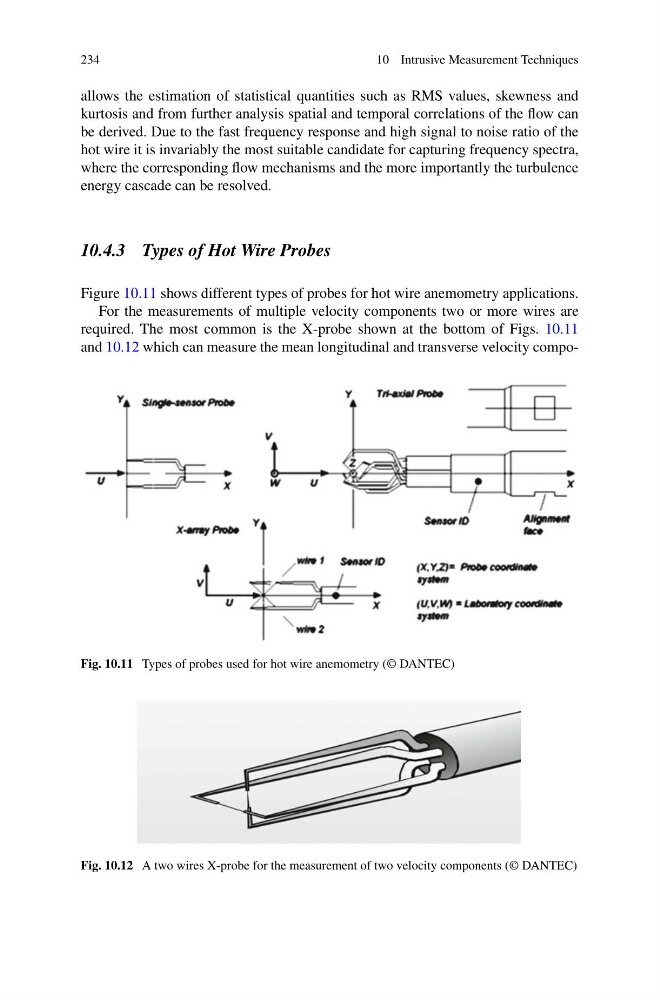
Figure 10.11 shows different types of probes for hot wire anemometry applications.
For the measurements of multiple velocity components two or more wires are
required. The most common is the X-probe shown at the bottom of Figs. 10.11
and 10.12 which can measure the mean longitudinal and transverse velocity compoFig. 10.11 Types of probes used for hot wire anemometry (© DANTEC)
Fig. 10.12 A two wires X-probe for the measurement of two velocity components (© DANTEC)
10 Intrusive Measurement Techniques
allows the estimation of statistical quantities such as RMS values, skewness and
kurtosis and from further analysis spatial and temporal correlations of the flow can
be derived. Due to the fast frequency response and high signal to noise ratio of the
hot wire it is invariably the most suitable candidate for capturing frequency spectra,
where the corresponding flow mechanisms and the more importantly the turbulence
energy cascade can be resolved.
10.4.3 Types of Hot Wire Probes
Figure 10.11 shows different types of probes for hot wire anemometry applications.
For the measurements of multiple velocity components two or more wires are
required. The most common is the X-probe shown at the bottom of Figs. 10.11
and 10.12 which can measure the mean longitudinal and transverse velocity compoFig. 10.11 Types of probes used for hot wire anemometry (© DANTEC)
Fig. 10.12 A two wires X-probe for the measurement of two velocity components (© DANTEC)