

10.4 Measurement Using Hot Wire and Hot Film Anemometry
233
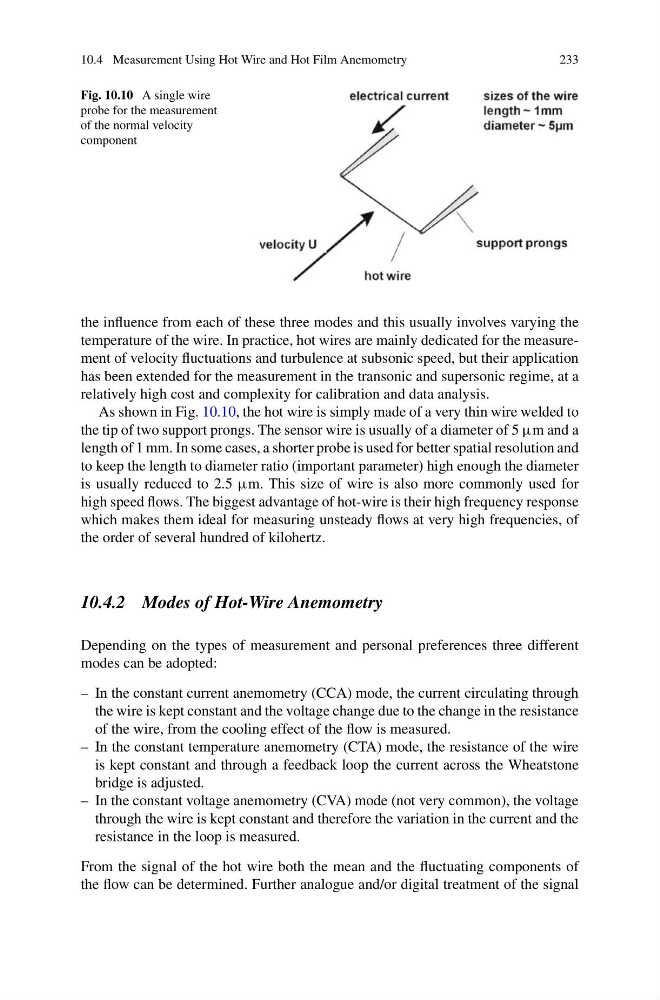
Fig. 10.10 A single wire
probe for the measurement
of the normal velocity
component
the influence from each of these three modes and this usually involves varying the
temperature of the wire. In practice, hot wires are mainly dedicated for the measurement of velocity fluctuations and turbulence at subsonic speed, but their application
has been extended for the measurement in the transonic and supersonic regime, at a
relatively high cost and complexity for calibration and data analysis.
As shown in Fig. 10.10, the hot wire is simply made of a very thin wire welded to
the tip of two support prongs. The sensor wire is usually of a diameter of 5 µm and a
length of 1 mm. In some cases, a shorter probe is used for better spatial resolution and
to keep the length to diameter ratio (important parameter) high enough the diameter
is usually reduced to 2.5 µm. This size of wire is also more commonly used for
high speed flows. The biggest advantage of hot-wire is their high frequency response
which makes them ideal for measuring unsteady flows at very high frequencies, of
the order of several hundred of kilohertz.
10.4.2 Modes of Hot-Wire Anemometry
Depending on the types of measurement and personal preferences three different
modes can be adopted:
– In the constant current anemometry (CCA) mode, the current circulating through
the wire is kept constant and the voltage change due to the change in the resistance
of the wire, from the cooling effect of the flow is measured.
– In the constant temperature anemometry (CTA) mode, the resistance of the wire
is kept constant and through a feedback loop the current across the Wheatstone
bridge is adjusted.
– In the constant voltage anemometry (CVA) mode (not very common), the voltage
through the wire is kept constant and therefore the variation in the current and the
resistance in the loop is measured.
From the signal of the hot wire both the mean and the fluctuating components of
the flow can be determined. Further analogue and/or digital treatment of the signal
233
Fig. 10.10 A single wire
probe for the measurement
of the normal velocity
component
the influence from each of these three modes and this usually involves varying the
temperature of the wire. In practice, hot wires are mainly dedicated for the measurement of velocity fluctuations and turbulence at subsonic speed, but their application
has been extended for the measurement in the transonic and supersonic regime, at a
relatively high cost and complexity for calibration and data analysis.
As shown in Fig. 10.10, the hot wire is simply made of a very thin wire welded to
the tip of two support prongs. The sensor wire is usually of a diameter of 5 µm and a
length of 1 mm. In some cases, a shorter probe is used for better spatial resolution and
to keep the length to diameter ratio (important parameter) high enough the diameter
is usually reduced to 2.5 µm. This size of wire is also more commonly used for
high speed flows. The biggest advantage of hot-wire is their high frequency response
which makes them ideal for measuring unsteady flows at very high frequencies, of
the order of several hundred of kilohertz.
10.4.2 Modes of Hot-Wire Anemometry
Depending on the types of measurement and personal preferences three different
modes can be adopted:
– In the constant current anemometry (CCA) mode, the current circulating through
the wire is kept constant and the voltage change due to the change in the resistance
of the wire, from the cooling effect of the flow is measured.
– In the constant temperature anemometry (CTA) mode, the resistance of the wire
is kept constant and through a feedback loop the current across the Wheatstone
bridge is adjusted.
– In the constant voltage anemometry (CVA) mode (not very common), the voltage
through the wire is kept constant and therefore the variation in the current and the
resistance in the loop is measured.
From the signal of the hot wire both the mean and the fluctuating components of
the flow can be determined. Further analogue and/or digital treatment of the signal