

10.3 Temperature Probes
231
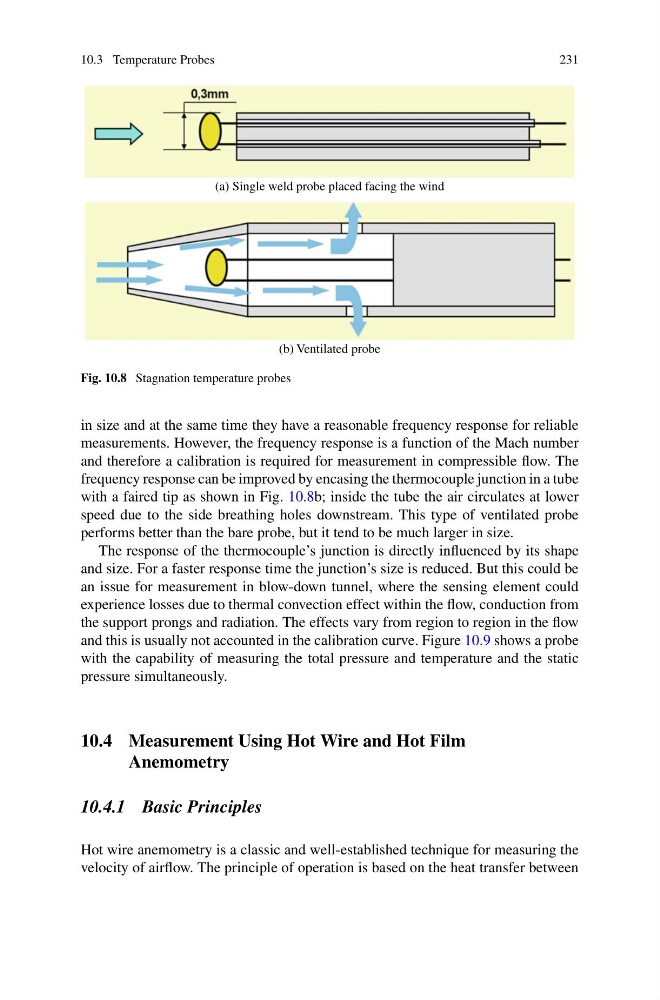
(a) Single weld probe placed facing the wind
(b) Ventilated probe
Fig. 10.8 Stagnation temperature probes
in size and at the same time they have a reasonable frequency response for reliable
measurements. However, the frequency response is a function of the Mach number
and therefore a calibration is required for measurement in compressible flow. The
frequency response can be improved by encasing the thermocouple junction in a tube
with a faired tip as shown in Fig. 10.8b; inside the tube the air circulates at lower
speed due to the side breathing holes downstream. This type of ventilated probe
performs better than the bare probe, but it tend to be much larger in size.
The response of the thermocouple’s junction is directly influenced by its shape
and size. For a faster response time the junction’s size is reduced. But this could be
an issue for measurement in blow-down tunnel, where the sensing element could
experience losses due to thermal convection effect within the flow, conduction from
the support prongs and radiation. The effects vary from region to region in the flow
and this is usually not accounted in the calibration curve. Figure 10.9 shows a probe
with the capability of measuring the total pressure and temperature and the static
pressure simultaneously.
10.4 Measurement Using Hot Wire and Hot Film
Anemometry
10.4.1 Basic Principles
Hot wire anemometry is a classic and well-established technique for measuring the
velocity of airflow. The principle of operation is based on the heat transfer between
231
(a) Single weld probe placed facing the wind
(b) Ventilated probe
Fig. 10.8 Stagnation temperature probes
in size and at the same time they have a reasonable frequency response for reliable
measurements. However, the frequency response is a function of the Mach number
and therefore a calibration is required for measurement in compressible flow. The
frequency response can be improved by encasing the thermocouple junction in a tube
with a faired tip as shown in Fig. 10.8b; inside the tube the air circulates at lower
speed due to the side breathing holes downstream. This type of ventilated probe
performs better than the bare probe, but it tend to be much larger in size.
The response of the thermocouple’s junction is directly influenced by its shape
and size. For a faster response time the junction’s size is reduced. But this could be
an issue for measurement in blow-down tunnel, where the sensing element could
experience losses due to thermal convection effect within the flow, conduction from
the support prongs and radiation. The effects vary from region to region in the flow
and this is usually not accounted in the calibration curve. Figure 10.9 shows a probe
with the capability of measuring the total pressure and temperature and the static
pressure simultaneously.
10.4 Measurement Using Hot Wire and Hot Film
Anemometry
10.4.1 Basic Principles
Hot wire anemometry is a classic and well-established technique for measuring the
velocity of airflow. The principle of operation is based on the heat transfer between