

230
10 Intrusive Measurement Techniques
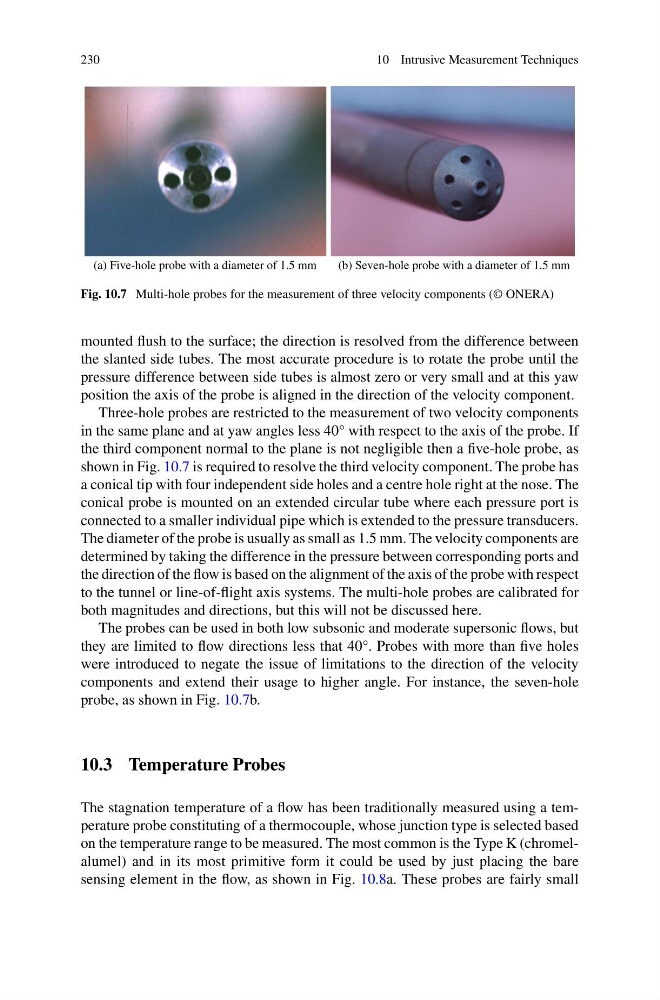
(a) Five-hole probe with a diameter of 1.5 mm
(b) Seven-hole probe with a diameter of 1.5 mm
Fig. 10.7 Multi-hole probes for the measurement of three velocity components (© ONERA)
mounted flush to the surface; the direction is resolved from the difference between
the slanted side tubes. The most accurate procedure is to rotate the probe until the
pressure difference between side tubes is almost zero or very small and at this yaw
position the axis of the probe is aligned in the direction of the velocity component.
Three-hole probes are restricted to the measurement of two velocity components
in the same plane and at yaw angles less 40° with respect to the axis of the probe. If
the third component normal to the plane is not negligible then a five-hole probe, as
shown in Fig. 10.7 is required to resolve the third velocity component. The probe has
a conical tip with four independent side holes and a centre hole right at the nose. The
conical probe is mounted on an extended circular tube where each pressure port is
connected to a smaller individual pipe which is extended to the pressure transducers.
The diameter of the probe is usually as small as 1.5 mm. The velocity components are
determined by taking the difference in the pressure between corresponding ports and
the direction of the flow is based on the alignment of the axis of the probe with respect
to the tunnel or line-of-flight axis systems. The multi-hole probes are calibrated for
both magnitudes and directions, but this will not be discussed here.
The probes can be used in both low subsonic and moderate supersonic flows, but
they are limited to flow directions less that 40°. Probes with more than five holes
were introduced to negate the issue of limitations to the direction of the velocity
components and extend their usage to higher angle. For instance, the seven-hole
probe, as shown in Fig. 10.7b.
10.3 Temperature Probes
The stagnation temperature of a flow has been traditionally measured using a temperature probe constituting of a thermocouple, whose junction type is selected based
on the temperature range to be measured. The most common is the Type K (chromelalumel) and in its most primitive form it could be used by just placing the bare
sensing element in the flow, as shown in Fig. 10.8a. These probes are fairly small
10 Intrusive Measurement Techniques
(a) Five-hole probe with a diameter of 1.5 mm
(b) Seven-hole probe with a diameter of 1.5 mm
Fig. 10.7 Multi-hole probes for the measurement of three velocity components (© ONERA)
mounted flush to the surface; the direction is resolved from the difference between
the slanted side tubes. The most accurate procedure is to rotate the probe until the
pressure difference between side tubes is almost zero or very small and at this yaw
position the axis of the probe is aligned in the direction of the velocity component.
Three-hole probes are restricted to the measurement of two velocity components
in the same plane and at yaw angles less 40° with respect to the axis of the probe. If
the third component normal to the plane is not negligible then a five-hole probe, as
shown in Fig. 10.7 is required to resolve the third velocity component. The probe has
a conical tip with four independent side holes and a centre hole right at the nose. The
conical probe is mounted on an extended circular tube where each pressure port is
connected to a smaller individual pipe which is extended to the pressure transducers.
The diameter of the probe is usually as small as 1.5 mm. The velocity components are
determined by taking the difference in the pressure between corresponding ports and
the direction of the flow is based on the alignment of the axis of the probe with respect
to the tunnel or line-of-flight axis systems. The multi-hole probes are calibrated for
both magnitudes and directions, but this will not be discussed here.
The probes can be used in both low subsonic and moderate supersonic flows, but
they are limited to flow directions less that 40°. Probes with more than five holes
were introduced to negate the issue of limitations to the direction of the velocity
components and extend their usage to higher angle. For instance, the seven-hole
probe, as shown in Fig. 10.7b.
10.3 Temperature Probes
The stagnation temperature of a flow has been traditionally measured using a temperature probe constituting of a thermocouple, whose junction type is selected based
on the temperature range to be measured. The most common is the Type K (chromelalumel) and in its most primitive form it could be used by just placing the bare
sensing element in the flow, as shown in Fig. 10.8a. These probes are fairly small