

10.2 Pressure Probes
229
10.2.3 Multi-holes Probe to Resolve the Direction
of the Velocity Vector
Pressure probes are also used to resolve velocity vectors in three-dimensional flows.
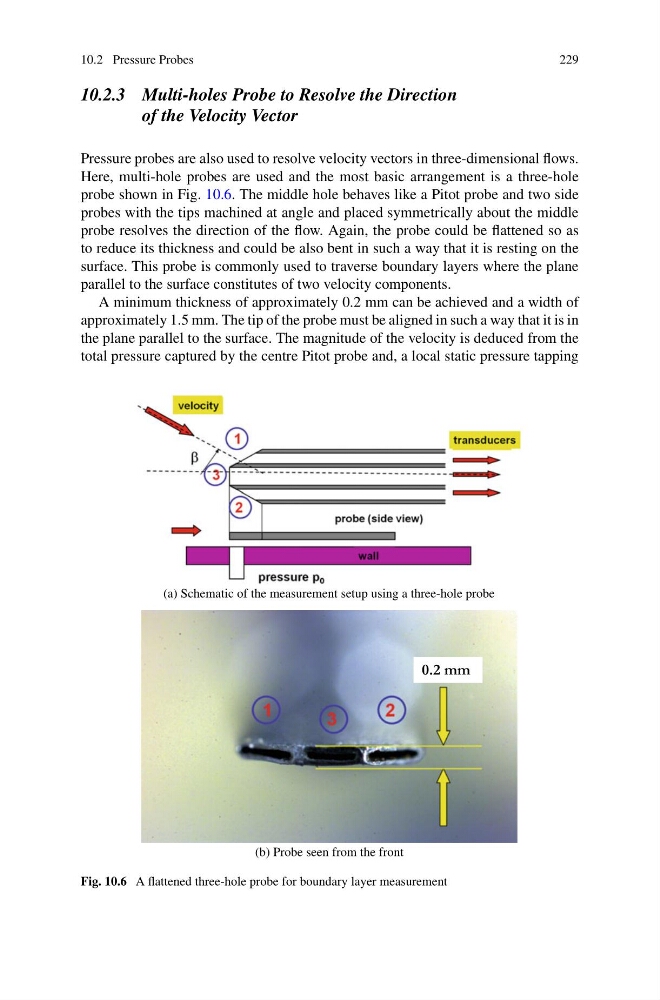
Here, multi-hole probes are used and the most basic arrangement is a three-hole
probe shown in Fig. 10.6. The middle hole behaves like a Pitot probe and two side
probes with the tips machined at angle and placed symmetrically about the middle
probe resolves the direction of the flow. Again, the probe could be flattened so as
to reduce its thickness and could be also bent in such a way that it is resting on the
surface. This probe is commonly used to traverse boundary layers where the plane
parallel to the surface constitutes of two velocity components.
A minimum thickness of approximately 0.2 mm can be achieved and a width of
approximately 1.5 mm. The tip of the probe must be aligned in such a way that it is in
the plane parallel to the surface. The magnitude of the velocity is deduced from the
total pressure captured by the centre Pitot probe and, a local static pressure tapping
(a) Schematic of the measurement setup using a three-hole probe
(b) Probe seen from the front
Fig. 10.6 A flattened three-hole probe for boundary layer measurement
229
10.2.3 Multi-holes Probe to Resolve the Direction
of the Velocity Vector
Pressure probes are also used to resolve velocity vectors in three-dimensional flows.
Here, multi-hole probes are used and the most basic arrangement is a three-hole
probe shown in Fig. 10.6. The middle hole behaves like a Pitot probe and two side
probes with the tips machined at angle and placed symmetrically about the middle
probe resolves the direction of the flow. Again, the probe could be flattened so as
to reduce its thickness and could be also bent in such a way that it is resting on the
surface. This probe is commonly used to traverse boundary layers where the plane
parallel to the surface constitutes of two velocity components.
A minimum thickness of approximately 0.2 mm can be achieved and a width of
approximately 1.5 mm. The tip of the probe must be aligned in such a way that it is in
the plane parallel to the surface. The magnitude of the velocity is deduced from the
total pressure captured by the centre Pitot probe and, a local static pressure tapping
(a) Schematic of the measurement setup using a three-hole probe
(b) Probe seen from the front
Fig. 10.6 A flattened three-hole probe for boundary layer measurement