

228
10 Intrusive Measurement Techniques
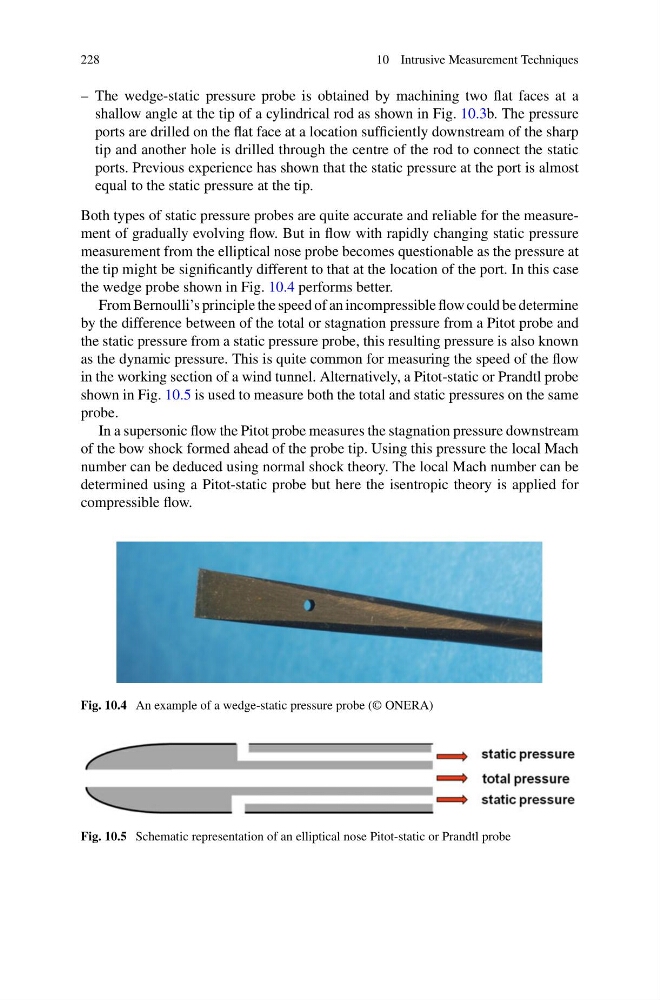
– The wedge-static pressure probe is obtained by machining two flat faces at a
shallow angle at the tip of a cylindrical rod as shown in Fig. 10.3b. The pressure
ports are drilled on the flat face at a location sufficiently downstream of the sharp
tip and another hole is drilled through the centre of the rod to connect the static
ports. Previous experience has shown that the static pressure at the port is almost
equal to the static pressure at the tip.
Both types of static pressure probes are quite accurate and reliable for the measurement of gradually evolving flow. But in flow with rapidly changing static pressure
measurement from the elliptical nose probe becomes questionable as the pressure at
the tip might be significantly different to that at the location of the port. In this case
the wedge probe shown in Fig. 10.4 performs better.
From Bernoulli’s principle the speed of an incompressible flow could be determine
by the difference between of the total or stagnation pressure from a Pitot probe and
the static pressure from a static pressure probe, this resulting pressure is also known
as the dynamic pressure. This is quite common for measuring the speed of the flow
in the working section of a wind tunnel. Alternatively, a Pitot-static or Prandtl probe
shown in Fig. 10.5 is used to measure both the total and static pressures on the same
probe.
In a supersonic flow the Pitot probe measures the stagnation pressure downstream
of the bow shock formed ahead of the probe tip. Using this pressure the local Mach
number can be deduced using normal shock theory. The local Mach number can be
determined using a Pitot-static probe but here the isentropic theory is applied for
compressible flow.
Fig. 10.4 An example of a wedge-static pressure probe (© ONERA)
Fig. 10.5 Schematic representation of an elliptical nose Pitot-static or Prandtl probe
10 Intrusive Measurement Techniques
– The wedge-static pressure probe is obtained by machining two flat faces at a
shallow angle at the tip of a cylindrical rod as shown in Fig. 10.3b. The pressure
ports are drilled on the flat face at a location sufficiently downstream of the sharp
tip and another hole is drilled through the centre of the rod to connect the static
ports. Previous experience has shown that the static pressure at the port is almost
equal to the static pressure at the tip.
Both types of static pressure probes are quite accurate and reliable for the measurement of gradually evolving flow. But in flow with rapidly changing static pressure
measurement from the elliptical nose probe becomes questionable as the pressure at
the tip might be significantly different to that at the location of the port. In this case
the wedge probe shown in Fig. 10.4 performs better.
From Bernoulli’s principle the speed of an incompressible flow could be determine
by the difference between of the total or stagnation pressure from a Pitot probe and
the static pressure from a static pressure probe, this resulting pressure is also known
as the dynamic pressure. This is quite common for measuring the speed of the flow
in the working section of a wind tunnel. Alternatively, a Pitot-static or Prandtl probe
shown in Fig. 10.5 is used to measure both the total and static pressures on the same
probe.
In a supersonic flow the Pitot probe measures the stagnation pressure downstream
of the bow shock formed ahead of the probe tip. Using this pressure the local Mach
number can be deduced using normal shock theory. The local Mach number can be
determined using a Pitot-static probe but here the isentropic theory is applied for
compressible flow.
Fig. 10.4 An example of a wedge-static pressure probe (© ONERA)
Fig. 10.5 Schematic representation of an elliptical nose Pitot-static or Prandtl probe