

9.4 Skin Friction Measurement
217
Skin friction can be also determined from boundary layer probing by fitting the
measured profile to other available theoretical laws, such as Coles’ law. The method
consists in iterating on the guessed values shear stress until the best overall agreement between the theoretical and measured profiles is obtained. If the point-to-point
adjustment of the velocity distribution is too delicate, it could be based on the shape
parameters adjustments. This second method is interesting if the probes cannot be
positioned close enough to the wall to obtain a good definition of the logarithmic
part of the profile. It also applies to boundary layers subjected to pressure gradients.
9.5 Measurement of the Wall Heat Transfer
9.5.1 Calorimetric Techniques
The local convective heat transfer between the flow and the model is most often
determined using calorimetric techniques consisting of the measurement of the rate
of change of the local temperature of the surface or of a sensing element (transducer)
inserted into the surface. An inverse solution to the equation governing the thermal
conduction through the wall of the model (or transducer) gives the heat transferred to
the surface by the flow (energy per unit time and per unit area). In practice simplified
forms of the heat equation are used by considering extreme situations leading to
simple analytical solutions. If the heat flow can be assumed to be one-dimensional
and if the wall is considered semi-infinite in thickness (so-called thick wall technique)
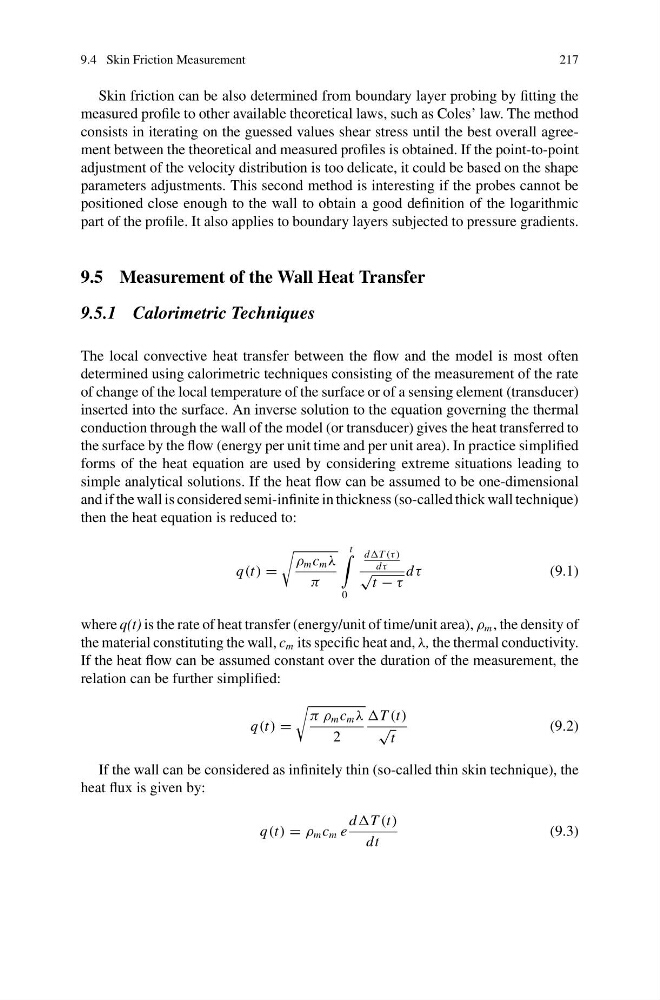
then the heat equation is reduced to:
q(t) =
ρ m c m λ
π
t
0
dT (τ )
dτ
√
t − τ
dτ
(9.1)
where q(t) is the rate of heat transfer (energy/unit of time/unit area), ρ m , the density of
the material constituting the wall, c m its specific heat and, λ, the thermal conductivity.
If the heat flow can be assumed constant over the duration of the measurement, the
relation can be further simplified:
q(t) =
π ρ m c m λ
2
T (t)
√
t
(9.2)
If the wall can be considered as infinitely thin (so-called thin skin technique), the
heat flux is given by:
q(t) = ρ m c m e
dT (t)
dt
(9.3)
217
Skin friction can be also determined from boundary layer probing by fitting the
measured profile to other available theoretical laws, such as Coles’ law. The method
consists in iterating on the guessed values shear stress until the best overall agreement between the theoretical and measured profiles is obtained. If the point-to-point
adjustment of the velocity distribution is too delicate, it could be based on the shape
parameters adjustments. This second method is interesting if the probes cannot be
positioned close enough to the wall to obtain a good definition of the logarithmic
part of the profile. It also applies to boundary layers subjected to pressure gradients.
9.5 Measurement of the Wall Heat Transfer
9.5.1 Calorimetric Techniques
The local convective heat transfer between the flow and the model is most often
determined using calorimetric techniques consisting of the measurement of the rate
of change of the local temperature of the surface or of a sensing element (transducer)
inserted into the surface. An inverse solution to the equation governing the thermal
conduction through the wall of the model (or transducer) gives the heat transferred to
the surface by the flow (energy per unit time and per unit area). In practice simplified
forms of the heat equation are used by considering extreme situations leading to
simple analytical solutions. If the heat flow can be assumed to be one-dimensional
and if the wall is considered semi-infinite in thickness (so-called thick wall technique)
then the heat equation is reduced to:
q(t) =
ρ m c m λ
π
t
0
dT (τ )
dτ
√
t − τ
dτ
(9.1)
where q(t) is the rate of heat transfer (energy/unit of time/unit area), ρ m , the density of
the material constituting the wall, c m its specific heat and, λ, the thermal conductivity.
If the heat flow can be assumed constant over the duration of the measurement, the
relation can be further simplified:
q(t) =
π ρ m c m λ
2
T (t)
√
t
(9.2)
If the wall can be considered as infinitely thin (so-called thin skin technique), the
heat flux is given by:
q(t) = ρ m c m e
dT (t)
dt
(9.3)