

218
9 Characterisation of Flow Properties at the Surface
where e is the wall thickness. Here, the wall of the model must have a thickness of
a few tenths of a millimetre, which prohibits its extension on models with complex
shape.
Given the properties of the material constituting the wall, the heat flux is calculated
by the Eqs. (9.1), (9.2) or (9.3) from a time recording of the wall temperature. The
above methods require the rapid establishment of the flow so that the heat flux is
applied almost instantaneously. This condition is achieved either by working in a
fast-starting wind tunnel (blow down type), or by inserting the model into the flow
after the nominal conditions have been established.
The simplifying assumptions underlying the formulae above are not always verified: the local curvature of the wall can be pronounced, the transient nature of
thermal transfer, the multi-directional conduction (the lateral conduction), the wall
material properties may vary with temperature and the wall thickness variation. In
these circumstances, correction terms must be added and a more rigorous processing
technique consisting of solving the heat equation by a numerical method is to be
employed.
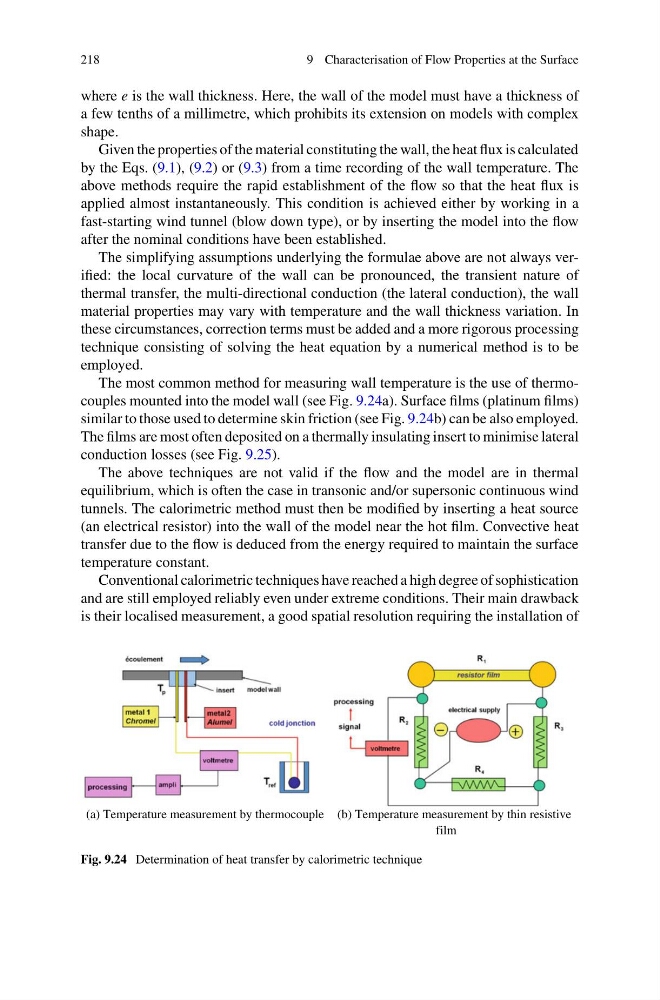
The most common method for measuring wall temperature is the use of thermocouples mounted into the model wall (see Fig. 9.24a). Surface films (platinum films)
similar to those used to determine skin friction (see Fig. 9.24b) can be also employed.
The films are most often deposited on a thermally insulating insert to minimise lateral
conduction losses (see Fig. 9.25).
The above techniques are not valid if the flow and the model are in thermal
equilibrium, which is often the case in transonic and/or supersonic continuous wind
tunnels. The calorimetric method must then be modified by inserting a heat source
(an electrical resistor) into the wall of the model near the hot film. Convective heat
transfer due to the flow is deduced from the energy required to maintain the surface
temperature constant.
Conventional calorimetric techniques have reached a high degree of sophistication
and are still employed reliably even under extreme conditions. Their main drawback
is their localised measurement, a good spatial resolution requiring the installation of
(a) Temperature measurement by thermocouple (b) Temperature measurement by thin resistive
film
Fig. 9.24 Determination of heat transfer by calorimetric technique
9 Characterisation of Flow Properties at the Surface
where e is the wall thickness. Here, the wall of the model must have a thickness of
a few tenths of a millimetre, which prohibits its extension on models with complex
shape.
Given the properties of the material constituting the wall, the heat flux is calculated
by the Eqs. (9.1), (9.2) or (9.3) from a time recording of the wall temperature. The
above methods require the rapid establishment of the flow so that the heat flux is
applied almost instantaneously. This condition is achieved either by working in a
fast-starting wind tunnel (blow down type), or by inserting the model into the flow
after the nominal conditions have been established.
The simplifying assumptions underlying the formulae above are not always verified: the local curvature of the wall can be pronounced, the transient nature of
thermal transfer, the multi-directional conduction (the lateral conduction), the wall
material properties may vary with temperature and the wall thickness variation. In
these circumstances, correction terms must be added and a more rigorous processing
technique consisting of solving the heat equation by a numerical method is to be
employed.
The most common method for measuring wall temperature is the use of thermocouples mounted into the model wall (see Fig. 9.24a). Surface films (platinum films)
similar to those used to determine skin friction (see Fig. 9.24b) can be also employed.
The films are most often deposited on a thermally insulating insert to minimise lateral
conduction losses (see Fig. 9.25).
The above techniques are not valid if the flow and the model are in thermal
equilibrium, which is often the case in transonic and/or supersonic continuous wind
tunnels. The calorimetric method must then be modified by inserting a heat source
(an electrical resistor) into the wall of the model near the hot film. Convective heat
transfer due to the flow is deduced from the energy required to maintain the surface
temperature constant.
Conventional calorimetric techniques have reached a high degree of sophistication
and are still employed reliably even under extreme conditions. Their main drawback
is their localised measurement, a good spatial resolution requiring the installation of
(a) Temperature measurement by thermocouple (b) Temperature measurement by thin resistive
film
Fig. 9.24 Determination of heat transfer by calorimetric technique