

216
9 Characterisation of Flow Properties at the Surface
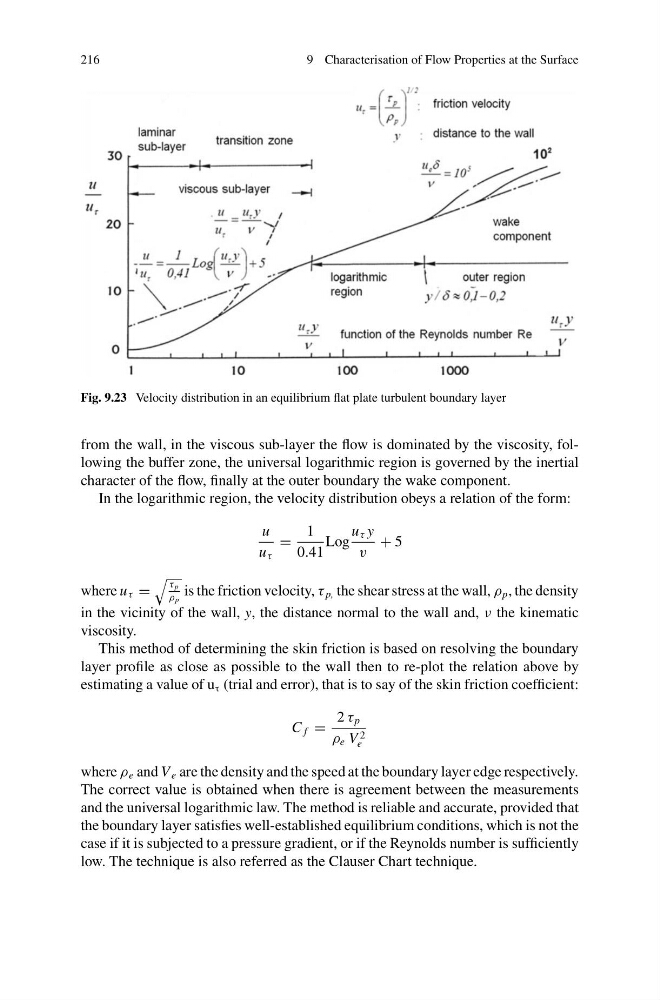
Fig. 9.23 Velocity distribution in an equilibrium flat plate turbulent boundary layer
from the wall, in the viscous sub-layer the flow is dominated by the viscosity, following the buffer zone, the universal logarithmic region is governed by the inertial
character of the flow, finally at the outer boundary the wake component.
In the logarithmic region, the velocity distribution obeys a relation of the form:
u
u τ
=
1
0.41
Log
u τ y
v
+ 5
where u τ =
τ p
ρ p
is the friction velocity, τ p, the shear stress at the wall, ρ p , the density
in the vicinity of the wall, y, the distance normal to the wall and, ν the kinematic
viscosity.
This method of determining the skin friction is based on resolving the boundary
layer profile as close as possible to the wall then to re-plot the relation above by
estimating a value of u τ (trial and error), that is to say of the skin friction coefficient:
C f =
2 τ p
ρ e V 2
e
where ρ e and V e are the density and the speed at the boundary layer edge respectively.
The correct value is obtained when there is agreement between the measurements
and the universal logarithmic law. The method is reliable and accurate, provided that
the boundary layer satisfies well-established equilibrium conditions, which is not the
case if it is subjected to a pressure gradient, or if the Reynolds number is sufficiently
low. The technique is also referred as the Clauser Chart technique.
9 Characterisation of Flow Properties at the Surface
Fig. 9.23 Velocity distribution in an equilibrium flat plate turbulent boundary layer
from the wall, in the viscous sub-layer the flow is dominated by the viscosity, following the buffer zone, the universal logarithmic region is governed by the inertial
character of the flow, finally at the outer boundary the wake component.
In the logarithmic region, the velocity distribution obeys a relation of the form:
u
u τ
=
1
0.41
Log
u τ y
v
+ 5
where u τ =
τ p
ρ p
is the friction velocity, τ p, the shear stress at the wall, ρ p , the density
in the vicinity of the wall, y, the distance normal to the wall and, ν the kinematic
viscosity.
This method of determining the skin friction is based on resolving the boundary
layer profile as close as possible to the wall then to re-plot the relation above by
estimating a value of u τ (trial and error), that is to say of the skin friction coefficient:
C f =
2 τ p
ρ e V 2
e
where ρ e and V e are the density and the speed at the boundary layer edge respectively.
The correct value is obtained when there is agreement between the measurements
and the universal logarithmic law. The method is reliable and accurate, provided that
the boundary layer satisfies well-established equilibrium conditions, which is not the
case if it is subjected to a pressure gradient, or if the Reynolds number is sufficiently
low. The technique is also referred as the Clauser Chart technique.