

8.2 Aerodynamic Balances
191
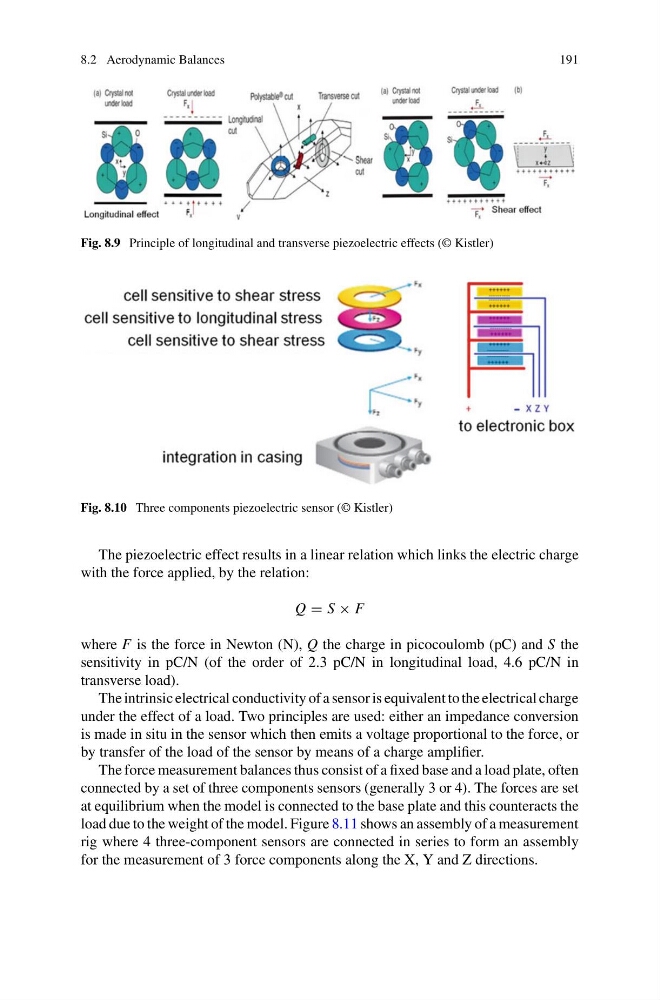
Fig. 8.9 Principle of longitudinal and transverse piezoelectric effects (© Kistler)
Fig. 8.10 Three components piezoelectric sensor (© Kistler)
The piezoelectric effect results in a linear relation which links the electric charge
with the force applied, by the relation:
Q = S × F
where F is the force in Newton (N), Q the charge in picocoulomb (pC) and S the
sensitivity in pC/N (of the order of 2.3 pC/N in longitudinal load, 4.6 pC/N in
transverse load).
The intrinsic electrical conductivity of a sensor is equivalent to the electrical charge
under the effect of a load. Two principles are used: either an impedance conversion
is made in situ in the sensor which then emits a voltage proportional to the force, or
by transfer of the load of the sensor by means of a charge amplifier.
The force measurement balances thus consist of a fixed base and a load plate, often
connected by a set of three components sensors (generally 3 or 4). The forces are set
at equilibrium when the model is connected to the base plate and this counteracts the
load due to the weight of the model. Figure 8.11 shows an assembly of a measurement
rig where 4 three-component sensors are connected in series to form an assembly
for the measurement of 3 force components along the X, Y and Z directions.
191
Fig. 8.9 Principle of longitudinal and transverse piezoelectric effects (© Kistler)
Fig. 8.10 Three components piezoelectric sensor (© Kistler)
The piezoelectric effect results in a linear relation which links the electric charge
with the force applied, by the relation:
Q = S × F
where F is the force in Newton (N), Q the charge in picocoulomb (pC) and S the
sensitivity in pC/N (of the order of 2.3 pC/N in longitudinal load, 4.6 pC/N in
transverse load).
The intrinsic electrical conductivity of a sensor is equivalent to the electrical charge
under the effect of a load. Two principles are used: either an impedance conversion
is made in situ in the sensor which then emits a voltage proportional to the force, or
by transfer of the load of the sensor by means of a charge amplifier.
The force measurement balances thus consist of a fixed base and a load plate, often
connected by a set of three components sensors (generally 3 or 4). The forces are set
at equilibrium when the model is connected to the base plate and this counteracts the
load due to the weight of the model. Figure 8.11 shows an assembly of a measurement
rig where 4 three-component sensors are connected in series to form an assembly
for the measurement of 3 force components along the X, Y and Z directions.