

190
8 Measurement of Aerodynamic Forces and Moments
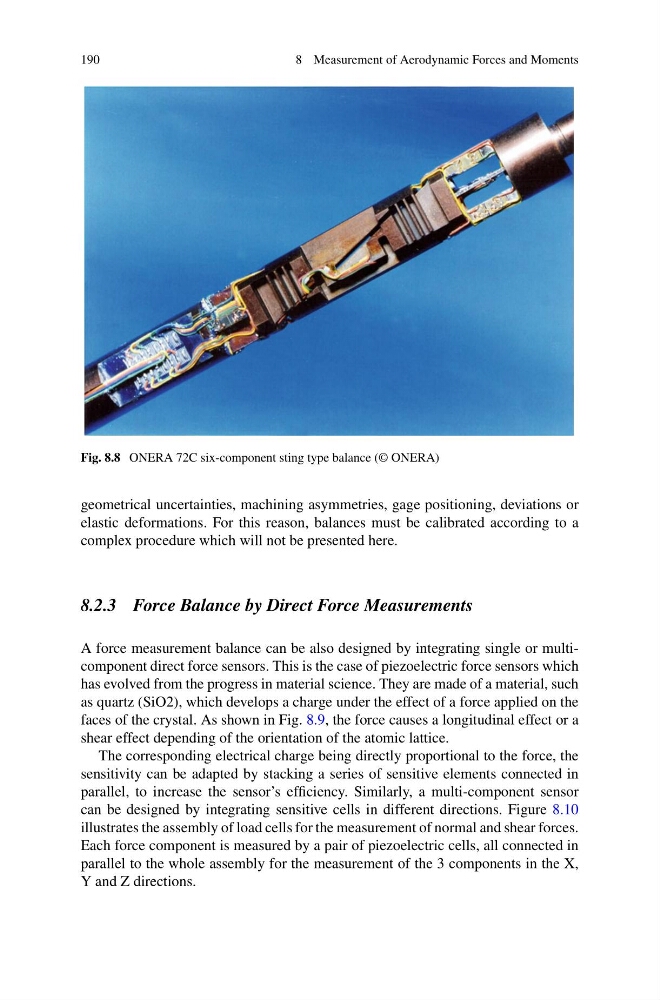
Fig. 8.8 ONERA 72C six-component sting type balance (© ONERA)
geometrical uncertainties, machining asymmetries, gage positioning, deviations or
elastic deformations. For this reason, balances must be calibrated according to a
complex procedure which will not be presented here.
8.2.3 Force Balance by Direct Force Measurements
A force measurement balance can be also designed by integrating single or multicomponent direct force sensors. This is the case of piezoelectric force sensors which
has evolved from the progress in material science. They are made of a material, such
as quartz (SiO2), which develops a charge under the effect of a force applied on the
faces of the crystal. As shown in Fig. 8.9, the force causes a longitudinal effect or a
shear effect depending of the orientation of the atomic lattice.
The corresponding electrical charge being directly proportional to the force, the
sensitivity can be adapted by stacking a series of sensitive elements connected in
parallel, to increase the sensor’s efficiency. Similarly, a multi-component sensor
can be designed by integrating sensitive cells in different directions. Figure 8.10
illustrates the assembly of load cells for the measurement of normal and shear forces.
Each force component is measured by a pair of piezoelectric cells, all connected in
parallel to the whole assembly for the measurement of the 3 components in the X,
Y and Z directions.
8 Measurement of Aerodynamic Forces and Moments
Fig. 8.8 ONERA 72C six-component sting type balance (© ONERA)
geometrical uncertainties, machining asymmetries, gage positioning, deviations or
elastic deformations. For this reason, balances must be calibrated according to a
complex procedure which will not be presented here.
8.2.3 Force Balance by Direct Force Measurements
A force measurement balance can be also designed by integrating single or multicomponent direct force sensors. This is the case of piezoelectric force sensors which
has evolved from the progress in material science. They are made of a material, such
as quartz (SiO2), which develops a charge under the effect of a force applied on the
faces of the crystal. As shown in Fig. 8.9, the force causes a longitudinal effect or a
shear effect depending of the orientation of the atomic lattice.
The corresponding electrical charge being directly proportional to the force, the
sensitivity can be adapted by stacking a series of sensitive elements connected in
parallel, to increase the sensor’s efficiency. Similarly, a multi-component sensor
can be designed by integrating sensitive cells in different directions. Figure 8.10
illustrates the assembly of load cells for the measurement of normal and shear forces.
Each force component is measured by a pair of piezoelectric cells, all connected in
parallel to the whole assembly for the measurement of the 3 components in the X,
Y and Z directions.