

7.5 Visualisation by Optical Imaging
177
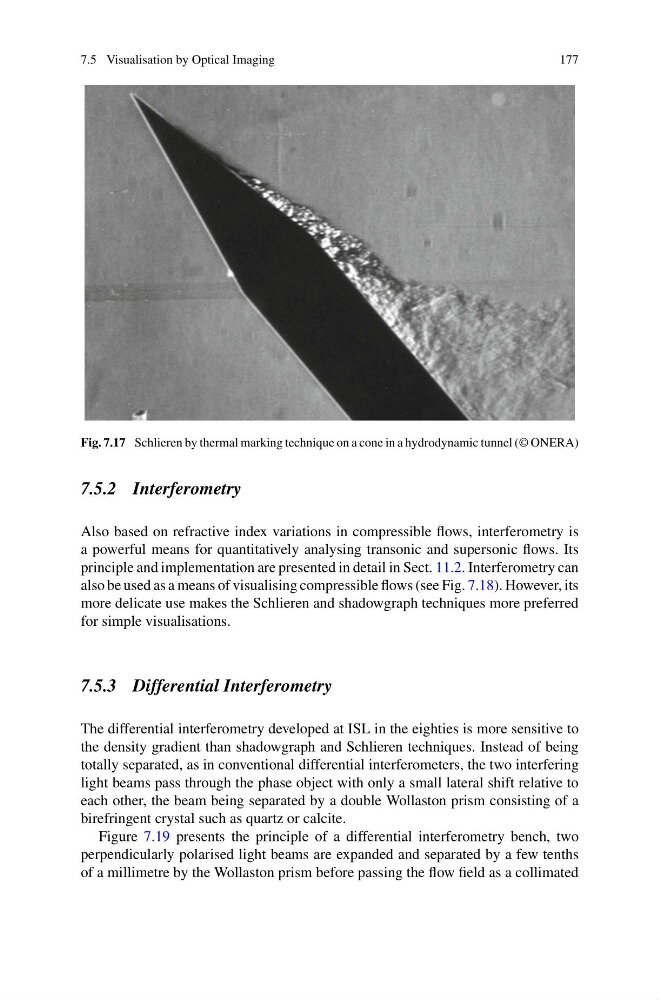
Fig. 7.17 Schlieren by thermal marking technique on a cone in a hydrodynamic tunnel (© ONERA)
7.5.2 Interferometry
Also based on refractive index variations in compressible flows, interferometry is
a powerful means for quantitatively analysing transonic and supersonic flows. Its
principle and implementation are presented in detail in Sect. 11.2. Interferometry can
also be used as a means of visualising compressible flows (see Fig. 7.18). However, its
more delicate use makes the Schlieren and shadowgraph techniques more preferred
for simple visualisations.
7.5.3 Differential Interferometry
The differential interferometry developed at ISL in the eighties is more sensitive to
the density gradient than shadowgraph and Schlieren techniques. Instead of being
totally separated, as in conventional differential interferometers, the two interfering
light beams pass through the phase object with only a small lateral shift relative to
each other, the beam being separated by a double Wollaston prism consisting of a
birefringent crystal such as quartz or calcite.
Figure 7.19 presents the principle of a differential interferometry bench, two
perpendicularly polarised light beams are expanded and separated by a few tenths
of a millimetre by the Wollaston prism before passing the flow field as a collimated
177
Fig. 7.17 Schlieren by thermal marking technique on a cone in a hydrodynamic tunnel (© ONERA)
7.5.2 Interferometry
Also based on refractive index variations in compressible flows, interferometry is
a powerful means for quantitatively analysing transonic and supersonic flows. Its
principle and implementation are presented in detail in Sect. 11.2. Interferometry can
also be used as a means of visualising compressible flows (see Fig. 7.18). However, its
more delicate use makes the Schlieren and shadowgraph techniques more preferred
for simple visualisations.
7.5.3 Differential Interferometry
The differential interferometry developed at ISL in the eighties is more sensitive to
the density gradient than shadowgraph and Schlieren techniques. Instead of being
totally separated, as in conventional differential interferometers, the two interfering
light beams pass through the phase object with only a small lateral shift relative to
each other, the beam being separated by a double Wollaston prism consisting of a
birefringent crystal such as quartz or calcite.
Figure 7.19 presents the principle of a differential interferometry bench, two
perpendicularly polarised light beams are expanded and separated by a few tenths
of a millimetre by the Wollaston prism before passing the flow field as a collimated