

176
7 Flow Visualisation Techniques
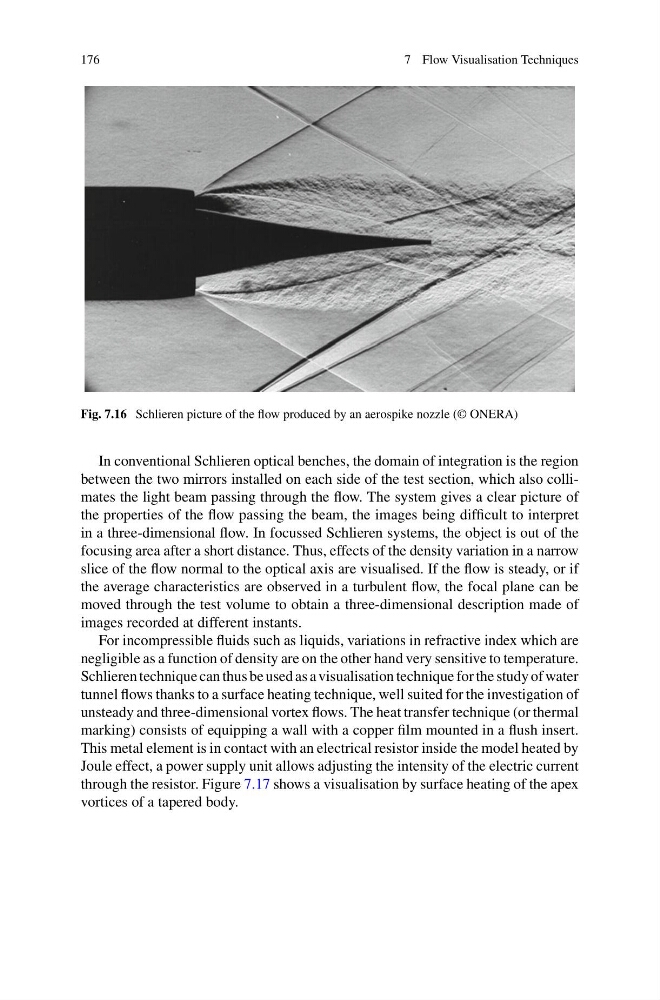
Fig. 7.16 Schlieren picture of the flow produced by an aerospike nozzle (© ONERA)
In conventional Schlieren optical benches, the domain of integration is the region
between the two mirrors installed on each side of the test section, which also collimates the light beam passing through the flow. The system gives a clear picture of
the properties of the flow passing the beam, the images being difficult to interpret
in a three-dimensional flow. In focussed Schlieren systems, the object is out of the
focusing area after a short distance. Thus, effects of the density variation in a narrow
slice of the flow normal to the optical axis are visualised. If the flow is steady, or if
the average characteristics are observed in a turbulent flow, the focal plane can be
moved through the test volume to obtain a three-dimensional description made of
images recorded at different instants.
For incompressible fluids such as liquids, variations in refractive index which are
negligible as a function of density are on the other hand very sensitive to temperature.
Schlieren technique can thus be used as a visualisation technique for the study of water
tunnel flows thanks to a surface heating technique, well suited for the investigation of
unsteady and three-dimensional vortex flows. The heat transfer technique (or thermal
marking) consists of equipping a wall with a copper film mounted in a flush insert.
This metal element is in contact with an electrical resistor inside the model heated by
Joule effect, a power supply unit allows adjusting the intensity of the electric current
through the resistor. Figure 7.17 shows a visualisation by surface heating of the apex
vortices of a tapered body.
7 Flow Visualisation Techniques
Fig. 7.16 Schlieren picture of the flow produced by an aerospike nozzle (© ONERA)
In conventional Schlieren optical benches, the domain of integration is the region
between the two mirrors installed on each side of the test section, which also collimates the light beam passing through the flow. The system gives a clear picture of
the properties of the flow passing the beam, the images being difficult to interpret
in a three-dimensional flow. In focussed Schlieren systems, the object is out of the
focusing area after a short distance. Thus, effects of the density variation in a narrow
slice of the flow normal to the optical axis are visualised. If the flow is steady, or if
the average characteristics are observed in a turbulent flow, the focal plane can be
moved through the test volume to obtain a three-dimensional description made of
images recorded at different instants.
For incompressible fluids such as liquids, variations in refractive index which are
negligible as a function of density are on the other hand very sensitive to temperature.
Schlieren technique can thus be used as a visualisation technique for the study of water
tunnel flows thanks to a surface heating technique, well suited for the investigation of
unsteady and three-dimensional vortex flows. The heat transfer technique (or thermal
marking) consists of equipping a wall with a copper film mounted in a flush insert.
This metal element is in contact with an electrical resistor inside the model heated by
Joule effect, a power supply unit allows adjusting the intensity of the electric current
through the resistor. Figure 7.17 shows a visualisation by surface heating of the apex
vortices of a tapered body.