

168
7 Flow Visualisation Techniques
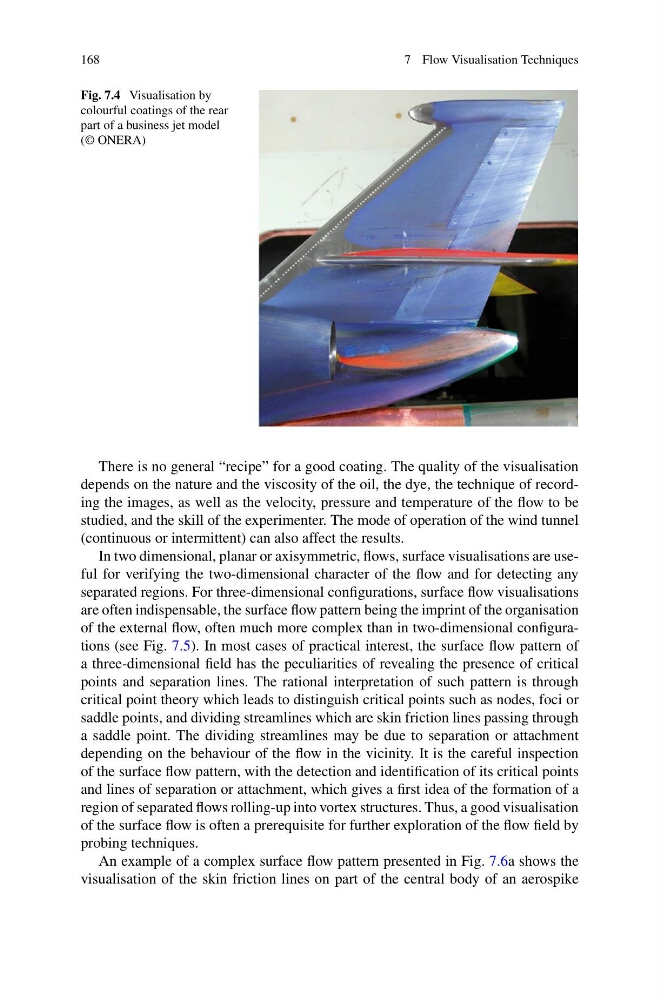
Fig. 7.4 Visualisation by
colourful coatings of the rear
part of a business jet model
(© ONERA)
There is no general “recipe” for a good coating. The quality of the visualisation
depends on the nature and the viscosity of the oil, the dye, the technique of recording the images, as well as the velocity, pressure and temperature of the flow to be
studied, and the skill of the experimenter. The mode of operation of the wind tunnel
(continuous or intermittent) can also affect the results.
In two dimensional, planar or axisymmetric, flows, surface visualisations are useful for verifying the two-dimensional character of the flow and for detecting any
separated regions. For three-dimensional configurations, surface flow visualisations
are often indispensable, the surface flow pattern being the imprint of the organisation
of the external flow, often much more complex than in two-dimensional configurations (see Fig. 7.5). In most cases of practical interest, the surface flow pattern of
a three-dimensional field has the peculiarities of revealing the presence of critical
points and separation lines. The rational interpretation of such pattern is through
critical point theory which leads to distinguish critical points such as nodes, foci or
saddle points, and dividing streamlines which are skin friction lines passing through
a saddle point. The dividing streamlines may be due to separation or attachment
depending on the behaviour of the flow in the vicinity. It is the careful inspection
of the surface flow pattern, with the detection and identification of its critical points
and lines of separation or attachment, which gives a first idea of the formation of a
region of separated flows rolling-up into vortex structures. Thus, a good visualisation
of the surface flow is often a prerequisite for further exploration of the flow field by
probing techniques.
An example of a complex surface flow pattern presented in Fig. 7.6a shows the
visualisation of the skin friction lines on part of the central body of an aerospike
7 Flow Visualisation Techniques
Fig. 7.4 Visualisation by
colourful coatings of the rear
part of a business jet model
(© ONERA)
There is no general “recipe” for a good coating. The quality of the visualisation
depends on the nature and the viscosity of the oil, the dye, the technique of recording the images, as well as the velocity, pressure and temperature of the flow to be
studied, and the skill of the experimenter. The mode of operation of the wind tunnel
(continuous or intermittent) can also affect the results.
In two dimensional, planar or axisymmetric, flows, surface visualisations are useful for verifying the two-dimensional character of the flow and for detecting any
separated regions. For three-dimensional configurations, surface flow visualisations
are often indispensable, the surface flow pattern being the imprint of the organisation
of the external flow, often much more complex than in two-dimensional configurations (see Fig. 7.5). In most cases of practical interest, the surface flow pattern of
a three-dimensional field has the peculiarities of revealing the presence of critical
points and separation lines. The rational interpretation of such pattern is through
critical point theory which leads to distinguish critical points such as nodes, foci or
saddle points, and dividing streamlines which are skin friction lines passing through
a saddle point. The dividing streamlines may be due to separation or attachment
depending on the behaviour of the flow in the vicinity. It is the careful inspection
of the surface flow pattern, with the detection and identification of its critical points
and lines of separation or attachment, which gives a first idea of the formation of a
region of separated flows rolling-up into vortex structures. Thus, a good visualisation
of the surface flow is often a prerequisite for further exploration of the flow field by
probing techniques.
An example of a complex surface flow pattern presented in Fig. 7.6a shows the
visualisation of the skin friction lines on part of the central body of an aerospike