

7.2 Surface Flow Visualisations
169
(a) View from above
(b) Side view
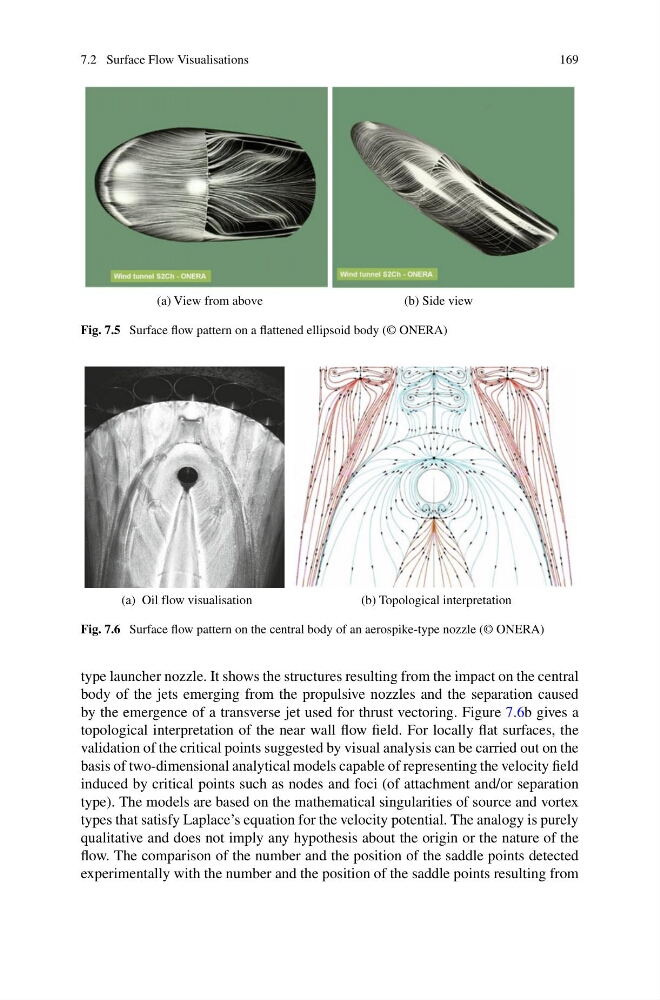
Fig. 7.5 Surface flow pattern on a flattened ellipsoid body (© ONERA)
(a) Oil flow visualisation
(b) Topological interpretation
Fig. 7.6 Surface flow pattern on the central body of an aerospike-type nozzle (© ONERA)
type launcher nozzle. It shows the structures resulting from the impact on the central
body of the jets emerging from the propulsive nozzles and the separation caused
by the emergence of a transverse jet used for thrust vectoring. Figure 7.6b gives a
topological interpretation of the near wall flow field. For locally flat surfaces, the
validation of the critical points suggested by visual analysis can be carried out on the
basis of two-dimensional analytical models capable of representing the velocity field
induced by critical points such as nodes and foci (of attachment and/or separation
type). The models are based on the mathematical singularities of source and vortex
types that satisfy Laplace’s equation for the velocity potential. The analogy is purely
qualitative and does not imply any hypothesis about the origin or the nature of the
flow. The comparison of the number and the position of the saddle points detected
experimentally with the number and the position of the saddle points resulting from
169
(a) View from above
(b) Side view
Fig. 7.5 Surface flow pattern on a flattened ellipsoid body (© ONERA)
(a) Oil flow visualisation
(b) Topological interpretation
Fig. 7.6 Surface flow pattern on the central body of an aerospike-type nozzle (© ONERA)
type launcher nozzle. It shows the structures resulting from the impact on the central
body of the jets emerging from the propulsive nozzles and the separation caused
by the emergence of a transverse jet used for thrust vectoring. Figure 7.6b gives a
topological interpretation of the near wall flow field. For locally flat surfaces, the
validation of the critical points suggested by visual analysis can be carried out on the
basis of two-dimensional analytical models capable of representing the velocity field
induced by critical points such as nodes and foci (of attachment and/or separation
type). The models are based on the mathematical singularities of source and vortex
types that satisfy Laplace’s equation for the velocity potential. The analogy is purely
qualitative and does not imply any hypothesis about the origin or the nature of the
flow. The comparison of the number and the position of the saddle points detected
experimentally with the number and the position of the saddle points resulting from