

148
6 Hypersonic Wind Tunnels
tank. High pressure air, stored in the secondary tank, is used to accelerate the heavy
piston along the compression tube. During this compression and the quasi-adiabatic
heating of the light driver gas (helium or argon-helium mixture), the piston reaches
a maximum speed of 300 m/s, the temperature of the driver gas increasing with the
volumetric compression ratio. When the primary diaphragm bursts, a wave system
similar to that which occurs in a conventional shock tube is formed.
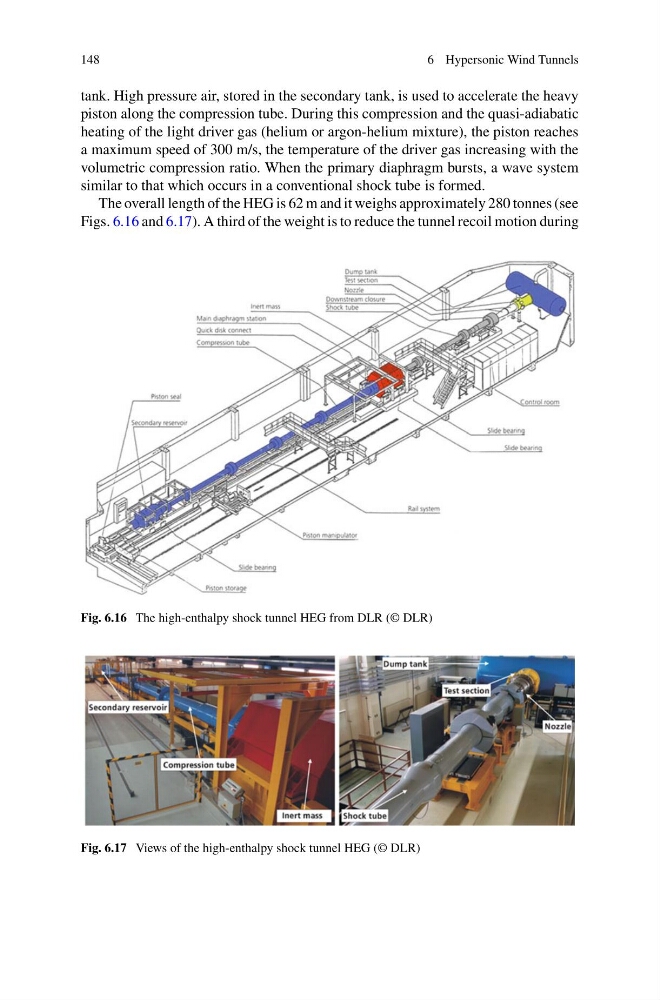
The overall length of the HEG is 62 m and it weighs approximately 280 tonnes (see
Figs. 6.16 and 6.17). A third of the weight is to reduce the tunnel recoil motion during
Fig. 6.16 The high-enthalpy shock tunnel HEG from DLR (© DLR)
Fig. 6.17 Views of the high-enthalpy shock tunnel HEG (© DLR)
6 Hypersonic Wind Tunnels
tank. High pressure air, stored in the secondary tank, is used to accelerate the heavy
piston along the compression tube. During this compression and the quasi-adiabatic
heating of the light driver gas (helium or argon-helium mixture), the piston reaches
a maximum speed of 300 m/s, the temperature of the driver gas increasing with the
volumetric compression ratio. When the primary diaphragm bursts, a wave system
similar to that which occurs in a conventional shock tube is formed.
The overall length of the HEG is 62 m and it weighs approximately 280 tonnes (see
Figs. 6.16 and 6.17). A third of the weight is to reduce the tunnel recoil motion during
Fig. 6.16 The high-enthalpy shock tunnel HEG from DLR (© DLR)
Fig. 6.17 Views of the high-enthalpy shock tunnel HEG (© DLR)