

6.3 Hypersonic “Hot” or Hyper-enthalpic Wind Tunnels
149
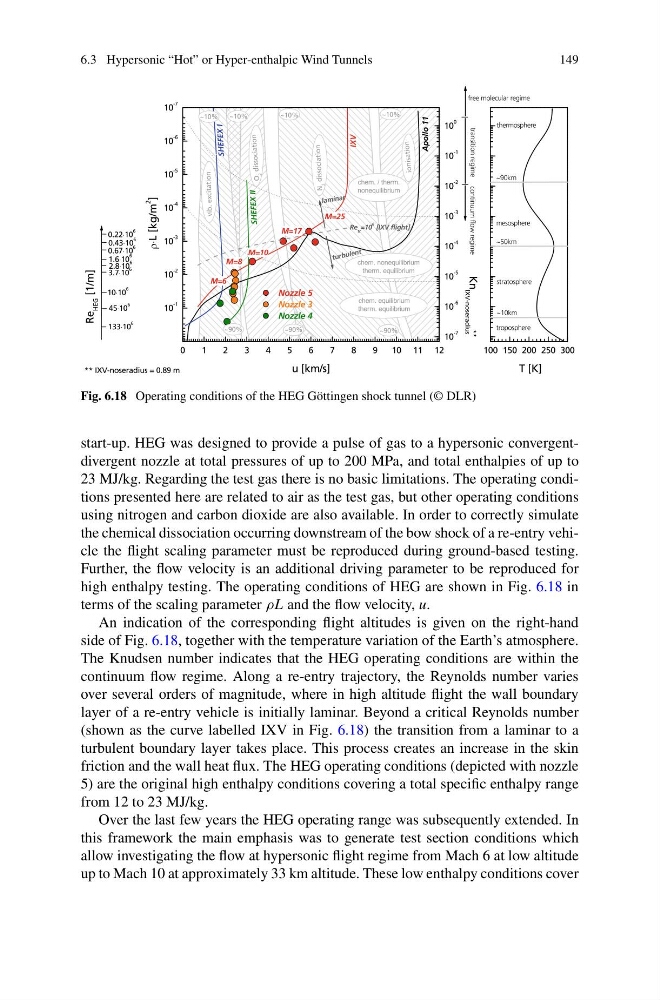
Fig. 6.18 Operating conditions of the HEG Göttingen shock tunnel (© DLR)
start-up. HEG was designed to provide a pulse of gas to a hypersonic convergentdivergent nozzle at total pressures of up to 200 MPa, and total enthalpies of up to
23 MJ/kg. Regarding the test gas there is no basic limitations. The operating conditions presented here are related to air as the test gas, but other operating conditions
using nitrogen and carbon dioxide are also available. In order to correctly simulate
the chemical dissociation occurring downstream of the bow shock of a re-entry vehicle the flight scaling parameter must be reproduced during ground-based testing.
Further, the flow velocity is an additional driving parameter to be reproduced for
high enthalpy testing. The operating conditions of HEG are shown in Fig. 6.18 in
terms of the scaling parameter ρL and the flow velocity, u.
An indication of the corresponding flight altitudes is given on the right-hand
side of Fig. 6.18, together with the temperature variation of the Earth’s atmosphere.
The Knudsen number indicates that the HEG operating conditions are within the
continuum flow regime. Along a re-entry trajectory, the Reynolds number varies
over several orders of magnitude, where in high altitude flight the wall boundary
layer of a re-entry vehicle is initially laminar. Beyond a critical Reynolds number
(shown as the curve labelled IXV in Fig. 6.18) the transition from a laminar to a
turbulent boundary layer takes place. This process creates an increase in the skin
friction and the wall heat flux. The HEG operating conditions (depicted with nozzle
5) are the original high enthalpy conditions covering a total specific enthalpy range
from 12 to 23 MJ/kg.
Over the last few years the HEG operating range was subsequently extended. In
this framework the main emphasis was to generate test section conditions which
allow investigating the flow at hypersonic flight regime from Mach 6 at low altitude
up to Mach 10 at approximately 33 km altitude. These low enthalpy conditions cover
149
Fig. 6.18 Operating conditions of the HEG Göttingen shock tunnel (© DLR)
start-up. HEG was designed to provide a pulse of gas to a hypersonic convergentdivergent nozzle at total pressures of up to 200 MPa, and total enthalpies of up to
23 MJ/kg. Regarding the test gas there is no basic limitations. The operating conditions presented here are related to air as the test gas, but other operating conditions
using nitrogen and carbon dioxide are also available. In order to correctly simulate
the chemical dissociation occurring downstream of the bow shock of a re-entry vehicle the flight scaling parameter must be reproduced during ground-based testing.
Further, the flow velocity is an additional driving parameter to be reproduced for
high enthalpy testing. The operating conditions of HEG are shown in Fig. 6.18 in
terms of the scaling parameter ρL and the flow velocity, u.
An indication of the corresponding flight altitudes is given on the right-hand
side of Fig. 6.18, together with the temperature variation of the Earth’s atmosphere.
The Knudsen number indicates that the HEG operating conditions are within the
continuum flow regime. Along a re-entry trajectory, the Reynolds number varies
over several orders of magnitude, where in high altitude flight the wall boundary
layer of a re-entry vehicle is initially laminar. Beyond a critical Reynolds number
(shown as the curve labelled IXV in Fig. 6.18) the transition from a laminar to a
turbulent boundary layer takes place. This process creates an increase in the skin
friction and the wall heat flux. The HEG operating conditions (depicted with nozzle
5) are the original high enthalpy conditions covering a total specific enthalpy range
from 12 to 23 MJ/kg.
Over the last few years the HEG operating range was subsequently extended. In
this framework the main emphasis was to generate test section conditions which
allow investigating the flow at hypersonic flight regime from Mach 6 at low altitude
up to Mach 10 at approximately 33 km altitude. These low enthalpy conditions cover