

6.3 Hypersonic “Hot” or Hyper-enthalpic Wind Tunnels
147
6.3.3 High Enthalpy Shock Tunnel
The High Enthalpy shock tunnel in Göttingen (HEG) is part of the German
Aerospace Centre (DLR) and one of the major European hypersonic test facilities.
It was commissioned in 1991 and has been utilised extensively since then in a large
number of national and international space and hypersonic flight projects. Originally,
the facility was designed for the investigation of the influence of high temperature
effects such as chemical and thermal relaxation on the external surface of re-entry
space vehicles. Over the last few years its range of operating conditions was subsequently extended. In this framework the main emphasis was to generate test section
conditions which allow investigating the flow past hypersonic flight configuration
from Mach 6 at low altitude up to Mach 10 at approximately 33 km altitude. The
studies performed in HEG focused on the external as well as internal aerodynamics
including combustion of hydrogen in complete supersonic combustion and the investigation of transition of the boundary layer from laminar to turbulent in hypersonic
flow while testing transition delay techniques.
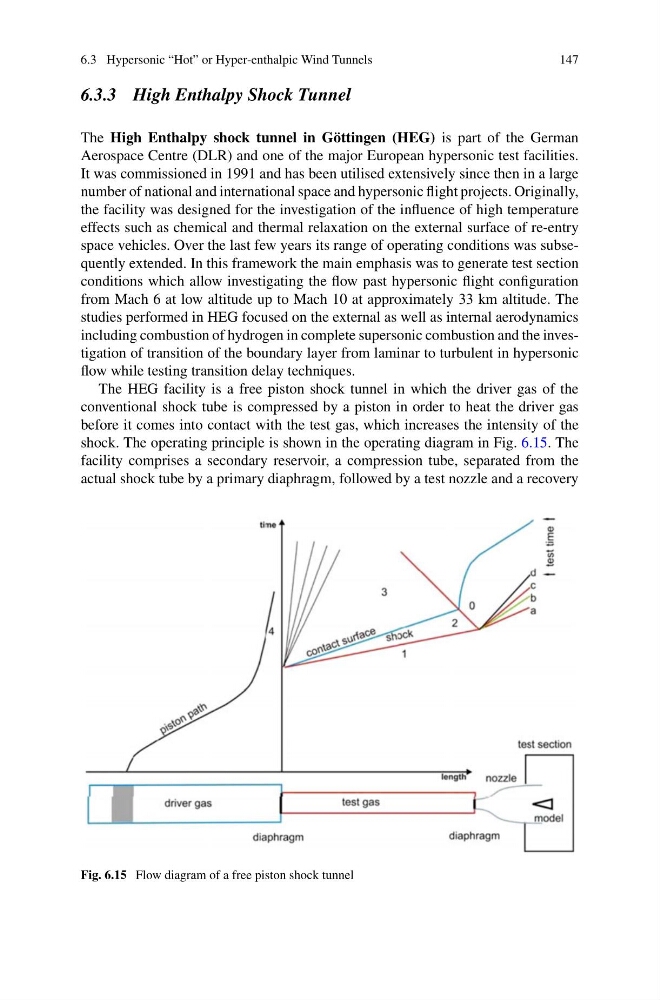
The HEG facility is a free piston shock tunnel in which the driver gas of the
conventional shock tube is compressed by a piston in order to heat the driver gas
before it comes into contact with the test gas, which increases the intensity of the
shock. The operating principle is shown in the operating diagram in Fig. 6.15. The
facility comprises a secondary reservoir, a compression tube, separated from the
actual shock tube by a primary diaphragm, followed by a test nozzle and a recovery
Fig. 6.15 Flow diagram of a free piston shock tunnel
147
6.3.3 High Enthalpy Shock Tunnel
The High Enthalpy shock tunnel in Göttingen (HEG) is part of the German
Aerospace Centre (DLR) and one of the major European hypersonic test facilities.
It was commissioned in 1991 and has been utilised extensively since then in a large
number of national and international space and hypersonic flight projects. Originally,
the facility was designed for the investigation of the influence of high temperature
effects such as chemical and thermal relaxation on the external surface of re-entry
space vehicles. Over the last few years its range of operating conditions was subsequently extended. In this framework the main emphasis was to generate test section
conditions which allow investigating the flow past hypersonic flight configuration
from Mach 6 at low altitude up to Mach 10 at approximately 33 km altitude. The
studies performed in HEG focused on the external as well as internal aerodynamics
including combustion of hydrogen in complete supersonic combustion and the investigation of transition of the boundary layer from laminar to turbulent in hypersonic
flow while testing transition delay techniques.
The HEG facility is a free piston shock tunnel in which the driver gas of the
conventional shock tube is compressed by a piston in order to heat the driver gas
before it comes into contact with the test gas, which increases the intensity of the
shock. The operating principle is shown in the operating diagram in Fig. 6.15. The
facility comprises a secondary reservoir, a compression tube, separated from the
actual shock tube by a primary diaphragm, followed by a test nozzle and a recovery
Fig. 6.15 Flow diagram of a free piston shock tunnel