

6.3 Hypersonic “Hot” or Hyper-enthalpic Wind Tunnels
143
6.3.2 Shock Tubes and Shock Tunnels
The shock tunnels are well adapted facilities for the study of objects under conditions
of hypersonic flight since conditions corresponding to the atmosphere of different
planets can be reproduced. In addition, the tests are performed at low cost compared
to those in wind tunnels equipped with a heater powerful enough to achieve the right
temperature in the flow. The shock tube and its variants, such as the shock tunnel, are
simpler means to achieve supersonic/hypersonic flow with high levels of pressure and
total enthalpy, while the energy spent to operate a shock tube being modest. In return,
the durations of a useful flow are very brief (from a few hundred microseconds to a
few milliseconds). The shock tube is also used to study the conditions of formation
of shock waves (detonation), the phenomena resulting from the propagation and
reflection of shocks and also for the analysis of rapid processes involved in chemical
kinetics or nuclear reactions.
A shock tube consists of a cylindrical tube of circular or square cross section,
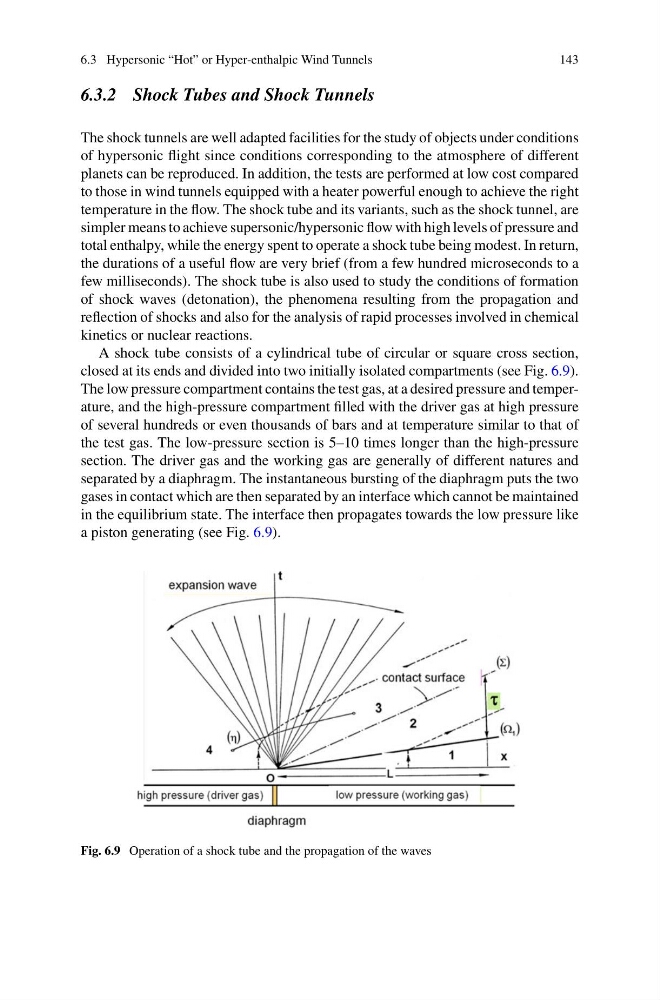
closed at its ends and divided into two initially isolated compartments (see Fig. 6.9).
The low pressure compartment contains the test gas, at a desired pressure and temperature, and the high-pressure compartment filled with the driver gas at high pressure
of several hundreds or even thousands of bars and at temperature similar to that of
the test gas. The low-pressure section is 5–10 times longer than the high-pressure
section. The driver gas and the working gas are generally of different natures and
separated by a diaphragm. The instantaneous bursting of the diaphragm puts the two
gases in contact which are then separated by an interface which cannot be maintained
in the equilibrium state. The interface then propagates towards the low pressure like
a piston generating (see Fig. 6.9).
Fig. 6.9 Operation of a shock tube and the propagation of the waves
143
6.3.2 Shock Tubes and Shock Tunnels
The shock tunnels are well adapted facilities for the study of objects under conditions
of hypersonic flight since conditions corresponding to the atmosphere of different
planets can be reproduced. In addition, the tests are performed at low cost compared
to those in wind tunnels equipped with a heater powerful enough to achieve the right
temperature in the flow. The shock tube and its variants, such as the shock tunnel, are
simpler means to achieve supersonic/hypersonic flow with high levels of pressure and
total enthalpy, while the energy spent to operate a shock tube being modest. In return,
the durations of a useful flow are very brief (from a few hundred microseconds to a
few milliseconds). The shock tube is also used to study the conditions of formation
of shock waves (detonation), the phenomena resulting from the propagation and
reflection of shocks and also for the analysis of rapid processes involved in chemical
kinetics or nuclear reactions.
A shock tube consists of a cylindrical tube of circular or square cross section,
closed at its ends and divided into two initially isolated compartments (see Fig. 6.9).
The low pressure compartment contains the test gas, at a desired pressure and temperature, and the high-pressure compartment filled with the driver gas at high pressure
of several hundreds or even thousands of bars and at temperature similar to that of
the test gas. The low-pressure section is 5–10 times longer than the high-pressure
section. The driver gas and the working gas are generally of different natures and
separated by a diaphragm. The instantaneous bursting of the diaphragm puts the two
gases in contact which are then separated by an interface which cannot be maintained
in the equilibrium state. The interface then propagates towards the low pressure like
a piston generating (see Fig. 6.9).
Fig. 6.9 Operation of a shock tube and the propagation of the waves