

100
4 Transonic Wind Tunnels
such that their curvatures are streamlines of the flow tending towards a uniform state
at infinity. The principle of adaptive walls is most often applied to two-dimensional
flows where only the upper and lower walls of the test section being adapted.
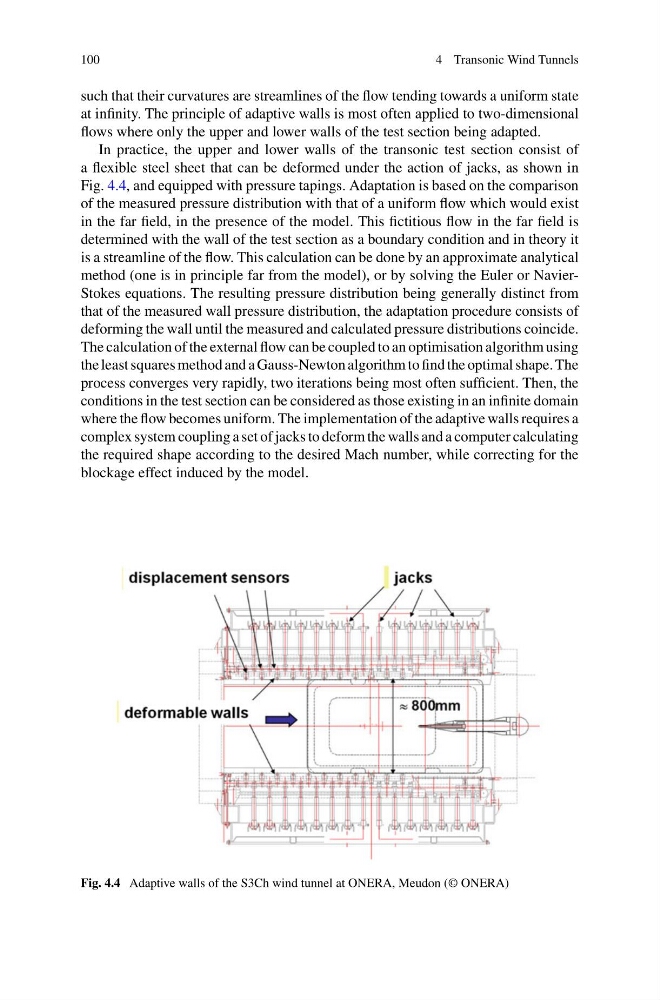
In practice, the upper and lower walls of the transonic test section consist of
a flexible steel sheet that can be deformed under the action of jacks, as shown in
Fig. 4.4, and equipped with pressure tapings. Adaptation is based on the comparison
of the measured pressure distribution with that of a uniform flow which would exist
in the far field, in the presence of the model. This fictitious flow in the far field is
determined with the wall of the test section as a boundary condition and in theory it
is a streamline of the flow. This calculation can be done by an approximate analytical
method (one is in principle far from the model), or by solving the Euler or NavierStokes equations. The resulting pressure distribution being generally distinct from
that of the measured wall pressure distribution, the adaptation procedure consists of
deforming the wall until the measured and calculated pressure distributions coincide.
The calculation of the external flow can be coupled to an optimisation algorithm using
the least squares method and a Gauss-Newton algorithm to find the optimal shape. The
process converges very rapidly, two iterations being most often sufficient. Then, the
conditions in the test section can be considered as those existing in an infinite domain
where the flow becomes uniform. The implementation of the adaptive walls requires a
complex system coupling a set of jacks to deform the walls and a computer calculating
the required shape according to the desired Mach number, while correcting for the
blockage effect induced by the model.
Fig. 4.4 Adaptive walls of the S3Ch wind tunnel at ONERA, Meudon (© ONERA)
4 Transonic Wind Tunnels
such that their curvatures are streamlines of the flow tending towards a uniform state
at infinity. The principle of adaptive walls is most often applied to two-dimensional
flows where only the upper and lower walls of the test section being adapted.
In practice, the upper and lower walls of the transonic test section consist of
a flexible steel sheet that can be deformed under the action of jacks, as shown in
Fig. 4.4, and equipped with pressure tapings. Adaptation is based on the comparison
of the measured pressure distribution with that of a uniform flow which would exist
in the far field, in the presence of the model. This fictitious flow in the far field is
determined with the wall of the test section as a boundary condition and in theory it
is a streamline of the flow. This calculation can be done by an approximate analytical
method (one is in principle far from the model), or by solving the Euler or NavierStokes equations. The resulting pressure distribution being generally distinct from
that of the measured wall pressure distribution, the adaptation procedure consists of
deforming the wall until the measured and calculated pressure distributions coincide.
The calculation of the external flow can be coupled to an optimisation algorithm using
the least squares method and a Gauss-Newton algorithm to find the optimal shape. The
process converges very rapidly, two iterations being most often sufficient. Then, the
conditions in the test section can be considered as those existing in an infinite domain
where the flow becomes uniform. The implementation of the adaptive walls requires a
complex system coupling a set of jacks to deform the walls and a computer calculating
the required shape according to the desired Mach number, while correcting for the
blockage effect induced by the model.
Fig. 4.4 Adaptive walls of the S3Ch wind tunnel at ONERA, Meudon (© ONERA)