

4.2 Blockage Reduction and Flow Un-Chocking
99
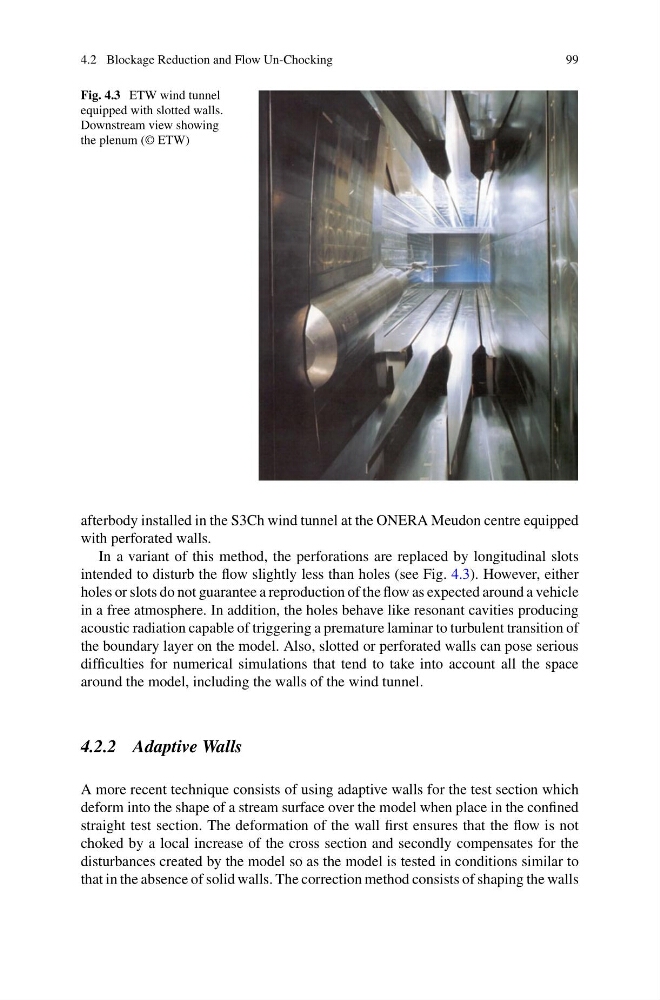
Fig. 4.3 ETW wind tunnel
equipped with slotted walls.
Downstream view showing
the plenum (© ETW)
afterbody installed in the S3Ch wind tunnel at the ONERA Meudon centre equipped
with perforated walls.
In a variant of this method, the perforations are replaced by longitudinal slots
intended to disturb the flow slightly less than holes (see Fig. 4.3). However, either
holes or slots do not guarantee a reproduction of the flow as expected around a vehicle
in a free atmosphere. In addition, the holes behave like resonant cavities producing
acoustic radiation capable of triggering a premature laminar to turbulent transition of
the boundary layer on the model. Also, slotted or perforated walls can pose serious
difficulties for numerical simulations that tend to take into account all the space
around the model, including the walls of the wind tunnel.
4.2.2 Adaptive Walls
A more recent technique consists of using adaptive walls for the test section which
deform into the shape of a stream surface over the model when place in the confined
straight test section. The deformation of the wall first ensures that the flow is not
choked by a local increase of the cross section and secondly compensates for the
disturbances created by the model so as the model is tested in conditions similar to
that in the absence of solid walls. The correction method consists of shaping the walls
99
Fig. 4.3 ETW wind tunnel
equipped with slotted walls.
Downstream view showing
the plenum (© ETW)
afterbody installed in the S3Ch wind tunnel at the ONERA Meudon centre equipped
with perforated walls.
In a variant of this method, the perforations are replaced by longitudinal slots
intended to disturb the flow slightly less than holes (see Fig. 4.3). However, either
holes or slots do not guarantee a reproduction of the flow as expected around a vehicle
in a free atmosphere. In addition, the holes behave like resonant cavities producing
acoustic radiation capable of triggering a premature laminar to turbulent transition of
the boundary layer on the model. Also, slotted or perforated walls can pose serious
difficulties for numerical simulations that tend to take into account all the space
around the model, including the walls of the wind tunnel.
4.2.2 Adaptive Walls
A more recent technique consists of using adaptive walls for the test section which
deform into the shape of a stream surface over the model when place in the confined
straight test section. The deformation of the wall first ensures that the flow is not
choked by a local increase of the cross section and secondly compensates for the
disturbances created by the model so as the model is tested in conditions similar to
that in the absence of solid walls. The correction method consists of shaping the walls