

86
3 Subsonic Wind Tunnels
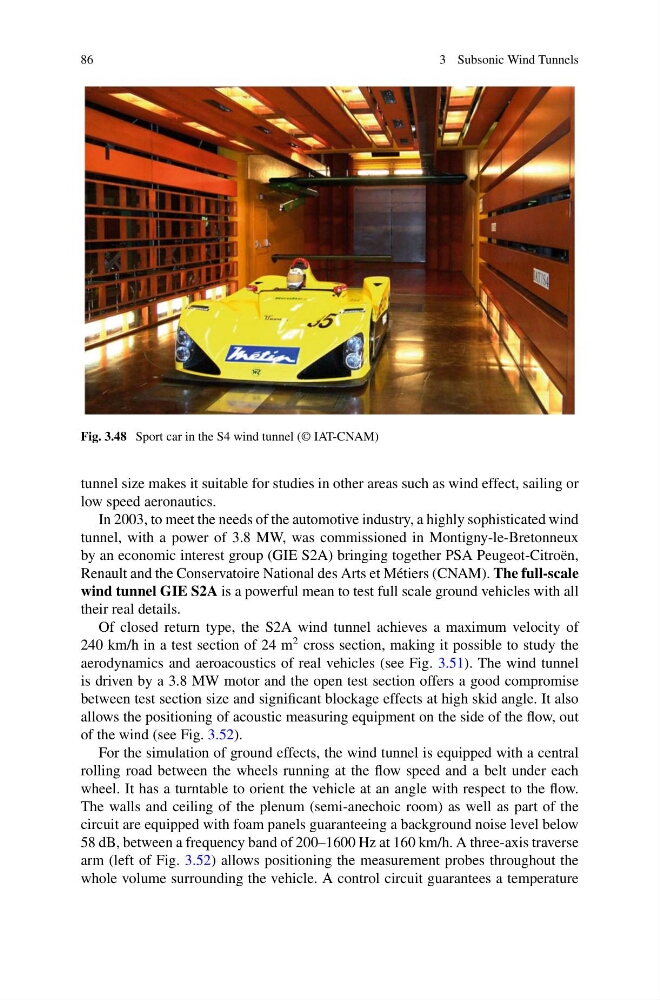
Fig. 3.48 Sport car in the S4 wind tunnel (© IAT-CNAM)
tunnel size makes it suitable for studies in other areas such as wind effect, sailing or
low speed aeronautics.
In 2003, to meet the needs of the automotive industry, a highly sophisticated wind
tunnel, with a power of 3.8 MW, was commissioned in Montigny-le-Bretonneux
by an economic interest group (GIE S2A) bringing together PSA Peugeot-Citroën,
Renault and the Conservatoire National des Arts et Métiers (CNAM). The full-scale
wind tunnel GIE S2A is a powerful mean to test full scale ground vehicles with all
their real details.
Of closed return type, the S2A wind tunnel achieves a maximum velocity of
240 km/h in a test section of 24 m
2 cross section, making it possible to study the
aerodynamics and aeroacoustics of real vehicles (see Fig. 3.51). The wind tunnel
is driven by a 3.8 MW motor and the open test section offers a good compromise
between test section size and significant blockage effects at high skid angle. It also
allows the positioning of acoustic measuring equipment on the side of the flow, out
of the wind (see Fig. 3.52).
For the simulation of ground effects, the wind tunnel is equipped with a central
rolling road between the wheels running at the flow speed and a belt under each
wheel. It has a turntable to orient the vehicle at an angle with respect to the flow.
The walls and ceiling of the plenum (semi-anechoic room) as well as part of the
circuit are equipped with foam panels guaranteeing a background noise level below
58 dB, between a frequency band of 200–1600 Hz at 160 km/h. A three-axis traverse
arm (left of Fig. 3.52) allows positioning the measurement probes throughout the
whole volume surrounding the vehicle. A control circuit guarantees a temperature
3 Subsonic Wind Tunnels
Fig. 3.48 Sport car in the S4 wind tunnel (© IAT-CNAM)
tunnel size makes it suitable for studies in other areas such as wind effect, sailing or
low speed aeronautics.
In 2003, to meet the needs of the automotive industry, a highly sophisticated wind
tunnel, with a power of 3.8 MW, was commissioned in Montigny-le-Bretonneux
by an economic interest group (GIE S2A) bringing together PSA Peugeot-Citroën,
Renault and the Conservatoire National des Arts et Métiers (CNAM). The full-scale
wind tunnel GIE S2A is a powerful mean to test full scale ground vehicles with all
their real details.
Of closed return type, the S2A wind tunnel achieves a maximum velocity of
240 km/h in a test section of 24 m
2 cross section, making it possible to study the
aerodynamics and aeroacoustics of real vehicles (see Fig. 3.51). The wind tunnel
is driven by a 3.8 MW motor and the open test section offers a good compromise
between test section size and significant blockage effects at high skid angle. It also
allows the positioning of acoustic measuring equipment on the side of the flow, out
of the wind (see Fig. 3.52).
For the simulation of ground effects, the wind tunnel is equipped with a central
rolling road between the wheels running at the flow speed and a belt under each
wheel. It has a turntable to orient the vehicle at an angle with respect to the flow.
The walls and ceiling of the plenum (semi-anechoic room) as well as part of the
circuit are equipped with foam panels guaranteeing a background noise level below
58 dB, between a frequency band of 200–1600 Hz at 160 km/h. A three-axis traverse
arm (left of Fig. 3.52) allows positioning the measurement probes throughout the
whole volume surrounding the vehicle. A control circuit guarantees a temperature