

82
3 Subsonic Wind Tunnels
attenuating cones with a cut-off frequency of 200 Hz and a background noise of less
than 40 dB. A removable motorised floor allows quick and easy access to the models
which is important considering the size of the anechoic chamber.
The SAA wind tunnel is devoted to fundamental or applied research related to
aeronautics such as:
– aeroacoustics of aircraft and drones, for the reduction of noise from high-lift
devices, landing gear, rotor noise, etc.;
– improved aerodynamic performance of aircraft and drones to test the efficiency of
flow control devices, drag reduction, etc.
3.3 Wind Tunnels for Ground Vehicles
3.3.1 Specifications
Most of the wind tunnels dedicated to experiments on ground vehicles and railways
are equipped with a rotating belt to simulate the moving ground. The wind tunnel
floor is replaced by a belt driven by a roller system (rolling road) at the same speed as
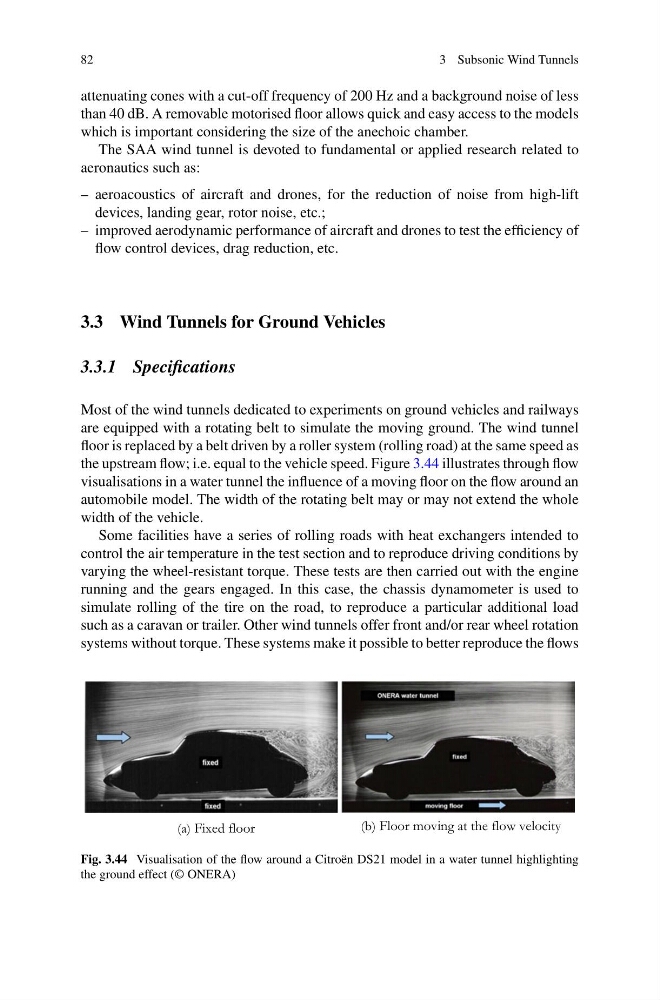
the upstream flow; i.e. equal to the vehicle speed. Figure 3.44 illustrates through flow
visualisations in a water tunnel the influence of a moving floor on the flow around an
automobile model. The width of the rotating belt may or may not extend the whole
width of the vehicle.
Some facilities have a series of rolling roads with heat exchangers intended to
control the air temperature in the test section and to reproduce driving conditions by
varying the wheel-resistant torque. These tests are then carried out with the engine
running and the gears engaged. In this case, the chassis dynamometer is used to
simulate rolling of the tire on the road, to reproduce a particular additional load
such as a caravan or trailer. Other wind tunnels offer front and/or rear wheel rotation
systems without torque. These systems make it possible to better reproduce the flows
(a) Fixed floor
(b) Floor moving at the flow velocity
Fig. 3.44 Visualisation of the flow around a Citroën DS21 model in a water tunnel highlighting
the ground effect (© ONERA)
3 Subsonic Wind Tunnels
attenuating cones with a cut-off frequency of 200 Hz and a background noise of less
than 40 dB. A removable motorised floor allows quick and easy access to the models
which is important considering the size of the anechoic chamber.
The SAA wind tunnel is devoted to fundamental or applied research related to
aeronautics such as:
– aeroacoustics of aircraft and drones, for the reduction of noise from high-lift
devices, landing gear, rotor noise, etc.;
– improved aerodynamic performance of aircraft and drones to test the efficiency of
flow control devices, drag reduction, etc.
3.3 Wind Tunnels for Ground Vehicles
3.3.1 Specifications
Most of the wind tunnels dedicated to experiments on ground vehicles and railways
are equipped with a rotating belt to simulate the moving ground. The wind tunnel
floor is replaced by a belt driven by a roller system (rolling road) at the same speed as
the upstream flow; i.e. equal to the vehicle speed. Figure 3.44 illustrates through flow
visualisations in a water tunnel the influence of a moving floor on the flow around an
automobile model. The width of the rotating belt may or may not extend the whole
width of the vehicle.
Some facilities have a series of rolling roads with heat exchangers intended to
control the air temperature in the test section and to reproduce driving conditions by
varying the wheel-resistant torque. These tests are then carried out with the engine
running and the gears engaged. In this case, the chassis dynamometer is used to
simulate rolling of the tire on the road, to reproduce a particular additional load
such as a caravan or trailer. Other wind tunnels offer front and/or rear wheel rotation
systems without torque. These systems make it possible to better reproduce the flows
(a) Fixed floor
(b) Floor moving at the flow velocity
Fig. 3.44 Visualisation of the flow around a Citroën DS21 model in a water tunnel highlighting
the ground effect (© ONERA)