

Solutions
465
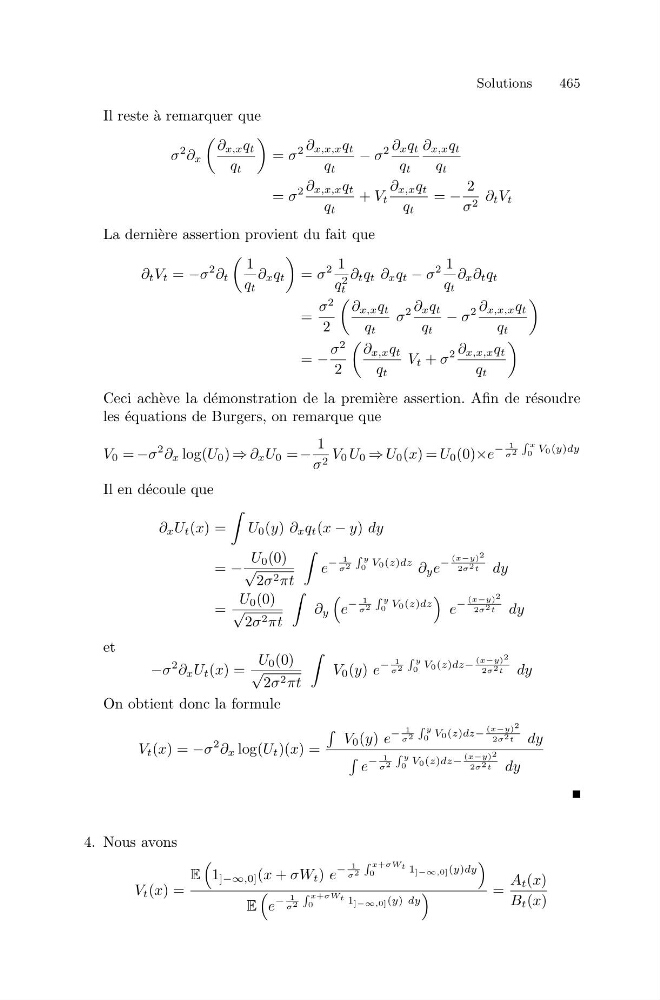
Il reste ` a remarquer que
σ
2 ∂ x
∂ x,x q t
q t
= σ
2 ∂ x,x,x q t
q t
− σ
2 ∂ x q t
q t
∂ x,x q t
q t
= σ
2 ∂ x,x,x q t
q t
+ V t
∂ x,x q t
q t
= −
2
σ 2 ∂ t V t
La derni` ere assertion provient du fait que
∂ t V t = −σ
2 ∂ t
1
q t
∂ x q t
= σ
2 1
q 2
t
∂ t q t ∂ x q t − σ
2 1
q t
∂ x ∂ t q t
=
σ
2
2
∂ x,x q t
q t
σ
2 ∂ x q t
q t
− σ
2 ∂ x,x,x q t
q t
= −
σ
2
2
∂ x,x q t
q t
V t + σ
2 ∂ x,x,x q t
q t
Ceci ach` eve la d´ emonstration de la premi` ere assertion. Afin de r´ esoudre
les ´ equations de Burgers, on remarque que
V 0 = −σ
2 ∂ x log(U 0 ) ⇒ ∂ x U 0 = −
1
σ 2 V 0 U 0 ⇒ U 0 (x) = U 0 (0)×e
−
1
σ 2
x
0
V0(y)dy
Il en d´ ecoule que
∂ x U t (x) =
U 0 (y) ∂ x q t (x − y) dy
= −
U 0 (0)
√
2σ 2 πt
e
−
1
σ 2
y
0
V0(z)dz ∂ y e
−
(x−y) 2
2σ 2 t
dy
=
U 0 (0)
√
2σ 2 πt
∂ y
e
−
1
σ 2
y
0
V0(z)dz
e
−
(x−y) 2
2σ 2 t
dy
et
−σ
2 ∂ x U t (x) =
U 0 (0)
√
2σ 2 πt
V 0 (y) e
−
1
σ 2
y
0
V0(z)dz−
(x−y) 2
2σ 2 t
dy
On obtient donc la formule
V t (x) = −σ
2 ∂ x log(U t )(x) =
V 0 (y) e
−
1
σ 2
y
0
V0(z)dz−
(x−y) 2
2σ 2 t
dy
e
−
1
σ 2
y
0
V0(z)dz−
(x−y) 2
2σ 2 t
dy
4. Nous avons
V t (x) =
E
1 ]−∞,0] (x + σW t ) e
−
1
σ 2
x+σW t
0
1 ]−∞,0] (y)dy
E
e
−
1
σ 2
x+σW t
0
1 ]−∞,0] (y) dy
=
A t (x)
B t (x)
465
Il reste ` a remarquer que
σ
2 ∂ x
∂ x,x q t
q t
= σ
2 ∂ x,x,x q t
q t
− σ
2 ∂ x q t
q t
∂ x,x q t
q t
= σ
2 ∂ x,x,x q t
q t
+ V t
∂ x,x q t
q t
= −
2
σ 2 ∂ t V t
La derni` ere assertion provient du fait que
∂ t V t = −σ
2 ∂ t
1
q t
∂ x q t
= σ
2 1
q 2
t
∂ t q t ∂ x q t − σ
2 1
q t
∂ x ∂ t q t
=
σ
2
2
∂ x,x q t
q t
σ
2 ∂ x q t
q t
− σ
2 ∂ x,x,x q t
q t
= −
σ
2
2
∂ x,x q t
q t
V t + σ
2 ∂ x,x,x q t
q t
Ceci ach` eve la d´ emonstration de la premi` ere assertion. Afin de r´ esoudre
les ´ equations de Burgers, on remarque que
V 0 = −σ
2 ∂ x log(U 0 ) ⇒ ∂ x U 0 = −
1
σ 2 V 0 U 0 ⇒ U 0 (x) = U 0 (0)×e
−
1
σ 2
x
0
V0(y)dy
Il en d´ ecoule que
∂ x U t (x) =
U 0 (y) ∂ x q t (x − y) dy
= −
U 0 (0)
√
2σ 2 πt
e
−
1
σ 2
y
0
V0(z)dz ∂ y e
−
(x−y) 2
2σ 2 t
dy
=
U 0 (0)
√
2σ 2 πt
∂ y
e
−
1
σ 2
y
0
V0(z)dz
e
−
(x−y) 2
2σ 2 t
dy
et
−σ
2 ∂ x U t (x) =
U 0 (0)
√
2σ 2 πt
V 0 (y) e
−
1
σ 2
y
0
V0(z)dz−
(x−y) 2
2σ 2 t
dy
On obtient donc la formule
V t (x) = −σ
2 ∂ x log(U t )(x) =
V 0 (y) e
−
1
σ 2
y
0
V0(z)dz−
(x−y) 2
2σ 2 t
dy
e
−
1
σ 2
y
0
V0(z)dz−
(x−y) 2
2σ 2 t
dy
4. Nous avons
V t (x) =
E
1 ]−∞,0] (x + σW t ) e
−
1
σ 2
x+σW t
0
1 ]−∞,0] (y)dy
E
e
−
1
σ 2
x+σW t
0
1 ]−∞,0] (y) dy
=
A t (x)
B t (x)