

456
Solutions
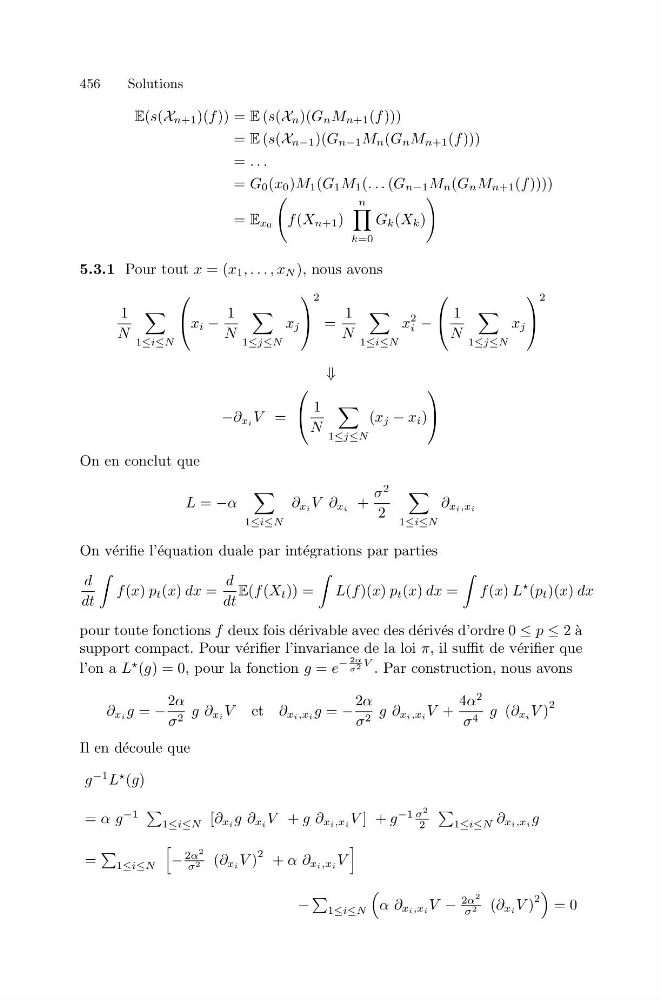
E(s(X n+1 )(f )) = E (s(X n )(G n M n+1 (f )))
= E (s(X n−1 )(G n−1 M n (G n M n+1 (f )))
= . . .
= G 0 (x 0 )M 1 (G 1 M 1 (. . . (G n−1 M n (G n M n+1 (f ))))
= E x0
f (X n+1 )
n
k=0
G k (X k )
5.3.1 Pour tout x = (x 1 , . . . , x N ), nous avons
1
N
1≤i≤N
⎛
⎝ x i −
1
N
1≤j≤N
x j
⎞
⎠
2
=
1
N
1≤i≤N
x
2
i −
⎛
⎝ 1
N
1≤j≤N
x j
⎞
⎠
2
⇓
−∂ xi V =
⎛
⎝ 1
N
1≤j≤N
(x j − x i )
⎞
⎠
On en conclut que
L = −α
1≤i≤N
∂ xi V ∂ xi +
σ
2
2
1≤i≤N
∂ xi,xi
On v´ erifie l’´ equation duale par int´ egrations par parties
d
dt
f (x) p t (x) dx =
d
dt
E(f (X t )) =
L(f )(x) p t (x) dx =
f (x) L
(p t )(x) dx
pour toute fonctions f deux fois d´ erivable avec des d´ eriv´ es d’ordre 0 ≤ p ≤ 2 `
a
support compact. Pour v´ erifier l’invariance de la loi π, il suffit de v´ erifier que
l’on a L
(g) = 0, pour la fonction g = e
−
2α
σ 2 V . Par construction, nous avons
∂ xi g = −
2α
σ 2 g ∂ xi V et ∂ xi,xi g = −
2α
σ 2 g ∂ xi,xi V +
4α
2
σ 4 g (∂ xi V )
2
Il en d´ ecoule que
g
−1 L
(g)
= α g
−1
1≤i≤N [∂ xi g ∂ xi V + g ∂ xi,xi V ] + g
−1 σ
2
2
1≤i≤N ∂ xi,xi g
=
1≤i≤N
−
2α
2
σ 2 (∂ xi V )
2 + α ∂ xi,xi V
−
1≤i≤N
α ∂ xi,xi V −
2α
2
σ 2 (∂ xi V )
2
= 0
Solutions
E(s(X n+1 )(f )) = E (s(X n )(G n M n+1 (f )))
= E (s(X n−1 )(G n−1 M n (G n M n+1 (f )))
= . . .
= G 0 (x 0 )M 1 (G 1 M 1 (. . . (G n−1 M n (G n M n+1 (f ))))
= E x0
f (X n+1 )
n
k=0
G k (X k )
5.3.1 Pour tout x = (x 1 , . . . , x N ), nous avons
1
N
1≤i≤N
⎛
⎝ x i −
1
N
1≤j≤N
x j
⎞
⎠
2
=
1
N
1≤i≤N
x
2
i −
⎛
⎝ 1
N
1≤j≤N
x j
⎞
⎠
2
⇓
−∂ xi V =
⎛
⎝ 1
N
1≤j≤N
(x j − x i )
⎞
⎠
On en conclut que
L = −α
1≤i≤N
∂ xi V ∂ xi +
σ
2
2
1≤i≤N
∂ xi,xi
On v´ erifie l’´ equation duale par int´ egrations par parties
d
dt
f (x) p t (x) dx =
d
dt
E(f (X t )) =
L(f )(x) p t (x) dx =
f (x) L
(p t )(x) dx
pour toute fonctions f deux fois d´ erivable avec des d´ eriv´ es d’ordre 0 ≤ p ≤ 2 `
a
support compact. Pour v´ erifier l’invariance de la loi π, il suffit de v´ erifier que
l’on a L
(g) = 0, pour la fonction g = e
−
2α
σ 2 V . Par construction, nous avons
∂ xi g = −
2α
σ 2 g ∂ xi V et ∂ xi,xi g = −
2α
σ 2 g ∂ xi,xi V +
4α
2
σ 4 g (∂ xi V )
2
Il en d´ ecoule que
g
−1 L
(g)
= α g
−1
1≤i≤N [∂ xi g ∂ xi V + g ∂ xi,xi V ] + g
−1 σ
2
2
1≤i≤N ∂ xi,xi g
=
1≤i≤N
−
2α
2
σ 2 (∂ xi V )
2 + α ∂ xi,xi V
−
1≤i≤N
α ∂ xi,xi V −
2α
2
σ 2 (∂ xi V )
2
= 0