

120
5 Du temps discret au temps continu
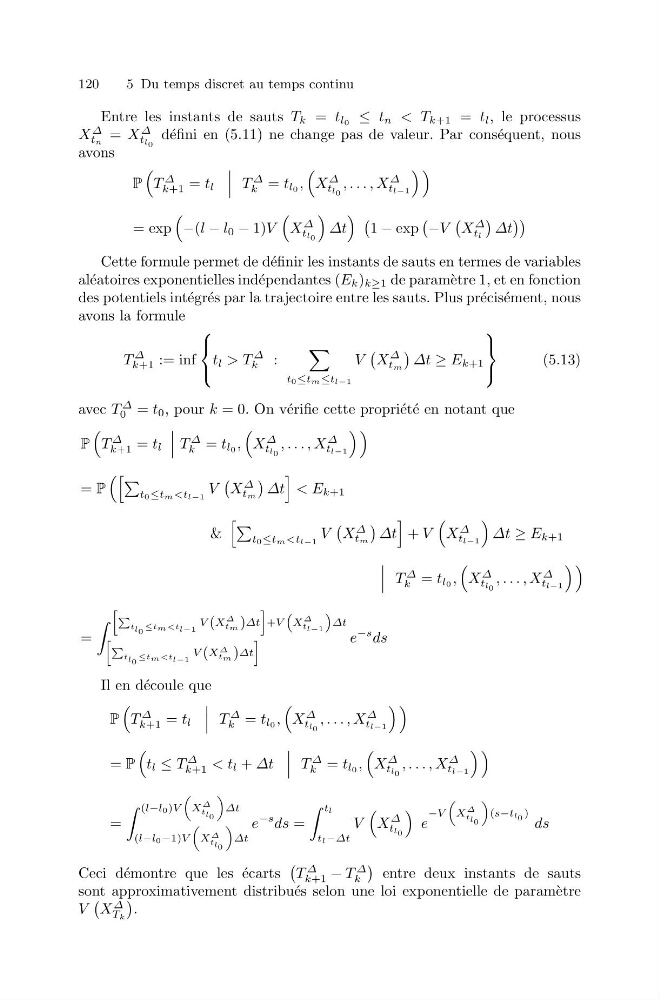
Entre les instants de sauts T k = t l0 ≤ t n < T k+1 = t l , le processus
X
Δ
tn = X
Δ
t l 0
d´ efini en (5.11) ne change pas de valeur. Par cons´ equent, nous
avons
P
T
Δ
k+1 = t l
T
Δ
k = t l0 ,
X
Δ
t l 0
, . . . , X
Δ
t l−1
= exp
−(l − l 0 − 1)V
X
Δ
t l 0
Δt
1 − exp
−V
X
Δ
t l
Δt
Cette formule permet de d´ efinir les instants de sauts en termes de variables
al´ eatoires exponentielles ind´ ependantes (E k ) k≥1 de param` etre 1, et en fonction
des potentiels int´ egr´ es par la trajectoire entre les sauts. Plus pr´ ecis´ ement, nous
avons la formule
T
Δ
k+1 := inf
⎧
⎨
⎩
t l > T
Δ
k :
t0≤tm≤t l−1
V
X
Δ
tm
Δt ≥ E k+1
⎫
⎬
⎭
(5.13)
avec T
Δ
0 = t 0 , pour k = 0. On v´ erifie cette propri´ et´ e en notant que
P
T
Δ
k+1 = t l
T
Δ
k = t l0 ,
X
Δ
t l 0
, . . . , X
Δ
t l−1
= P
t0≤tm
X
Δ
tm
Δt
< E k+1
&
t0≤tm
X
Δ
tm
Δt
+ V
X
Δ
t l−1
Δt ≥ E k+1
T
Δ
k = t l0 ,
X
Δ
t l 0
, . . . , X
Δ
t l−1
=
t l 0
≤tm
Δ
tm )Δt
+V
X
Δ
t l−1
Δt
t l 0
≤tm
Δ
tm )Δt
e
−s ds
Il en d´ ecoule que
P
T
Δ
k+1 = t l
T
Δ
k = t l0 ,
X
Δ
t l 0
, . . . , X
Δ
t l−1
= P
t l ≤ T
Δ
k+1 < t l + Δt
T
Δ
k = t l0 ,
X
Δ
t l 0
, . . . , X
Δ
t l−1
=
(l−l0)V
X
Δ
t l 0
Δt
(l−l0−1)V
X Δ
t l 0
Δt
e
−s ds =
t l
t l −Δt
V
X
Δ
t l 0
e
−V
X
Δ
t l 0
(s−t l 0 )
ds
Ceci d´ emontre que les ´ ecarts
T
Δ
k+1 − T
Δ
k
entre deux instants de sauts
sont approximativement distribu´ es selon une loi exponentielle de param` etre
V
X
Δ
T k
.
5 Du temps discret au temps continu
Entre les instants de sauts T k = t l0 ≤ t n < T k+1 = t l , le processus
X
Δ
tn = X
Δ
t l 0
d´ efini en (5.11) ne change pas de valeur. Par cons´ equent, nous
avons
P
T
Δ
k+1 = t l
T
Δ
k = t l0 ,
X
Δ
t l 0
, . . . , X
Δ
t l−1
= exp
−(l − l 0 − 1)V
X
Δ
t l 0
Δt
1 − exp
−V
X
Δ
t l
Δt
Cette formule permet de d´ efinir les instants de sauts en termes de variables
al´ eatoires exponentielles ind´ ependantes (E k ) k≥1 de param` etre 1, et en fonction
des potentiels int´ egr´ es par la trajectoire entre les sauts. Plus pr´ ecis´ ement, nous
avons la formule
T
Δ
k+1 := inf
⎧
⎨
⎩
t l > T
Δ
k :
t0≤tm≤t l−1
V
X
Δ
tm
Δt ≥ E k+1
⎫
⎬
⎭
(5.13)
avec T
Δ
0 = t 0 , pour k = 0. On v´ erifie cette propri´ et´ e en notant que
P
T
Δ
k+1 = t l
T
Δ
k = t l0 ,
X
Δ
t l 0
, . . . , X
Δ
t l−1
= P
t0≤tm
X
Δ
tm
Δt
< E k+1
&
t0≤tm
X
Δ
tm
Δt
+ V
X
Δ
t l−1
Δt ≥ E k+1
T
Δ
k = t l0 ,
X
Δ
t l 0
, . . . , X
Δ
t l−1
=
t l 0
≤tm
Δ
tm )Δt
+V
X
Δ
t l−1
Δt
t l 0
≤tm
Δ
tm )Δt
e
−s ds
Il en d´ ecoule que
P
T
Δ
k+1 = t l
T
Δ
k = t l0 ,
X
Δ
t l 0
, . . . , X
Δ
t l−1
= P
t l ≤ T
Δ
k+1 < t l + Δt
T
Δ
k = t l0 ,
X
Δ
t l 0
, . . . , X
Δ
t l−1
=
(l−l0)V
X
Δ
t l 0
Δt
(l−l0−1)V
X Δ
t l 0
Δt
e
−s ds =
t l
t l −Δt
V
X
Δ
t l 0
e
−V
X
Δ
t l 0
(s−t l 0 )
ds
Ceci d´ emontre que les ´ ecarts
T
Δ
k+1 − T
Δ
k
entre deux instants de sauts
sont approximativement distribu´ es selon une loi exponentielle de param` etre
V
X
Δ
T k
.