

5.4 Processus ` a sauts marqu´ es
119
A
Δ
tn (f )−A
Δ
t0 (f ) =
tn−1
0
(f (y)−f (X
Δ
t )) V (X
Δ
t ) M (X
Δ
t , dy) dt+O((Δt)
2 )
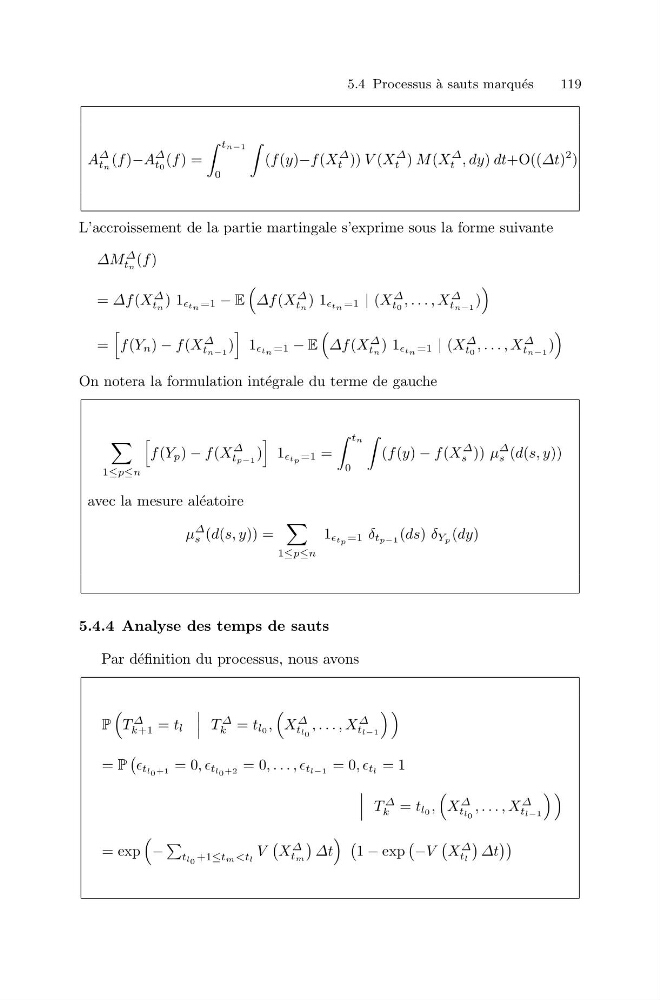
L’accroissement de la partie martingale s’exprime sous la forme suivante
ΔM
Δ
tn (f )
= Δf (X
Δ
tn ) 1 t n =1 − E
Δf (X
Δ
tn ) 1 t n =1 | (X
Δ
t0 , . . . , X
Δ
tn−1 )
=
f (Y n ) − f (X
Δ
tn−1 )
1 t n =1 − E
Δf (X
Δ
tn ) 1 t n =1 | (X
Δ
t0 , . . . , X
Δ
tn−1 )
On notera la formulation int´ egrale du terme de gauche
1≤p≤n
f (Y p ) − f (X
Δ
tp−1 )
1 t p =1 =
tn
0
(f (y) − f (X
Δ
s )) μ
Δ
s (d(s, y))
avec la mesure al´ eatoire
μ
Δ
s (d(s, y)) =
1≤p≤n
1 t p =1 δ tp−1 (ds) δ Yp (dy)
5.4.4 Analyse des temps de sauts
Par d´ efinition du processus, nous avons
P
T
Δ
k+1 = t l
T
Δ
k = t l0 ,
X
Δ
t l 0
, . . . , X
Δ
t l−1
= P
t l 0 +1 = 0, , t l 0 +2 = 0, . . . , , t l−1 = 0, , t l = 1
T
Δ
k = t l0 ,
X
Δ
t l 0
, . . . , X
Δ
t l−1
= exp
−
t l 0 +1≤tm
X
Δ
tm
Δt
1 − exp
−V
X
Δ
t l
Δt
119
A
Δ
tn (f )−A
Δ
t0 (f ) =
tn−1
0
(f (y)−f (X
Δ
t )) V (X
Δ
t ) M (X
Δ
t , dy) dt+O((Δt)
2 )
L’accroissement de la partie martingale s’exprime sous la forme suivante
ΔM
Δ
tn (f )
= Δf (X
Δ
tn ) 1 t n =1 − E
Δf (X
Δ
tn ) 1 t n =1 | (X
Δ
t0 , . . . , X
Δ
tn−1 )
=
f (Y n ) − f (X
Δ
tn−1 )
1 t n =1 − E
Δf (X
Δ
tn ) 1 t n =1 | (X
Δ
t0 , . . . , X
Δ
tn−1 )
On notera la formulation int´ egrale du terme de gauche
1≤p≤n
f (Y p ) − f (X
Δ
tp−1 )
1 t p =1 =
tn
0
(f (y) − f (X
Δ
s )) μ
Δ
s (d(s, y))
avec la mesure al´ eatoire
μ
Δ
s (d(s, y)) =
1≤p≤n
1 t p =1 δ tp−1 (ds) δ Yp (dy)
5.4.4 Analyse des temps de sauts
Par d´ efinition du processus, nous avons
P
T
Δ
k+1 = t l
T
Δ
k = t l0 ,
X
Δ
t l 0
, . . . , X
Δ
t l−1
= P
t l 0 +1 = 0, , t l 0 +2 = 0, . . . , , t l−1 = 0, , t l = 1
T
Δ
k = t l0 ,
X
Δ
t l 0
, . . . , X
Δ
t l−1
= exp
−
t l 0 +1≤tm
X
Δ
tm
Δt
1 − exp
−V
X
Δ
t l
Δt