

5.2 Processus de diffusion
103
E(O((Δt)
α ) | X
Δ
tn−1 ) ≤ Cte (Δt)
α
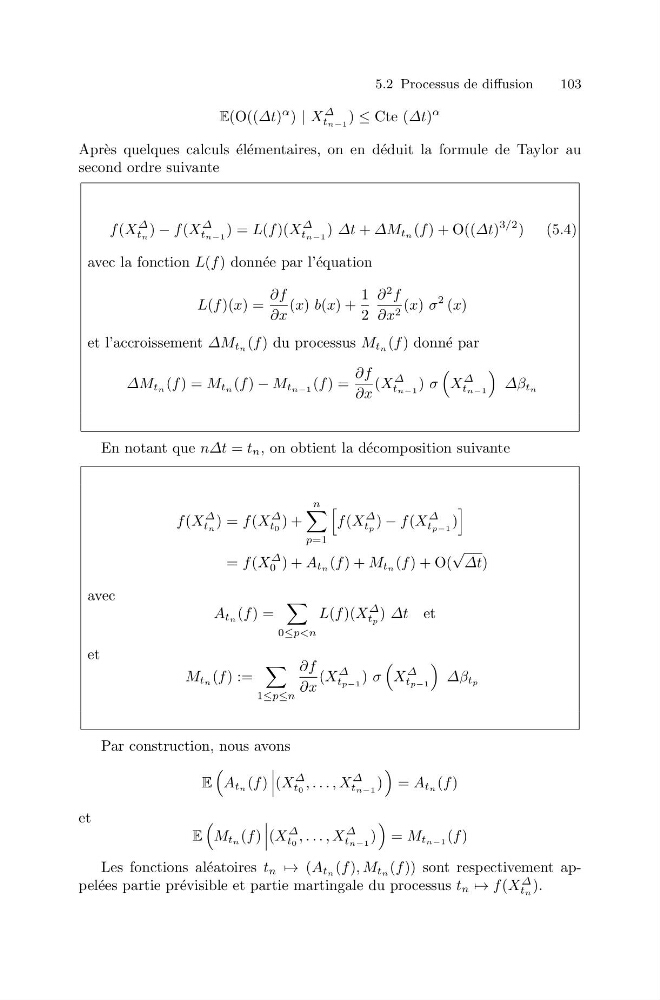
Apr` es quelques calculs ´ el´ ementaires, on en d´ eduit la formule de Taylor au
second ordre suivante
f (X
Δ
tn ) − f (X
Δ
tn−1 ) = L(f )(X
Δ
tn−1 ) Δt + ΔM tn (f ) + O((Δt)
3/2 ) (5.4)
avec la fonction L(f ) donn´ ee par l’´ equation
L(f )(x) =
∂f
∂x
(x) b(x) +
1
2
∂
2 f
∂x 2 (x) σ
2 (x)
et l’accroissement ΔM tn (f ) du processus M tn (f ) donn´ e par
ΔM tn (f ) = M tn (f ) − M tn−1 (f ) =
∂f
∂x
(X
Δ
tn−1 ) σ
X
Δ
tn−1
Δβ tn
En notant que nΔt = t n , on obtient la d´ ecomposition suivante
f (X
Δ
tn ) = f (X
Δ
t0 ) +
n
p=1
f (X
Δ
tp ) − f (X
Δ
tp−1 )
= f (X
Δ
0 ) + A tn (f ) + M tn (f ) + O(
√
Δt)
avec
A tn (f ) =
0≤p
Δ
tp ) Δt et
et
M tn (f ) :=
1≤p≤n
∂f
∂x
(X
Δ
tp−1 ) σ
X
Δ
tp−1
Δβ tp
Par construction, nous avons
E
A tn (f )
(X
Δ
t0 , . . . , X
Δ
tn−1 )
= A tn (f )
et
E
M tn (f )
(X
Δ
t0 , . . . , X
Δ
tn−1 )
= M tn−1 (f )
Les fonctions al´ eatoires t n → (A tn (f ), M tn (f )) sont respectivement appel´ ees partie pr´ evisible et partie martingale du processus t n → f (X
Δ
tn ).
103
E(O((Δt)
α ) | X
Δ
tn−1 ) ≤ Cte (Δt)
α
Apr` es quelques calculs ´ el´ ementaires, on en d´ eduit la formule de Taylor au
second ordre suivante
f (X
Δ
tn ) − f (X
Δ
tn−1 ) = L(f )(X
Δ
tn−1 ) Δt + ΔM tn (f ) + O((Δt)
3/2 ) (5.4)
avec la fonction L(f ) donn´ ee par l’´ equation
L(f )(x) =
∂f
∂x
(x) b(x) +
1
2
∂
2 f
∂x 2 (x) σ
2 (x)
et l’accroissement ΔM tn (f ) du processus M tn (f ) donn´ e par
ΔM tn (f ) = M tn (f ) − M tn−1 (f ) =
∂f
∂x
(X
Δ
tn−1 ) σ
X
Δ
tn−1
Δβ tn
En notant que nΔt = t n , on obtient la d´ ecomposition suivante
f (X
Δ
tn ) = f (X
Δ
t0 ) +
n
p=1
f (X
Δ
tp ) − f (X
Δ
tp−1 )
= f (X
Δ
0 ) + A tn (f ) + M tn (f ) + O(
√
Δt)
avec
A tn (f ) =
0≤p
Δ
tp ) Δt et
et
M tn (f ) :=
1≤p≤n
∂f
∂x
(X
Δ
tp−1 ) σ
X
Δ
tp−1
Δβ tp
Par construction, nous avons
E
A tn (f )
(X
Δ
t0 , . . . , X
Δ
tn−1 )
= A tn (f )
et
E
M tn (f )
(X
Δ
t0 , . . . , X
Δ
tn−1 )
= M tn−1 (f )
Les fonctions al´ eatoires t n → (A tn (f ), M tn (f )) sont respectivement appel´ ees partie pr´ evisible et partie martingale du processus t n → f (X
Δ
tn ).