

3 Bichromatic Control of Free Electron Wave Packets
59
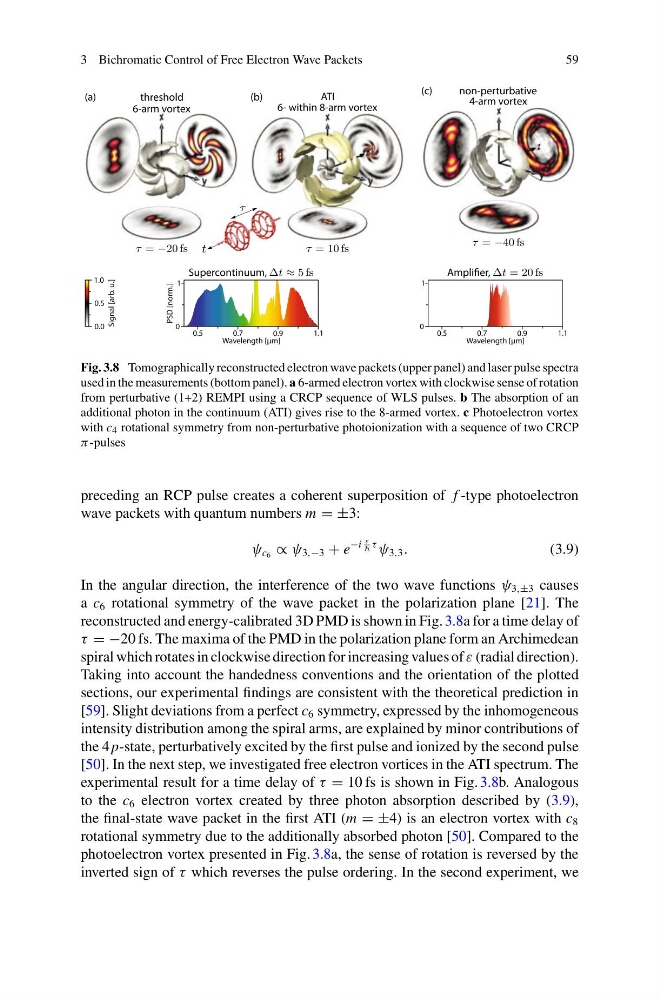
Fig. 3.8 Tomographically reconstructed electron wave packets (upper panel) and laser pulse spectra
used in the measurements (bottom panel). a 6-armed electron vortex with clockwise sense of rotation
from perturbative (1+2) REMPI using a CRCP sequence of WLS pulses. b The absorption of an
additional photon in the continuum (ATI) gives rise to the 8-armed vortex. c Photoelectron vortex
with c 4 rotational symmetry from non-perturbative photoionization with a sequence of two CRCP
π -pulses
preceding an RCP pulse creates a coherent superposition of f -type photoelectron
wave packets with quantum numbers m = ±3:
ψ c 6 ∝ ψ 3,−3 + e
−i
ε
τ
ψ 3,3 .
(3.9)
In the angular direction, the interference of the two wave functions ψ 3,±3 causes
a c 6 rotational symmetry of the wave packet in the polarization plane [21]. The
reconstructed and energy-calibrated 3D PMD is shown in Fig. 3.8a for a time delay of
τ = −20 fs. The maxima of the PMD in the polarization plane form an Archimedean
spiral which rotates in clockwise direction for increasing values of ε (radial direction).
Taking into account the handedness conventions and the orientation of the plotted
sections, our experimental findings are consistent with the theoretical prediction in
[59]. Slight deviations from a perfect c 6 symmetry, expressed by the inhomogeneous
intensity distribution among the spiral arms, are explained by minor contributions of
the 4 p-state, perturbatively excited by the first pulse and ionized by the second pulse
[50]. In the next step, we investigated free electron vortices in the ATI spectrum. The
experimental result for a time delay of τ = 10 fs is shown in Fig. 3.8b. Analogous
to the c 6 electron vortex created by three photon absorption described by (3.9),
the final-state wave packet in the first ATI (m = ±4) is an electron vortex with c 8
rotational symmetry due to the additionally absorbed photon [50]. Compared to the
photoelectron vortex presented in Fig. 3.8a, the sense of rotation is reversed by the
inverted sign of τ which reverses the pulse ordering. In the second experiment, we
59
Fig. 3.8 Tomographically reconstructed electron wave packets (upper panel) and laser pulse spectra
used in the measurements (bottom panel). a 6-armed electron vortex with clockwise sense of rotation
from perturbative (1+2) REMPI using a CRCP sequence of WLS pulses. b The absorption of an
additional photon in the continuum (ATI) gives rise to the 8-armed vortex. c Photoelectron vortex
with c 4 rotational symmetry from non-perturbative photoionization with a sequence of two CRCP
π -pulses
preceding an RCP pulse creates a coherent superposition of f -type photoelectron
wave packets with quantum numbers m = ±3:
ψ c 6 ∝ ψ 3,−3 + e
−i
ε
τ
ψ 3,3 .
(3.9)
In the angular direction, the interference of the two wave functions ψ 3,±3 causes
a c 6 rotational symmetry of the wave packet in the polarization plane [21]. The
reconstructed and energy-calibrated 3D PMD is shown in Fig. 3.8a for a time delay of
τ = −20 fs. The maxima of the PMD in the polarization plane form an Archimedean
spiral which rotates in clockwise direction for increasing values of ε (radial direction).
Taking into account the handedness conventions and the orientation of the plotted
sections, our experimental findings are consistent with the theoretical prediction in
[59]. Slight deviations from a perfect c 6 symmetry, expressed by the inhomogeneous
intensity distribution among the spiral arms, are explained by minor contributions of
the 4 p-state, perturbatively excited by the first pulse and ionized by the second pulse
[50]. In the next step, we investigated free electron vortices in the ATI spectrum. The
experimental result for a time delay of τ = 10 fs is shown in Fig. 3.8b. Analogous
to the c 6 electron vortex created by three photon absorption described by (3.9),
the final-state wave packet in the first ATI (m = ±4) is an electron vortex with c 8
rotational symmetry due to the additionally absorbed photon [50]. Compared to the
photoelectron vortex presented in Fig. 3.8a, the sense of rotation is reversed by the
inverted sign of τ which reverses the pulse ordering. In the second experiment, we