

60
S. Kerbstadt et al.
investigated electron vortices created by non-perturbative (1+2) REMPI of K atoms
using CRCP pulse sequences from the amplifier. The spectral width of the pulses
is ω = 0.14 rad/fs (cf. inset Fig. 3.8c) corresponding to a pulse duration of t
20 fs. While perturbative excitation leaves the ground state population essentially
unchanged, the population dynamics during non-perturbative interaction of the first
pulse with the quantum system changes the initial conditions for the second laser
pulse. Non-perturbative excitation with an RCP π -pulse depletes the ground state
and stores the population exclusively in the excited 4 p (m = −1) state. This excited
state is ionized by absorption of two photons from the subsequent LCP pulse, leading
to a wave packet
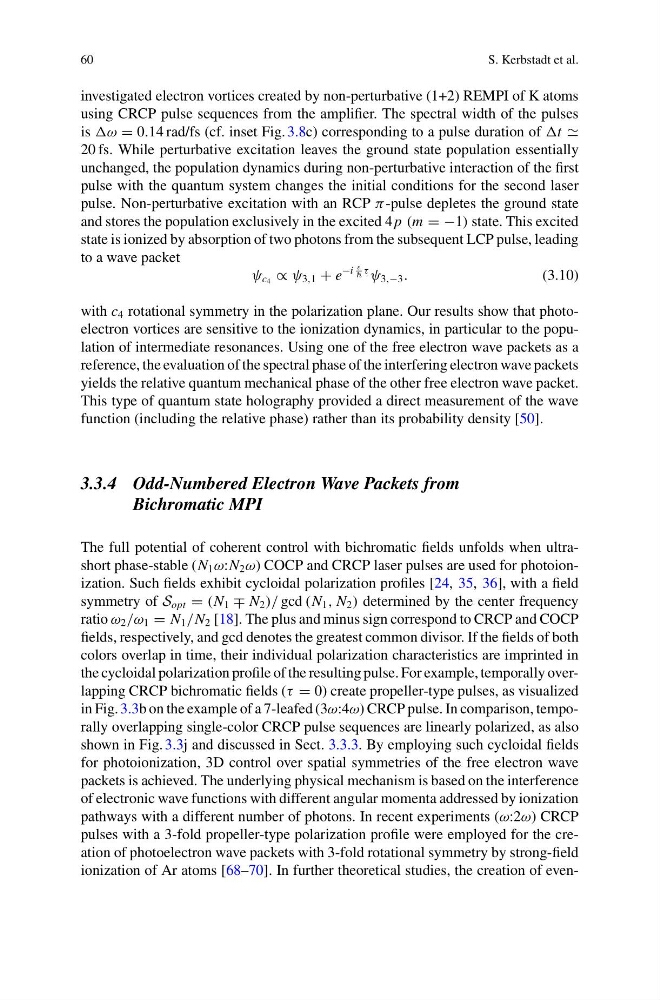
ψ c 4 ∝ ψ 3,1 + e
−i
ε
τ
ψ 3,−3 .
(3.10)
with c 4 rotational symmetry in the polarization plane. Our results show that photoelectron vortices are sensitive to the ionization dynamics, in particular to the population of intermediate resonances. Using one of the free electron wave packets as a
reference, the evaluation of the spectral phase of the interfering electron wave packets
yields the relative quantum mechanical phase of the other free electron wave packet.
This type of quantum state holography provided a direct measurement of the wave
function (including the relative phase) rather than its probability density [50].
3.3.4 Odd-Numbered Electron Wave Packets from
Bichromatic MPI
The full potential of coherent control with bichromatic fields unfolds when ultrashort phase-stable (N 1 ω:N 2 ω) COCP and CRCP laser pulses are used for photoionization. Such fields exhibit cycloidal polarization profiles [24, 35, 36], with a field
symmetry of S opt = (N 1 ∓ N 2 )/ gcd (N 1 , N 2 ) determined by the center frequency
ratio ω 2 /ω 1 = N 1 /N 2 [18]. The plus and minus sign correspond to CRCP and COCP
fields, respectively, and gcd denotes the greatest common divisor. If the fields of both
colors overlap in time, their individual polarization characteristics are imprinted in
the cycloidal polarization profile of the resulting pulse. For example, temporally overlapping CRCP bichromatic fields (τ = 0) create propeller-type pulses, as visualized
in Fig. 3.3b on the example of a 7-leafed (3ω:4ω) CRCP pulse. In comparison, temporally overlapping single-color CRCP pulse sequences are linearly polarized, as also
shown in Fig. 3.3j and discussed in Sect. 3.3.3. By employing such cycloidal fields
for photoionization, 3D control over spatial symmetries of the free electron wave
packets is achieved. The underlying physical mechanism is based on the interference
of electronic wave functions with different angular momenta addressed by ionization
pathways with a different number of photons. In recent experiments (ω:2ω) CRCP
pulses with a 3-fold propeller-type polarization profile were employed for the creation of photoelectron wave packets with 3-fold rotational symmetry by strong-field
ionization of Ar atoms [68–70]. In further theoretical studies, the creation of even-
S. Kerbstadt et al.
investigated electron vortices created by non-perturbative (1+2) REMPI of K atoms
using CRCP pulse sequences from the amplifier. The spectral width of the pulses
is ω = 0.14 rad/fs (cf. inset Fig. 3.8c) corresponding to a pulse duration of t
20 fs. While perturbative excitation leaves the ground state population essentially
unchanged, the population dynamics during non-perturbative interaction of the first
pulse with the quantum system changes the initial conditions for the second laser
pulse. Non-perturbative excitation with an RCP π -pulse depletes the ground state
and stores the population exclusively in the excited 4 p (m = −1) state. This excited
state is ionized by absorption of two photons from the subsequent LCP pulse, leading
to a wave packet
ψ c 4 ∝ ψ 3,1 + e
−i
ε
τ
ψ 3,−3 .
(3.10)
with c 4 rotational symmetry in the polarization plane. Our results show that photoelectron vortices are sensitive to the ionization dynamics, in particular to the population of intermediate resonances. Using one of the free electron wave packets as a
reference, the evaluation of the spectral phase of the interfering electron wave packets
yields the relative quantum mechanical phase of the other free electron wave packet.
This type of quantum state holography provided a direct measurement of the wave
function (including the relative phase) rather than its probability density [50].
3.3.4 Odd-Numbered Electron Wave Packets from
Bichromatic MPI
The full potential of coherent control with bichromatic fields unfolds when ultrashort phase-stable (N 1 ω:N 2 ω) COCP and CRCP laser pulses are used for photoionization. Such fields exhibit cycloidal polarization profiles [24, 35, 36], with a field
symmetry of S opt = (N 1 ∓ N 2 )/ gcd (N 1 , N 2 ) determined by the center frequency
ratio ω 2 /ω 1 = N 1 /N 2 [18]. The plus and minus sign correspond to CRCP and COCP
fields, respectively, and gcd denotes the greatest common divisor. If the fields of both
colors overlap in time, their individual polarization characteristics are imprinted in
the cycloidal polarization profile of the resulting pulse. For example, temporally overlapping CRCP bichromatic fields (τ = 0) create propeller-type pulses, as visualized
in Fig. 3.3b on the example of a 7-leafed (3ω:4ω) CRCP pulse. In comparison, temporally overlapping single-color CRCP pulse sequences are linearly polarized, as also
shown in Fig. 3.3j and discussed in Sect. 3.3.3. By employing such cycloidal fields
for photoionization, 3D control over spatial symmetries of the free electron wave
packets is achieved. The underlying physical mechanism is based on the interference
of electronic wave functions with different angular momenta addressed by ionization
pathways with a different number of photons. In recent experiments (ω:2ω) CRCP
pulses with a 3-fold propeller-type polarization profile were employed for the creation of photoelectron wave packets with 3-fold rotational symmetry by strong-field
ionization of Ar atoms [68–70]. In further theoretical studies, the creation of even-